

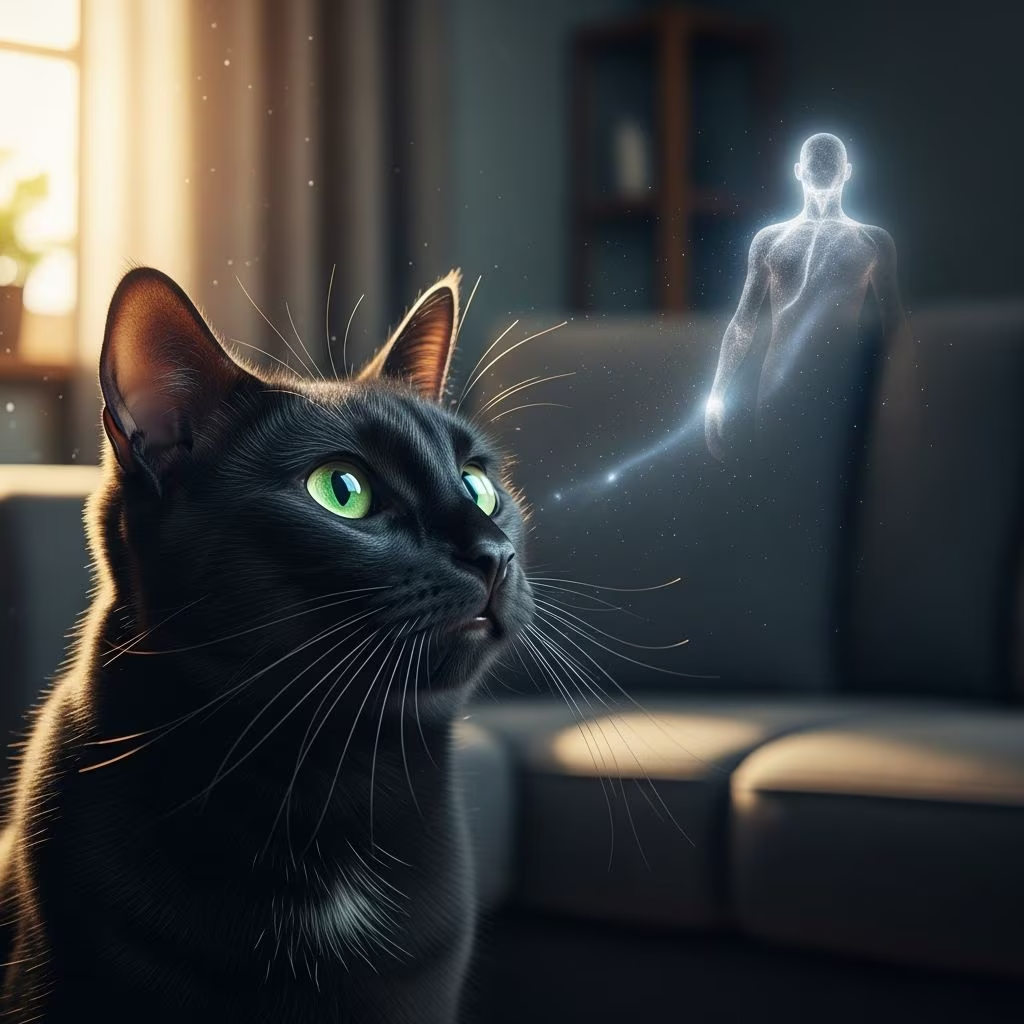
Can Cats See Ghosts? What Science Really Says
For centuries, cats have been shrouded in mystery and folklore, often associated with the supernatural and the unexplainable. One of the most enduring questions pet owners ask is: can cats actually see ghosts and spirits that humans cannot perceive? Scientific research has consistently shown that cats do not perceive the supernatural, yet their behaviors often seem to suggest otherwise. The answer lies not in the paranormal, but in understanding the remarkable sensory abilities that cats possess, which far exceed human capabilities.
The Mystery Behind Cat Behavior
Cats have captivated human imagination for thousands of years with their enigmatic behaviors. From sudden stares at empty spaces to pouncing on seemingly invisible targets, these actions have sparked countless ghost-related theories. A study published in Applied Animal Behaviour Science examined feline reactions to environmental stimuli and confirmed that cats can detect movements, sounds, and vibrations imperceptible to humans. This scientific explanation transforms what seems supernatural into something far more fascinating: the extraordinary sensory perception of our feline companions.
Many cat owners report witnessing their pets seemingly react to invisible presences. Your cat might freeze mid-step, twitch its ears intently, or cautiously approach an empty corner of the room. These behaviors, while appearing eerie to us, are typically responses to stimuli that exist in the environment but remain undetectable to human senses. The mystery deepens when we consider that cats have evolved to sense things that humans simply cannot, including subtle changes in light, air currents, and acoustic frequencies far beyond our hearing range.
Understanding Cats’ Extraordinary Sensory Abilities
Superior Night Vision
Cats can see in extremely low light conditions, up to six times dimmer than humans can perceive, which allows them to detect subtle movements in the dark that would be invisible to our eyes. This exceptional night vision is due to the high concentration of rod cells in their retinas and a special reflective layer called the tapetum lucidum, which bounces light back through the photoreceptors. This adaptation made cats excellent nocturnal hunters in the wild, but in our homes, it means they can perceive movement and activity in conditions we consider pitch black.
Acute Hearing
Cats detect sounds ranging from 48 Hz to 85 kHz, far beyond human hearing capabilities, including distant insects, small rodents, and high-pitched noises we cannot perceive. This incredible auditory range means that while your home may sound silent to you, your cat is experiencing a rich soundscape filled with activity. They can hear ultrasonic frequencies produced by rodents and other small creatures, as well as infrasound frequencies that may indicate seismic activity or distant events. A cat’s hearing is six to eight times more powerful than a human’s, giving them an auditory advantage that humans cannot match.
Sensitive Whiskers and Smell
Cats’ whiskers detect tiny air currents, and their sense of smell can identify chemical cues invisible to us. These whiskers, known as vibrissae, are highly sensitive tactile organs connected to specialized nerve endings. They allow cats to detect minute changes in air pressure and movement, essentially giving them a sense beyond the traditional five. Combined with their olfactory capabilities, which are approximately fourteen times more sensitive than humans, cats can perceive the world in ways we can scarcely imagine.
Additional Sensory Capabilities
Cats can sense seismic vibrations, changes in the atmosphere, and even electromagnetic fields. These additional sensory modalities mean that cats are constantly receiving information about their environment that humans are completely unaware of. With their heightened vision, cats can see certain kinds of light, such as ultraviolet (UV) light, that humans cannot, expanding their visual perception beyond the visible spectrum that we experience.
What Cats Are Actually Reacting To
When your cat appears to be staring at ghosts or reacting to invisible spirits, there are several rational explanations rooted in science:
- Tiny movements: Insects crawling inside walls, shadows passing across surfaces, or reflections bouncing off objects can trigger a cat’s predatory instincts.
- Environmental changes: Drafts from air vents, vibrations from appliances, or shifts in temperature can alert a cat’s sensitive nervous system.
- Natural curiosity: Cats are inherently curious creatures who investigate anything unusual in their territory.
- Playful instincts: Sometimes, a cat is simply engaging in natural play behavior rather than responding to external stimuli.
- Sounds outside human range: High-pitched or low-frequency noises can capture your cat’s attention without you being aware they even exist.
Historical and Cultural Beliefs
The association between cats and the supernatural spans centuries and cultures. In more modern times, the mysterious behavior of Siamese cats has helped bolster beliefs about cats seeing ghosts, as they are highly active and erratic, more so than other cats, frequently gazing off into empty spaces before promptly darting off. Black cats, in particular, have been linked to witchcraft and paranormal activity throughout history. Some people even thought that witches could turn into black cats and vice versa, leading to the assumption that if any cat could see ghosts, it would be a black cat.
This historical baggage has created a self-reinforcing belief system where any unusual cat behavior is interpreted through a supernatural lens. However, cats’ heightened senses often exaggerate the impression of supernatural awareness, creating myths that have persisted for centuries.
The Role of Electromagnetic Fields
One fascinating scientific explanation for seemingly paranormal cat behavior involves electromagnetic fields. Many hauntings throughout history have been revealed to just be the result of electromagnetism, and if cats behave in a way that implies ghosts, but are also sensitive to electromagnetic fields, those electromagnets may explain their seemingly supernatural reactions. This discovery has led researchers to reconsider many historical accounts of hauntings and paranormal activity, attributing them instead to environmental electromagnetic exposure that affects animal behavior.
Can Cats Sense Death and Emotional States?
Pet cats have the ability to sense their human parents’ emotions, and like dogs, our feline companions have evolved to read non-verbal communication from the humans in their lives and can even tell when you’re stressed. This emotional attunement, combined with their sensory abilities, may explain why cats sometimes seem to know when something significant is about to happen.
There are many stories of cats wailing at the exact instant of a beloved owner’s death, even when separated by miles. While these accounts are compelling, they likely reflect the cat’s ability to sense physiological changes, pheromone releases, or other biological signals associated with death, rather than actual perception of spirits.
How to Understand Your Cat’s Mysterious Behavior
A cat freezing mid-step, twitching its ears, or cautiously approaching an empty corner is likely responding to stimuli too subtle for humans. By understanding these behaviors as natural responses to environmental stimuli, you can better appreciate your cat’s incredible sensory capabilities. Recognizing these behaviors as natural responses allows cat owners to appreciate the complexity of feline perception, transforming mystery into admiration for our feline companions’ incredible abilities.
Frequently Asked Questions
Q: Can cats really see ghosts?
A: Science shows that cats do not perceive the supernatural, though their heightened senses allow them to detect things humans cannot, which may create the illusion of ghost-seeing.
Q: What can cats sense that humans cannot?
Q: Why do cats stare at empty spaces?
Q: Are certain cat breeds more likely to see ghosts?
A: There is no scientific evidence that certain breeds like Siamese or black cats are more likely to see ghosts. Their heightened activity levels simply make their sensory responses more noticeable to humans.
Q: Should I be concerned if my cat exhibits ghost-seeing behavior?
A: Awareness of how cats perceive their environment helps strengthen your bond and reduces the mystery behind seemingly ghostly actions. These behaviors are normal and not cause for concern.
Conclusion: The Real Magic of Cat Perception
While the idea of cats seeing ghosts is captivating, science reveals that these behaviors stem from their advanced sensory abilities, not the supernatural. Rather than diminishing the wonder of cat behavior, understanding the science behind it deepens our appreciation for these remarkable creatures. By understanding cats’ seeing abilities from a scientific perspective, owners can appreciate the true wonder of feline perception and recognize that next time a cat stares into space or reacts to an unseen stimulus, it’s their extraordinary senses at work, not spirits.
References
- Can your cat see ghosts? Here’s what science says — Times of India. 2024. https://timesofindia.indiatimes.com/life-style/relationships/pets/can-your-cat-see-ghosts-heres-what-science-says/articleshow/123678180.cms
- Can Cats See Ghosts? Here’s What the Science Says — Kinship. https://www.kinship.com/cat-behavior/can-cats-see-ghosts
- We Asked If Cats Can See Ghosts – But This Behavior Says More — YouTube. https://www.youtube.com/watch?v=jjShbN-Y-_w
- Ghost Cats, Ghost Dogs, and Visitations From Beyond — Amy Shojai. https://amyshojai.com/ghost-cats-ghost-dogs-and-visitations-from-beyond/



