

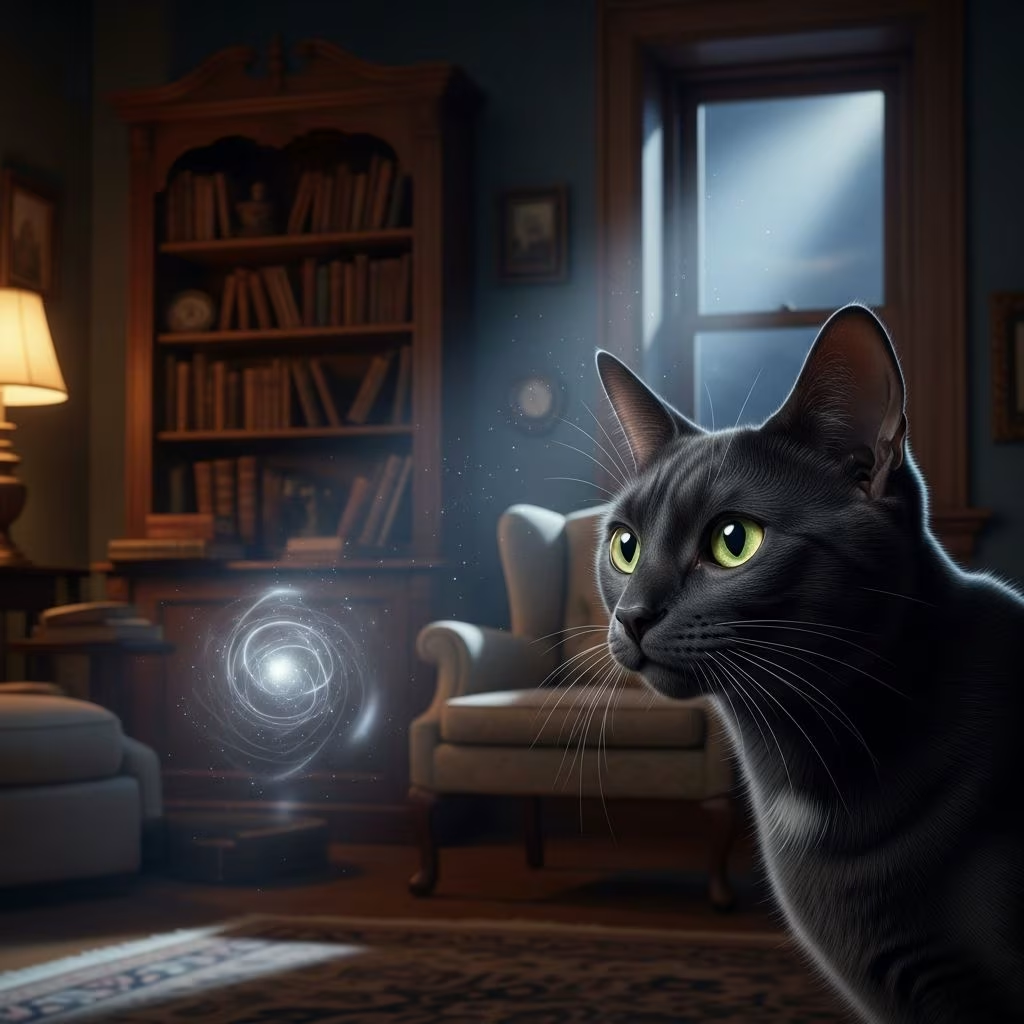
Can Cats See Ghosts? The Science Behind the Mystery
Cats have captivated humans for centuries with their mysterious behavior—sudden stares at empty spaces, pouncing on invisible targets, and unexplained reactions to seemingly nothing. These eerie actions have sparked countless tales of feline supernatural abilities, leading many cat owners to wonder: can cats actually see ghosts? The answer lies not in the supernatural, but in the extraordinary sensory capabilities that set cats apart from humans.
While there is no scientific evidence that cats perceive the supernatural, their advanced senses—sharp vision, acute hearing, and highly sensitive whiskers—allow them to detect details completely invisible to human perception. Understanding the true source of these behaviors transforms mystery into admiration for feline physiology and instinct.
The Superior Vision of Cats: More Than Meets the Eye
One of the most remarkable aspects of cat vision is their exceptional ability to see in low-light conditions. Cats can see in light six times dimmer than humans require, giving them a significant advantage in dark environments. This explains why cats appear to navigate effortlessly through dimly lit rooms and why they seem to come alive at dusk and dawn.
Beyond night vision, cats possess a wider field of vision than humans. Cats have a field of view of approximately 200 degrees, compared to humans’ 180 degrees. This expanded peripheral vision allows them to detect movement from unexpected angles and track fast-moving prey or objects that humans might miss entirely.
Research has revealed another remarkable visual capability: cats can detect ultraviolet (UV) light, which is completely invisible to human eyes. A 2014 study published in the proceedings of the Royal Society B found that many mammals, including cats, have eyes capable of detecting UV patterns. This means when your cat appears transfixed on an empty wall or corner, they may be seeing patterns, marks, or movements in the UV spectrum that are entirely beyond human perception.
The combination of superior night vision, wider field of view, and UV detection creates an entirely different visual world for cats compared to humans. What appears to us as empty space may be filled with subtle movements, shadows, and light patterns that completely captivate feline attention.
Extraordinary Hearing: Detecting Sounds Beyond Human Range
Cats’ auditory capabilities are equally impressive and often underestimated. Cats can detect sounds ranging from 48 Hz to 85 kHz, far exceeding the human hearing range of 20 Hz to 20 kHz. According to the Cornell Feline Health Center, cats can hear up to 64,000 hertz—more than three times the upper limit of human hearing.
This exceptional hearing sensitivity means cats can detect:
- Distant insects and small rodents moving through walls or under floors
- High-pitched ultrasonic sounds produced by electronics, pipes, and rodent communication
- Subtle vibrations traveling through floorboards and structural elements
- Faint sounds from outside your home that are inaudible to human ears
When your cat suddenly perks up and stares intently at a wall or ceiling, they may be responding to the faint hum of electronics, the squeak of pipes, or tiny scratches inside the walls. These sounds are entirely real but simply exist outside the range of human perception.
Whisker Sensitivity and Tactile Perception
A cat’s whiskers are far more sophisticated than they appear. These specialized sensory organs, called vibrissae, are highly sensitive instruments that detect tiny air currents and environmental changes. When a breeze slips under a door or a vibration travels through floorboards, cats may notice instantly, even if humans feel nothing.
Additionally, cats possess an exceptionally developed sense of smell that can identify chemical cues invisible to humans. Their olfactory system is so sensitive that they can detect:
- Pheromones and hormonal changes in other animals
- Subtle chemical shifts in their environment
- Scents associated with stress or illness in humans and other animals
- Odors from distant sources that humans cannot perceive
Why Cats Stare at Nothing: Behavioral Explanations
Despite appearances, science shows that cats do not perceive the supernatural. When cats exhibit seemingly eerie behavior, their actions are typically responses to very real, measurable stimuli:
Common Triggers for Unexplained Cat Behavior
- Tiny movements: Insects, shadows, dust particles, or reflections moving in ways imperceptible to humans
- Environmental changes: Drafts, vibrations, temperature shifts, or air currents
- Auditory stimuli: Sounds outside human hearing range, such as ultrasonic frequencies from electronics or rodent activity
- Natural curiosity: Cats’ inherent playful instincts and hunting drive responding to subtle environmental cues
- Sensory processing: Environmental changes that stress cats may trigger unusual behaviors or heightened alertness
A cat freezing mid-step, twitching its ears, or cautiously approaching an empty corner is likely responding to stimuli too subtle for humans to detect. These are natural responses rooted in survival mechanisms and predatory instincts developed over thousands of years of evolution.
Understanding Cats’ Nocturnal Nature and Mysterious Behavior
Cats’ nocturnal habits, heightened alertness, and solitary nature amplify the impression of supernatural awareness. Unlike humans, who are diurnal (active during the day), cats are crepuscular and nocturnal, meaning they are most active during twilight hours and at night. This behavioral pattern, combined with their superior senses, creates an aura of mystery around feline perception.
During nighttime hours when the household is quiet, cats’ sensory advantages become even more pronounced. What we interpret as ghostly awareness is actually a remarkable demonstration of their ability to sense their surroundings with extraordinary precision. The behaviors that seem eerie—sudden alertness, focused staring, or cautious exploration—are part of the normal spectrum of feline instincts and survival mechanisms.
The Myth vs. Reality: What Science Actually Says
A comprehensive study published in Applied Animal Behaviour Science examined feline reactions to environmental stimuli and confirmed that cats can detect movements, sounds, and vibrations imperceptible to humans. This research provides scientific validation for what many cat owners observe: cats do see, hear, and sense things that humans cannot.
However, it’s crucial to distinguish between detecting real sensory input and perceiving the supernatural. There is no scientific data to show that cats can see spirits or feel the presence of ghosts. The illusion of ghost-seeing is created by cats’ heightened senses, not by any supernatural ability.
Cats’ heightened senses often exaggerate the impression of supernatural awareness, perpetuating myths that have persisted for centuries. What looks like ghost-seeing is actually cats noticing things invisible to human eyes—insects, shadows, ultrasonic sounds, and environmental vibrations that are entirely physical and measurable.
Should You Be Concerned About Your Cat’s Behavior?
In most cases, when your cat stares at empty space or reacts to unseen stimuli, there is no cause for concern. These behaviors are completely normal expressions of feline perception. However, there are situations where unusual cat behavior might warrant attention:
- Sudden behavioral changes: If your cat’s behavior changes dramatically or becomes obsessive, consult a veterinarian to rule out medical issues
- Signs of distress: If your cat shows signs of anxiety, fear, or excessive stress, underlying health problems may be responsible
- Safety hazards: Ensure your cat isn’t reacting to dangerous situations, such as pests, electrical hazards, or structural issues indicated by their behavior
Awareness of how cats perceive their environment helps strengthen your bond with your feline companion and reduces the mystery behind seemingly ghostly actions. By understanding that your cat’s reactions stem from advanced sensory abilities rather than supernatural forces, you can appreciate the true wonder of feline perception.
The Evolution of Feline Senses: Why Cats See and Hear Differently
The extraordinary sensory capabilities of cats are the result of millions of years of evolutionary adaptation. Cats evolved as solitary, nocturnal hunters, making exceptional night vision, hearing, and smell essential for survival. These adaptations allowed wild cats to:
- Hunt small prey in low-light conditions
- Detect the ultrasonic vocalizations of rodents and other small animals
- Navigate complex environments with minimal visual input
- Identify prey through subtle sensory cues
These same capabilities that made wild cats successful hunters now make domestic cats appear mysteriously attuned to invisible forces. Understanding this evolutionary context helps explain why your indoor cat behaves the way it does.
Frequently Asked Questions About Cats and Ghosts
Q: Why does my cat stare at the wall or ceiling for no apparent reason?
A: Your cat is likely detecting something real but invisible to humans—perhaps an insect moving inside the wall, ultrasonic sounds from electronics or rodents, air currents from gaps or vents, or UV patterns on the surface. These are normal sensory responses, not supernatural activity.
Q: Can cats really see in complete darkness?
A: Not complete darkness, but cats can see in light conditions six times dimmer than humans require. They require at least some minimal light source, but they see far better than humans in low-light environments due to their tapetum lucidum—a reflective layer behind the retina.
Q: Is it normal for cats to hiss or act afraid of empty spaces?
A: Yes, this is normal feline behavior. Cats may hiss, crouch, or show defensive postures in response to perceived threats detected by their senses. This could be a small animal, unfamiliar sound, or environmental change that triggers their natural defensive instincts.
Q: Do cats have a sixth sense?
A: Cats don’t have a supernatural sixth sense, but their five senses are extraordinarily developed. Their combination of superior vision, hearing, smell, taste, and touch gives them a perception of the world far richer than human senses, which might create the illusion of supernatural awareness.
Q: Should I be worried if my cat frequently reacts to empty spaces?
A: No, this is typically normal behavior. However, if the behavior is sudden, obsessive, or accompanied by signs of distress or illness, consult your veterinarian to rule out medical or behavioral issues.
Conclusion: Appreciating Your Cat’s Remarkable Abilities
While the idea of cats seeing ghosts is captivating and has inspired centuries of folklore, science reveals that these behaviors stem entirely from their advanced sensory abilities, not the supernatural. Their exceptional night vision, acute hearing spanning ultrasonic frequencies, sensitive whiskers, and keen sense of smell allow cats to notice details that remain forever hidden from human perception.
Next time your cat stares into space or reacts to an unseen stimulus, you’ll know it’s their extraordinary senses at work, not spirits. By understanding cats’ perception from a scientific perspective, you can transform mystery into admiration for your feline companion’s incredible abilities. The true wonder of cats lies not in supernatural powers, but in the remarkable evolutionary adaptations that make them such fascinating creatures.
References
- Can your cat see ghosts? Here’s what science says — Times of India. 2024-12-15. https://timesofindia.indiatimes.com/life-style/relationships/pets/can-your-cat-see-ghosts-heres-what-science-says/articleshow/123678180.cms
- Can Cats See Ghosts? What Science, Faith, and Folklore Say — Cornell Feline Health Center. 2025-01-10. https://www.vet.cornell.edu/feline-health-center
- Can Cats See Ghosts? The Spooky Myth Busted! — Purina UK. 2022-09-27. https://www.purina.co.uk/articles/cats/behaviour/common-questions/can-cats-see-ghosts
- Feline reactions to environmental stimuli — Applied Animal Behaviour Science. Peer-reviewed research on cat sensory perception and behavior.
- Mammalian ultraviolet vision — Proceedings of the Royal Society B. 2014. Research on UV light detection in animals including domestic cats.



