

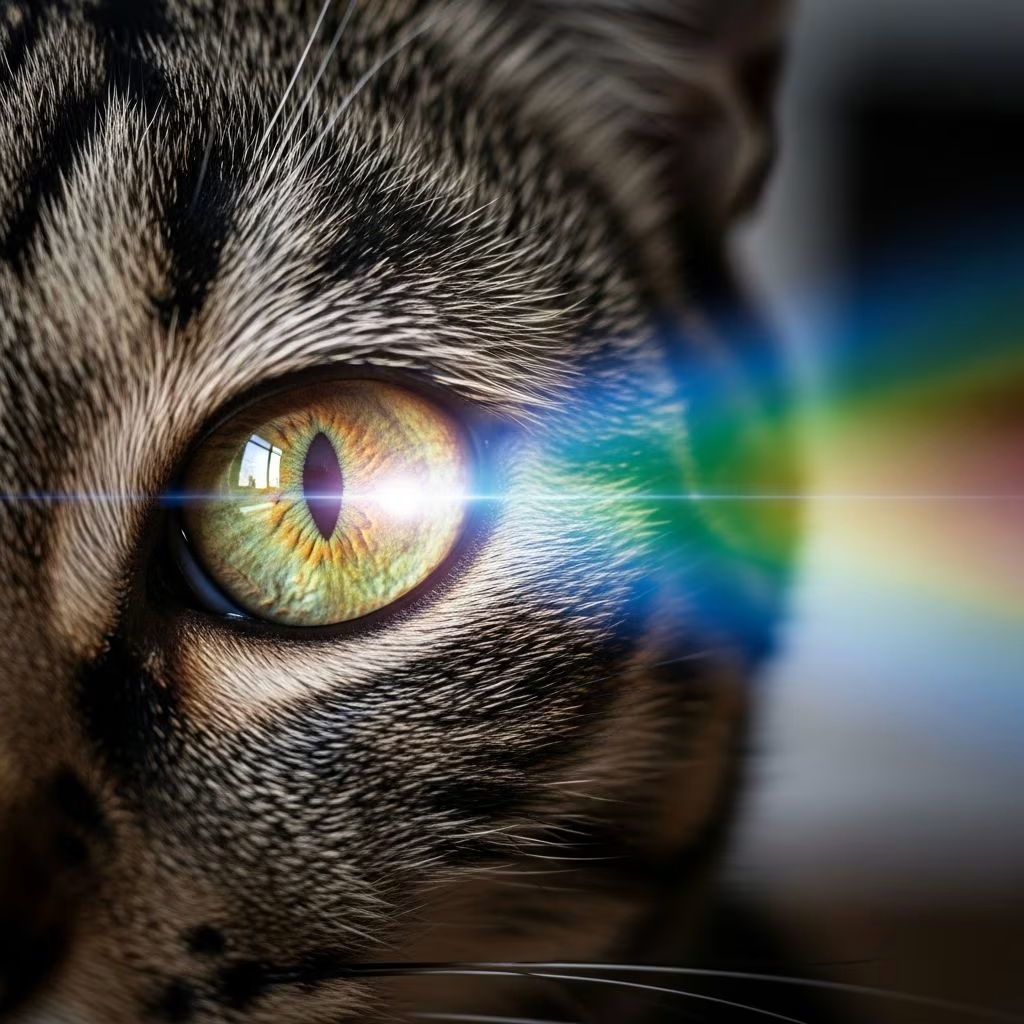
For generations, cat owners have wondered if their feline companions live in a black-and-white world or if they can appreciate the vibrant hues we see daily. The myth that cats see only in grayscale has persisted, but modern science reveals a more nuanced picture. Cats possess color vision, though it is limited compared to humans, relying on two types of cone cells for dichromatic perception. This article delves into the anatomy of cat eyes, their color capabilities, visual comparisons to humans, and practical implications for pet owners.
The Anatomy of Cat Eyes
Cat eyes are marvels of evolutionary adaptation, optimized for a crepuscular lifestyle—most active at dawn and dusk. Unlike human eyes, feline retinas contain a higher proportion of rod cells, which excel at detecting motion and low light, over cone cells responsible for color and detail.
- Rod Cells: Cats have 6-8 times more rods than humans, enabling them to see in light levels just one-sixth of what humans require. This gives them superior night vision, approximately 5.5-7 times better in dim conditions.
- Cone Cells: Fewer in number, these are tuned to shorter wavelengths, supporting limited color discrimination.
- Tapetum Lucidum: A reflective layer behind the retina amplifies available light, causing the characteristic “glow” in cat eyes at night. This structure boosts low-light sensitivity but does not aid color vision.
- Large Corneas and Pupils: Wider pupils and larger corneas allow more light entry, with lenses positioned closer to the retina for brighter images in low light.
- Nictitating Membrane: A third eyelid protects eyes during hunts, keeping them moist and shielded from debris.
These features make cats adept hunters, prioritizing motion detection and visibility in twilight over color richness.
Can Cats See Color? The Science Behind Feline Color Vision
Early studies debated cat color vision, with some suggesting reliance on brightness cues alone. However, behavioral and electrophysiological research confirms cats are dichromats, possessing two cone types: one sensitive to blue-violet (around 460 nm) and another to green-yellow (around 560 nm).
A key 2016 study used neutral point testing, where cats discriminated monochromatic LEDs from white light. They succeeded at wavelengths from 456-497 nm and 510-524 nm but failed at 505 nm, indicating a neutral point akin to human deuteranopes (red-green colorblind). This establishes cats as dichromatic, not trichromatic.
Older research from 1970 reinforced this, showing cats distinguish red from cyan and orange from cyan even when rods were saturated, implying multiple cone processes. Single-unit recordings in the lateral geniculate nucleus revealed opponent color units from green- and blue-absorbing cones.
Despite these findings, cats struggle with reds and pinks, which may appear grayish, as their cones overlap less with longer wavelengths.
What Colors Can Cats See?
Cats perceive a muted palette: blues, greens, and grays most vividly, with possible yellow detection. Reds, oranges, and pinks fade into dull tones.
| Color | Human Perception | Cat Perception |
|---|---|---|
| Blue | Vivid blue | Clear blue |
| Green | Bright green | Discernible green/yellow |
| Red | Bright red | Gray or brown |
| Purple | Rich purple | Blue-ish |
| Yellow | Golden yellow | Possible light green/gray |
This limited spectrum suits their needs—detecting prey against foliage—without the evolutionary pressure for full trichromacy like primates.
How Cat Vision Compares to Human Vision
Humans are trichromats with three cone types (red, green, blue ~420-564 nm), enabling a broad color gamut. Cats’ dichromacy mirrors human red-green colorblindness.
- Visual Acuity: Cats: 20/100 to 20/200 vs. human 20/20. Fine details blur for cats beyond 20 feet.
- Field of View: Cats: 200° peripheral vision (eyes laterally placed) vs. human 180°.
- Night Vision: Cats dominate, seeing in near-darkness via rods and tapetum.
- Color Depth: Humans see millions of hues; cats a narrower, desaturated range.
- Motion Sensitivity: Cats detect faster movements, ideal for hunting.
In essence, cats trade color vibrancy for low-light prowess and wide-angle detection.
Cat Vision Myths Debunked
- Myth: Cats see only black and white. False—dichromatic vision confirmed by multiple studies.
- Myth: Cats are blind during day. No, cones function well in daylight, though less sharply.
- Myth: Tapetum enables color sight. It enhances light only, not color.
Implications for Cat Owners
Understanding cat vision informs enrichment. Use blue/green toys for visibility; avoid red lasers (appear as dots without color appeal). Provide dim lighting for comfort, and note their motion bias—stagnant toys bore them.
In multi-cat homes, vision limits may affect play dynamics, but superior night sight aids navigation.
Frequently Asked Questions (FAQs)
Can cats see color at all?
Yes, cats see colors but in a limited dichromatic spectrum, primarily blues and greens, unlike human trichromatic vision.
What colors do cats see best?
Blues, greens, and grays; reds appear grayish.
Do cats have better night vision than humans?
Absolutely—6-8 times more rods and tapetum lucidum allow sight in 1/6th the light humans need.
Are cats colorblind like dogs?
Similar dichromacy, but cats distinguish more greens; both lack red sensitivity.
How far can cats see clearly?
Visual acuity is 20/100-20/200; details blur beyond 20 feet.
Why do cat eyes glow in the dark?
Tapetum lucidum reflects light back through the retina for enhanced low-light vision.
Can cats see TV or screens?
Limited—fast motion flickers; colors desaturate for them.
Conclusion: Appreciating the Feline Gaze
While cats don’t bask in rainbows like us, their vision—honed for survival—offers unparalleled night prowess and motion mastery. Embrace their world with tailored toys and environments for a happier bond. (Word count: 1624)
References
- Cat colour vision: evidence for more than one cone process — Daw NW, Pearlman AL. J Physiol. 1970-11-01. https://pmc.ncbi.nlm.nih.gov/articles/PMC1395586/
- Neutral point testing of color vision in the domestic cat — PubMed. 2016. https://pubmed.ncbi.nlm.nih.gov/27720709/
- Can cats see color? Understanding feline vision — Wisdom Panel. Recent. https://www.wisdompanel.com/en-us/blog/can-cats-see-color
- Cat Vision: What Do Cats See? — Purina US. Recent. https://www.purina.com/articles/cat/behavior/understanding-cats/cat-vision
- Cat Eyes: A Fascinating Look at Feline Vision — Fulton County Vet Clinic. Recent. https://fultoncountyvetclinic.com/blog/cat-eyes/
- Color Discrimination in the Cat — Science. 1964-04-24. https://www.science.org/doi/10.1126/science.144.3617.427



