

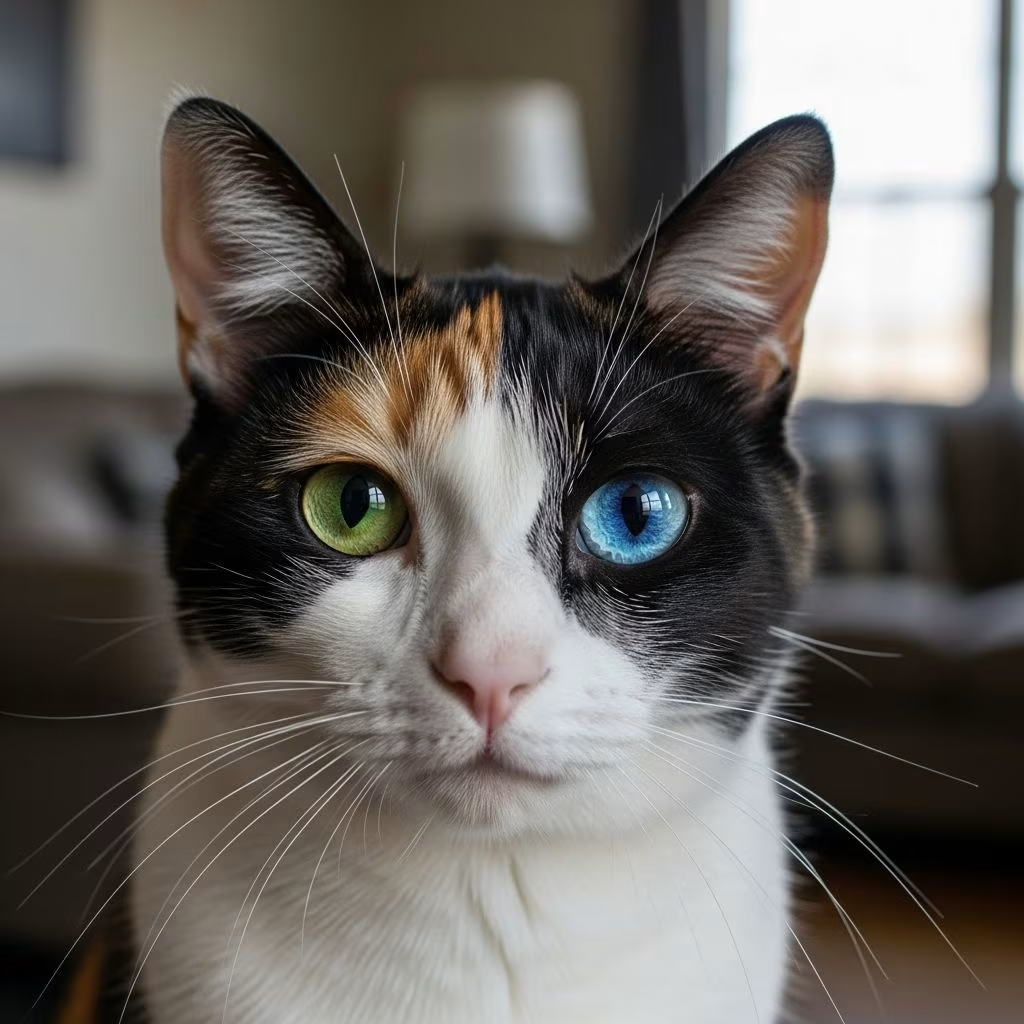
Cats possess dichromatic vision, perceiving a limited range of colors primarily in blues and greens, unlike humans’ trichromatic spectrum including reds. This adaptation prioritizes low-light detection over vivid hues, reflecting their crepuscular hunting lifestyle.
How Do Cats See Color?
Cat vision relies on retinal cells: rods for motion and low light, cones for color. Humans have three cone types (red, green, blue-sensitive), enabling rich color discernment. Cats have fewer cones—primarily blue-sensitive (peak ~460 nm) and green-sensitive (~560 nm)—resulting in dichromatic vision with a neutral point around 505 nm where colors appear indistinguishable.
Electrophysiological studies confirm cats discriminate wavelengths using these cones, even when rods are saturated, proving color vision beyond luminance cues. Behavioral tests show cats distinguish blue from green/gray but struggle with reds, akin to human red-green colorblindness (deuteranopia).
What Colors Can Cats See?
Cats see blues, greens, and possibly muted yellows/ oranges, but reds/pinks appear as grays or dark tones. Their world is pastel-like: vivid blues and yellow-greens dominate, while warm hues fade.
- Blues: Clearly perceived, vital for detecting prey or sky.
- Greens/Yellows: Discernible, though less saturated than in humans.
- Reds/Oranges: Poorly differentiated from browns/grays.
- Purples: Often register as blue variants.
This palette suits survival: distinguishing foliage from prey in dawn/dusk light.
How Cat Vision Compares to Human Vision
| Aspect | Humans | Cats |
|---|---|---|
| Color Cones | 3 types (trichromatic) | 2 types (dichromatic) |
| Visual Acuity | 20/20 | 20/100 to 20/200 |
| Night Vision | Requires 6x more light | 6-8x more rods; tapetum lucidum |
| Field of View | ~180° | ~200° peripheral |
| Motion Detection | Good | Superior, detects subtle movements |
While humans excel in daylight detail and color richness, cats dominate low-light scenarios. Their elliptical pupils, larger corneas, and lens positioning amplify light intake. The tapetum lucidum—a reflective layer—bounces light back through the retina, boosting sensitivity 5.5-7x over humans.
Cat Night Vision: Why They Excel in the Dark
Cats’ crepuscular nature demands superior dim-light vision. With 6-8x more rods, they need just 1/6th human light levels. Rods hyper-focus on motion, aiding hunts.
- Tapetum Lucidum: Reflects light for second-pass detection, causing eye-shine.
- Nictitating Membrane: Protects eyes during high-speed chases.
- Oval Pupils: Maximize light in low conditions, narrow for bright light.
Result: Cats navigate twilight effortlessly, spotting rodents humans miss.
Common Myths About Cat Vision
Myths persist: “Cats see only black and white” ignores cone evidence. Another: “Perfect night vision”—they falter in total darkness without rods. Cats don’t see infrared; claims stem from whisker/heat sensitivity confusion.
- Myth 1: Black-and-white vision. Fact: Dichromatic, not monochromatic.
- Myth 2: See through walls. Fact: Enhanced motion, not X-ray.
- Myth 3: Blind in daylight. Fact: Overload possible, but adaptable.
Does Limited Color Vision Affect Cats?
No—evolution optimized for utility. Colors aid minimal discrimination; motion/low-light prowess ensures hunting success. Toys in blues/greens engage more than reds. Domestic cats thrive regardless, prioritizing scent/texture play.
Frequently Asked Questions (FAQs)
Can cats see color at all?
Yes, dichromatically: blues/greens primarily, reds as grays.
What is a cat’s favorite color to look at?
Blues and yellow-greens; use for toys/environments.
Are cats colorblind?
Partially—like red-green colorblind humans, not fully.
How far can cats see?
Clearly to 20 feet; motion detection extends further.
Why do cat eyes glow in the dark?
Tapetum lucidum reflects light.
Do all cats see the same?
Generally yes; breeds vary slightly in acuity.
Enhancing Your Cat’s Visual World
Provide blue/green toys, window perches for bird-watching, laser pointers (supervised). Avoid overwhelming bright lights; dim environments mimic natural habitats.
Understanding feline vision fosters better care: prioritize motion-rich play, low-light spaces. Science demystifies their world—pastel yet powerfully adapted.
References
- Cat colour vision: evidence for more than one cone process — Journal of Physiology (NIH/PMC). 1970-11. https://pmc.ncbi.nlm.nih.gov/articles/PMC1395586/
- Neutral point testing of color vision in the domestic cat — PubMed. 2016. https://pubmed.ncbi.nlm.nih.gov/27720709/
- Can cats see color? Understanding feline vision — Wisdom Panel. Recent. https://www.wisdompanel.com/en-us/blog/can-cats-see-color
- Cat Vision: What Do Cats See? — Purina US. Recent. https://www.purina.com/articles/cat/behavior/understanding-cats/cat-vision
- Do Cats See Color? — VCA Animal Hospitals. Recent. https://vcahospitals.com/know-your-pet/do-cats-see-color



