

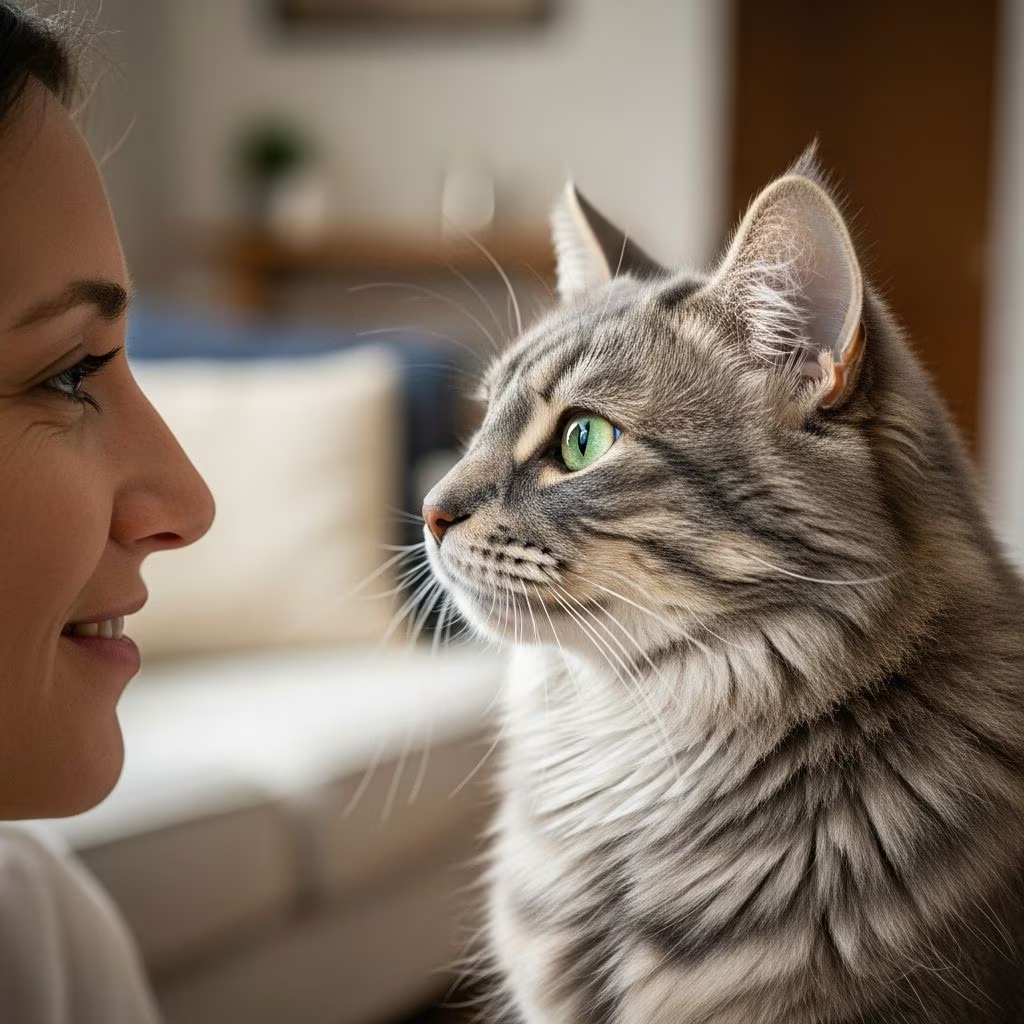
Cats possess remarkable cognitive abilities, but whether they recognize faces like humans do remains a topic of intrigue. Scientific studies indicate that while cats excel at identifying their owners through scent and voice, visual face recognition is less definitive, with evidence suggesting limited capability compared to dogs. This article delves into feline vision, memory, behavioral cues, and cutting-edge AI research to provide a comprehensive overview.
How Do Cats See the World?
Cats’ vision is optimized for low-light hunting, featuring excellent night vision but reduced color perception and acuity for fine details like facial features. Their eyes have more rod cells for motion detection and a reflective tapetum lucidum layer enhancing dim light visibility, allowing them to see six times better than humans at night.
- Visual Acuity: Cats have 20/100 to 20/200 vision, focusing on movement over sharp details.
- Color Vision: Limited to blues and greens; reds appear grayish.
- Field of View: Wider peripheral vision at 200 degrees versus humans’ 180.
These adaptations mean cats prioritize scents and sounds for identification, potentially explaining why face recognition isn’t their forte.
Can Cats Recognize Human Faces?
Research shows mixed results on cats recognizing human faces. A key study found dogs readily identify their handlers’ faces, but cats did not perform above chance levels in similar tasks, suggesting reliance on other cues. Cats bond strongly with owners via pheromones and voices rather than visuals alone.
- Cats may learn to associate faces with positive experiences but struggle with isolated face recognition.
- Experiments using screens displaying owners’ faces elicited minimal responses compared to voices or scents.
However, familiarity breeds comfort; cats often show relaxed behaviors around known faces in context.
Do Cats Recognize Other Cats’ Faces?
Intraspecies recognition leans more on scent marking and body language than faces. While cats in multi-cat homes distinguish familiars, studies using AI suggest they process facial features subtly, aiding individual identification.
A Stanford project achieved 95% accuracy in verifying cat faces via deep learning, implying distinct facial traits exist, though cats may not rely on them primarily. Wild cats use facial cues alongside whiskers and ear positions for communication.
The Role of Cat Memory in Face Recognition
Cats have associative memory linking faces to rewards or routines. Long-term memory allows recognition of absent owners upon return, but this integrates multiple senses. Short-term memory spans 16 hours for locations or events, supporting habit-based face association.
| Memory Type | Duration | Relevance to Faces |
|---|---|---|
| Short-term | 16 hours | Recalls recent interactions |
| Long-term | Years | Associates familiar faces with care |
| Sensory | Indefinite | Prioritizes scent over visuals |
Memory reinforces bonds but doesn’t confirm isolated face processing.
Scientific Studies on Feline Facial Recognition
Recent AI-driven research illuminates cats’ facial processing potential. A real-time deep learning model classifies cat expressions (Pleased, Angry, Alarmed, Calm) with high accuracy using CNNs, indicating nuanced facial feature detection.
Another study developed pipelines for breed, cephalic type, and pain recognition via 48 facial landmarks, achieving 66-75% accuracy, proving landmarks capture meaningful variations. Stanford’s work verified individual cats at 95% and identified at 81% rank-5 using EfficientNet.
These findings suggest cats’ faces convey identity and emotion, potentially recognizable by cats themselves, though behavioral studies lag.
Signs Your Cat Recognizes Your Face
- Slow Blinks: A trust signal mimicking smiles.
- Rubbing and Purring: Affection upon seeing you.
- Dilated Pupils then Relaxed Gaze: Initial alert followed by comfort.
- Head Butts: Scent-marking for bonding.
Observe in consistent lighting; cats respond better to full profiles.
Training Cats to Recognize Faces
Use positive reinforcement with photos or videos. Start with high-reward treats for owner images, gradually isolating visuals. Consistency aids association, though progress varies by cat personality.
- Display clear face images on a screen.
- Pair with voice recordings and treats.
- Increase distance and duration.
- Monitor for engagement like approaching or meowing.
Patience is key; not all cats respond visually.
Common Misconceptions About Cat Vision and Recognition
- Myth: Cats are colorblind. They see muted colors.
- Myth: Cats ignore owners visually. They notice but prioritize other senses.
- Myth: All cats recognize faces equally. Breed and individual differences matter.
AI and Future Research in Cat Facial Recognition
Advancements like HRNetV2 for landmarks and CNNs for expressions promise vet tools for pain detection and behavior analysis. Automated systems could revolutionize welfare by decoding subtle cues humans miss.
Future studies may test cats’ innate face processing with controlled visuals, bridging AI accuracy and ethological evidence.
Frequently Asked Questions (FAQs)
Can cats recognize their owner’s face on a photo?
Cats may show mild interest in photos but prefer live interactions with scent and movement. AI verifies faces accurately, but cats rely less on static images.
Do cats recognize other cats by face?
Primarily by scent, but facial features contribute, as shown by 81% identification accuracy in studies.
How good is a cat’s memory for faces?
Excellent for associated contexts, lasting years, but visual alone is secondary.
Can you train a cat to recognize faces?
Yes, with treats and repetition, though results vary.
What if my cat doesn’t seem to recognize me visually?
They use voice and smell more; strengthen bonds multisensorially.
This exploration reveals cats’ sophisticated yet scent-dominant world, enriched by emerging science.
References
- Domestic Cats Facial Expression Recognition Based on Deep Learning — SSRN. 2024. https://papers.ssrn.com/sol3/papers.cfm?abstract_id=4871374
- Pet Cat Face Verification and Identification — Stanford CS230. 2019-12. http://cs230.stanford.edu/projects_fall_2019/reports/26251543.pdf
- Automated landmark-based cat facial analysis and its applications — Frontiers in Veterinary Science. 2024. https://www.frontiersin.org/journals/veterinary-science/articles/10.3389/fvets.2024.1442634/full
- Dogs, but not cats, can readily recognize the face of their handler — Journal of Vision. 2019. https://jov.arvojournals.org/article.aspx?articleid=2132249
- A Study of Cat Facial Landmark Detection Using HRNetV2 — ACM. 2024. https://dl.acm.org/doi/full/10.1145/3705927.3705933



