

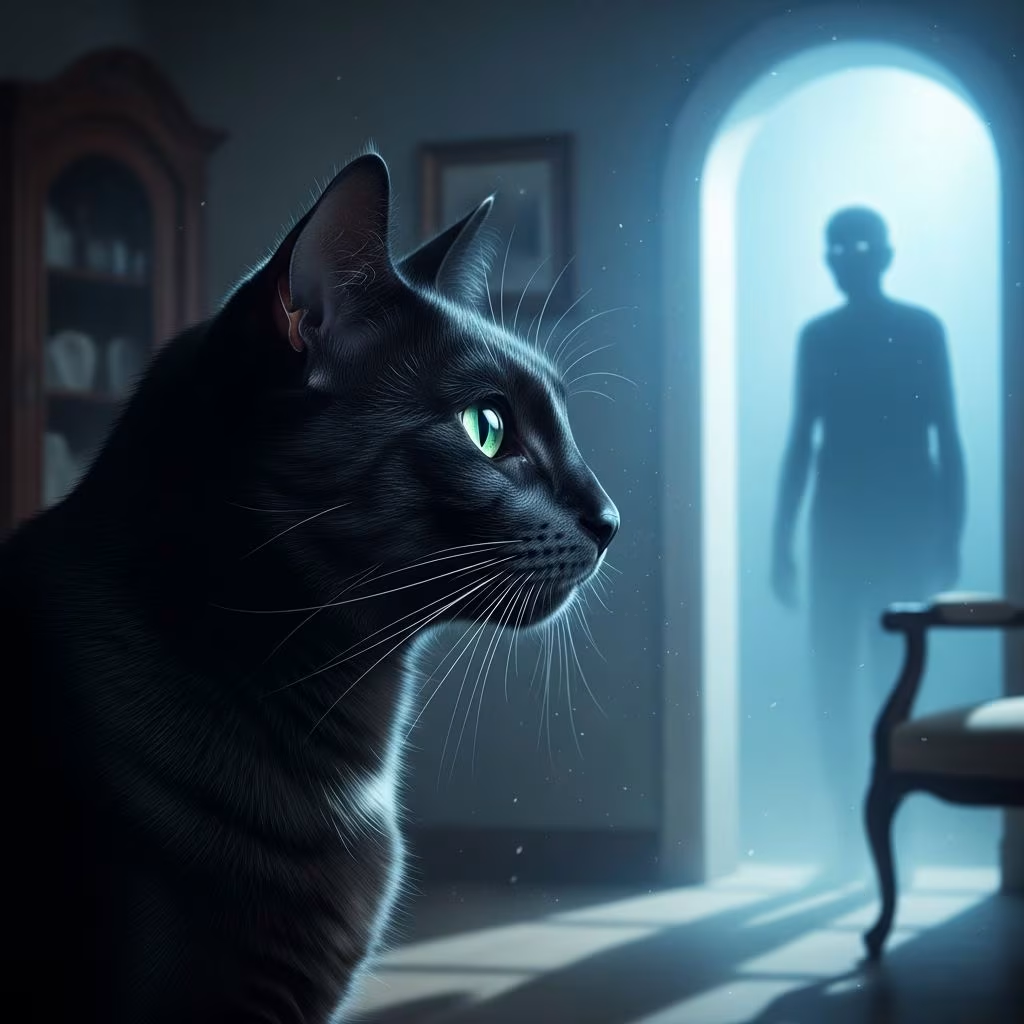
Cats have long been shrouded in mystery, often credited with supernatural abilities due to their acute senses and enigmatic behavior. One of the most compelling questions pet owners and animal enthusiasts ask is: can cats predict death? While scientific proof remains elusive, numerous anecdotes, including the famous case of Oscar the cat, suggest that felines may detect subtle signs of impending death in humans and other animals. This article examines the evidence, scientific explanations, and what these observations reveal about our feline companions.
The Story of Oscar: A Cat with an Uncanny Gift
In 2007, a remarkable story captured global attention when the New England Journal of Medicine published an article about Oscar, a therapy cat residing at the Steere House Nursing and Rehabilitation Center in Providence, Rhode Island. Adopted as a kitten by the nursing home staff, Oscar quickly became known for his peculiar habit of curling up next to patients with end-stage dementia just hours before their deaths.
Oscar’s predictions were strikingly accurate. As of 2010, he had correctly identified over 50 patients who passed away shortly after he chose to sit vigil by their bedsides. Staff members developed a protocol: whenever Oscar settled beside a resident, they would alert families to come immediately, allowing loved ones to say goodbye. Families often welcomed his presence, finding comfort in the cat’s apparent certainty.
Oscar’s behavior was deliberate. He roamed the dementia unit, sniffing and observing patients before selecting one. He would purr soothingly, remaining until death occurred, and become agitated if removed from the room, meowing at the door. This wasn’t random affection; Oscar ignored most patients, only choosing those in their final hours.
Scientific Explanations: How Might Cats Sense Death?
While no definitive scientific study proves cats can predict death, experts propose plausible biological mechanisms rooted in feline physiology. Cats possess an extraordinary sense of smell—14 times stronger than humans’—allowing them to detect volatile organic compounds (VOCs) released by dying cells.
As cells die, carbohydrates break down into ketones and other oxygenated compounds, producing a distinctive “sweet smell of death.” These chemicals emanate from the body via breath and skin, undetectable to humans but perceptible to cats. Studies have shown dogs detecting cancer via similar breath scents, suggesting cats could sense pre-death biochemical shifts.
- Heightened Olfaction: Cats have over 200 million olfactory receptors compared to humans’ 5 million, enabling microscopic chemical detection.
- Behavioral Cues: Cats observe subtle physical changes like irregular breathing, bluish skin, or slowed movements signaling organ failure.
- Electromagnetic Sensitivity: Some theories suggest animals sense electromagnetic changes in dying bodies, though this lacks robust evidence.
Jacqueline Pritchard, a British animal expert, asserted that cats sense vital organs shutting down, aligning with Oscar’s precision. Dr. David Dosa, who documented Oscar, speculated on biochemical markers similar to those in cancer-detection dogs.
Can Cats Sense Their Own Death?
Beyond humans, cats may recognize their own mortality. Veterinary observations indicate dying cats often isolate themselves, seeking quiet hiding spots—a behavior called “hiding to die.” This instinct minimizes predator vulnerability and conserves energy.
Signs include withdrawal from social interaction, reduced appetite, lethargy, and vocalization changes. Cats detect internal chemical shifts via smell and pain signals, prompting solitude. While they may not comprehend death’s finality like humans, they appear aware of severe decline.
| Sign of Impending Death in Cats | Description |
|---|---|
| Lethargy | Extreme fatigue, reluctance to move or play. |
| Appetite Loss | Refusal of food and water, leading to dehydration. |
| Isolation | Hiding in dark, secluded areas away from family. |
| Altered Breathing | Shallow, rapid, or irregular patterns. |
| Vocal Changes | Weak meows or excessive crying. |
Pet owners report cats becoming unusually affectionate or distant before passing, mirroring human interactions.
Anecdotal Evidence from Around the World
Oscar’s fame sparked global stories. In the UK, cats have alerted owners to illnesses by behavioral shifts. During disasters, animals like cats flee before earthquakes, hinting at predictive senses.
A 16th-century Italian superstition viewed bedside black cats as death omens, echoing modern observations. Contemporary accounts describe cats cuddling terminally ill owners or hiding before their own deaths.
What the Science Says: Limitations and Ongoing Research
Despite compelling anecdotes, science cautions against supernatural claims. No controlled studies confirm death prediction; Oscar’s case is observational. Skeptics attribute behaviors to learned patterns, like associating heated blankets or staff presence with dying patients.
However, peer-reviewed papers acknowledge potential. A PMC review revisited Oscar, noting his 100% accuracy in 50 cases, urging further VOC research. Recent veterinary insights (2025) affirm cats sense biochemical changes without conceptualizing death.
Training animals for medical detection continues, with cats potentially aiding hospice care.
Frequently Asked Questions (FAQs)
Q: Can cats really predict human death?
A: Anecdotal evidence, like Oscar’s 50+ accurate predictions, suggests yes via smell and cues, but no conclusive scientific proof exists.
Q: Why does my cat sit on my chest when I’m sick?
A: Cats sense illness through pheromones and body heat, offering comfort or investigating changes.
Q: Do cats know when another pet is dying?
A: Yes, they detect similar chemical and behavioral shifts in fellow animals.
Q: What should I do if my cat is hiding and seems ill?
A: Consult a vet immediately; it may signal serious health issues or end-of-life behavior.
Q: Is Oscar the cat still alive?
A: Oscar passed away in 2022 after years of service; his legacy endures in medical literature.
Ethical Considerations for Pet Owners
If your cat exhibits death-predicting behaviors, observe without anthropomorphizing. Provide comfort, veterinary care, and emotional support. These insights deepen our bond with cats, highlighting their role as intuitive companions.
In hospice settings, cats like Oscar offer solace, reducing isolation for the dying. Future research may validate these abilities, advancing animal-assisted therapy.
References
- Can animals predict death? — HowStuffWorks. 2007-07-31. https://animals.howstuffworks.com/animal-facts/pet-sixth-sense.htm
- Can Cats Sense Death? What Science Says — Catster. Accessed 2026. https://www.catster.com/lifestyle/can-cats-sense-death/
- Therapy Cat Was Believed to Have Predicted Residents’ Deaths — Snopes. 2024-04. https://www.snopes.com/fact-check/cat-predicted-deaths-nursing-home/
- Do Cats Know When They Are Dying? — PetMD. Accessed 2026. https://www.petmd.com/cat/general-health/do-cats-know-when-they-are-dying
- Classic cases revisited: Oscar the cat and predicting death — PMC (National Library of Medicine). 2017-10-01. https://pmc.ncbi.nlm.nih.gov/articles/PMC5624465/
- Can a hospice cat signal death is looming? — McGill University Office for Science and Society. Accessed 2026. https://www.mcgill.ca/oss/article/science-science-everywhere/hospice-cat-harbinger-death
- Vet’s 2025 Insight: Do Cats Know When They Are Dying? — Ask A Vet. 2025. https://askavet.com/blogs/news/vet-s-2025-insight-do-cats-know-when-they-are-dying-%F0%9F%90%B1



