

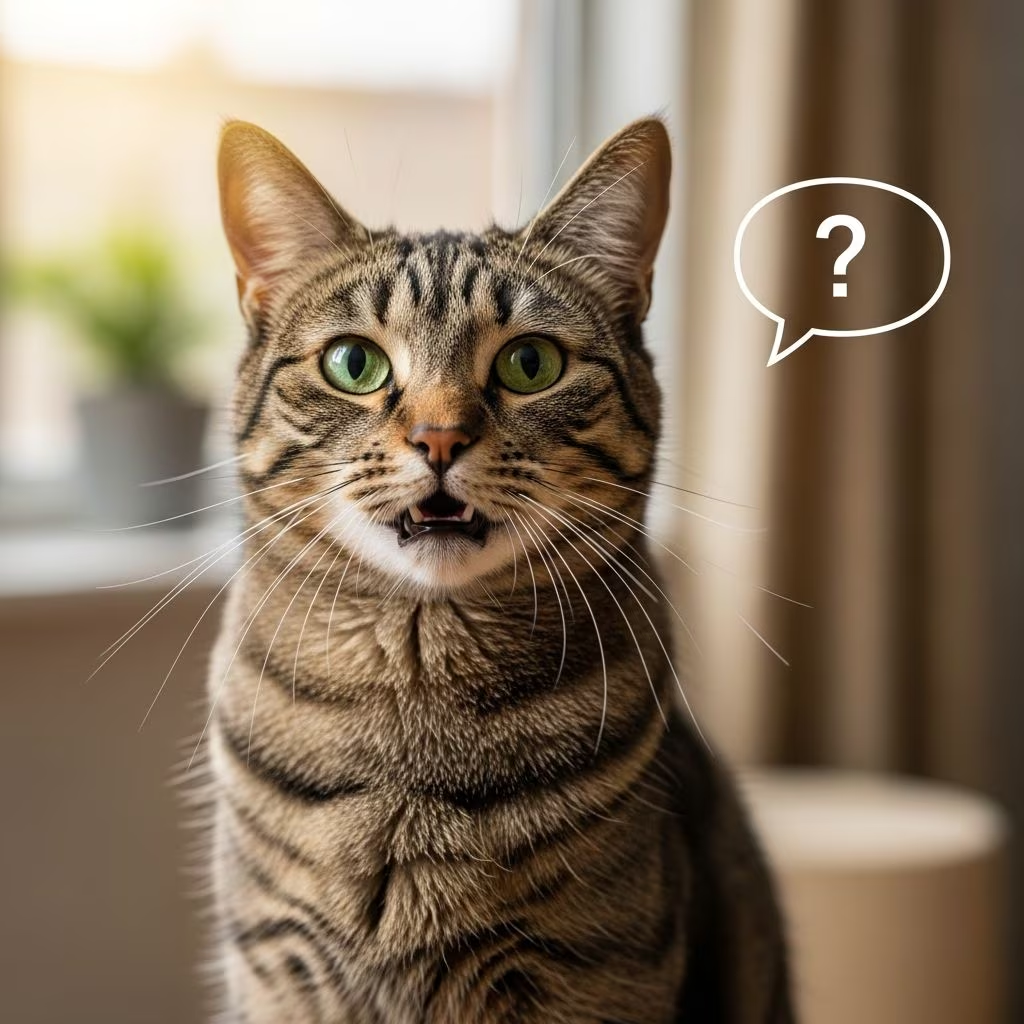
Can Cats Actually Mimic Human Speech?
The internet is filled with viral videos showing cats seemingly saying human words—from “Bongiorno” to “hello” and everything in between. These clips garner millions of views and inspire countless comments from delighted cat owners convinced their feline friends are attempting to speak English. But can cats actually mimic human speech, or is something else happening in these captivating videos? The answer involves understanding cat physiology, cognition, and how our brains interpret sounds.
How Cats Communicate
To understand whether cats can mimic human speech, it’s essential to first examine how cats naturally communicate. According to research, cats possess a sophisticated vocal communication system that is quite distinct from human language.
Cat Vocalizations: The Basic Repertoire
Scientific studies have documented that cats are capable of producing approximately 21 different vocalizations. These include chirps, growls, gurgles, hisses, moans, and mews. Each of these sounds serves a specific communicative purpose, indicating simple states of being such as pain, pleasure, need or want, and aggression or defense. However, it’s crucial to understand that these vocalizations should not be confused with language in the human sense.
The Fundamental Difference: Cats Don’t Use Language
Unlike humans, cats do not combine sounds to create words or develop grammatical structures. Even if they could combine sounds more sophisticatedly, they would not be capable of producing the same number and variety of vocalizations that humans generate. Humans are capable of producing around 600 consonant sounds and 200 vowel sounds. While English doesn’t utilize all of these possibilities—using only 24 consonant phonemes and 15 vowel phonemes for 39 distinct meaningful sounds—this still far exceeds what cats could physically produce.
The Physical Limitations of Cat Speech
Beyond behavioral differences, cats face significant biological constraints that prevent them from mimicking human speech, regardless of their intelligence or motivation.
Vocal Cord Structure
According to pet behavior expert Josh Wiesenfeld, founder of Boxiecat, “Physically, their vocal cords are not suited for the breadth of sounds we classify as speech. Although they can produce a wide variety of utterances, they lack the physical structure necessary for articulate speech”. This anatomical limitation is fundamental and cannot be overcome through training or intelligence alone.
Brain Structure and Cognitive Capacity
While cat brains share approximately 90 percent structural similarity with human brains in terms of folding and organization, the cognitive capacity differs dramatically. Cats possess approximately 300 million neurons in their cerebral cortex, compared to the 21 to 26 billion neurons found in the human cerebral cortex. This neurological difference significantly impacts their ability to process complex language and understand speech at the same level humans do.
It’s worth noting that cats are notably more intelligent than dogs, possessing roughly twice the number of cerebral cortex neurons as their canine counterparts. However, this advantage doesn’t grant them the ability to understand or reproduce human speech in any meaningful way.
How Cats Understand Human Communication
Although cats cannot mimic human speech, they do demonstrate a surprising ability to understand certain aspects of human communication, albeit in a very different manner than we might assume.
Recognition of Key Words and Tone
According to Wiesenfeld, “cats are ‘highly attuned’ to how someone says something and can recognize key words or phrases, like their names or their human calling them for food”. This recognition is not based on a deep understanding of language but rather on pattern recognition and association.
Comprehension Without Language Understanding
Wiesenfeld explains that “Just because cats aren’t as smart as humans doesn’t mean they can’t understand many aspects of human speech, but it’s not the same level of comprehension we associate with human language”. Research has shown that cats can learn to recognize their names, demonstrating a form of auditory recognition and learning.
The key distinction is that cats process human communication through emotional cues, tone, and context rather than semantic meaning. As Wiesenfeld notes, “on an intellectual level, cats do not process our words with the depth or complexity that we may think. They rely more on tone and context and pick up patterns that enable them to predict what might happen, such as feeding, playing, or petting”.
Non-Verbal Communication: How Cats Really Speak
While humans rely heavily on verbal communication, cats employ a sophisticated system of non-verbal signals that convey meaning and emotion far more effectively than their vocalizations ever could.
Body Language
Cats communicate through a complex system of body language cues including:
- Tail position and movement
- Ear orientation and angle
- Eye contact and pupil dilation
- Posture and muscle tension
- Facial expressions
For example, when threatened, a cat might puff itself up to appear larger and hiss as a warning. Conversely, when content, cats purr and knead their paws—behaviors that communicate comfort and affection far more effectively than any vocalization could.
Scent Marking and Chemical Communication
Cats also utilize scent marking as a primary means of communication. By rubbing their faces against objects or people, cats deposit pheromones that express familiarity and mark territory. This chemical communication system is far more sophisticated and meaningful to cats than any verbal exchange with humans could be.
Understanding these non-verbal cues is essential for interpreting how cats feel. Wiesenfeld emphasizes that “understanding these cues is key in interpreting how they feel”.
The Truth Behind Viral Videos
Now that we understand the limitations of cat speech and how cats actually communicate, we can examine what’s really happening in those viral videos that seem to show cats mimicking human words.
Explanation 1: Audio Enhancement and Editing
The first and most straightforward explanation is that many of these videos may have been enhanced or edited before posting. Audio editing software can subtly modify feline vocalizations to sound more human-like, making them seem more similar to speech than they actually are. This explains some—though certainly not all—of the viral clips circulating online.
Explanation 2: Pareidolia and Priming
A second explanation involves human psychology rather than cat ability. This phenomenon is called pareidolia—the human tendency to perceive meaningful patterns in random stimuli. In the famous example where a cat seems to say “Bongiorno,” viewers hear the woman in the video say that word just before the cat vocalizes. This primes the brain to notice similarities between what the woman said and the cat’s meow, leading viewers to perceive speech where none exists.
Our brains are pattern-recognition machines, constantly looking for familiar shapes, sounds, and words. When we’re primed to expect a particular word, we’re far more likely to hear it in ambiguous audio—a phenomenon well-documented in psychology research.
Explanation 3: Statistical Probability
The third explanation is elegantly simple: given enough cats and enough time, statistical probability suggests that some of them are bound to make occasional sounds that mimic human speech. This concept relates to the infinite monkeys theorem—the idea that if enough monkeys typed randomly long enough, one would eventually produce a Shakespeare play. Similarly, with millions of cats vocalizing daily and millions of people recording their behavior, it’s inevitable that some cats will produce sounds that happen to resemble human words, purely by chance.
Cats and Mimicry: A Broader Perspective
While cats cannot mimic human speech, they do demonstrate an interesting capacity for mimicry in other contexts. Research from Eötvös Loránd University documented that cats can recognize and mimic human behavior. This finding was surprising because cats were not previously thought to possess the necessary cognitive abilities to intentionally imitate the actions of other creatures.
The study involved training a cat using the “Do as I do” technique, where an animal learns to perform actions and then reproduce them on command. The cat responded as desired approximately 81 percent of the time. The researchers suggest that the cat demonstrated the capability of mapping its own body parts to those of another creature and understanding how those parts could be used in similar ways.
This research demonstrates that cats possess more sophisticated cognitive abilities than previously believed, particularly regarding imitation. However, this ability to mimic physical actions differs fundamentally from mimicking human speech, which requires both physical capabilities cats lack and a motivation to communicate through language that cats simply don’t possess.
How Cats Have Specialized Their Communication
Interestingly, research suggests that the domestic cat has actually specialized its meow specifically to communicate with humans rather than with other cats. This indicates an evolutionary adaptation to living alongside humans and a sensitivity to human responsiveness. Cats may use their meows more frequently and in different ways when interacting with humans than they do with other felines, suggesting they’ve learned what vocalizations get human attention and response.
This specialization represents a form of adaptation and communication optimization, but it still falls short of actual speech mimicry. Instead, it demonstrates cats’ ability to modulate their natural vocalizations based on their audience—a sophisticated behavior, but not language.
Improving Communication With Your Cat
Rather than waiting for cats to learn our language, the responsibility falls on humans to learn theirs. If we want to strengthen our relationships with our feline companions, we must meet them where they are communicatively.
Key Communication Strategies
- Observe and interpret body language signals consistently
- Pay attention to tail position, ear orientation, and eye contact
- Learn what different meows and purrs indicate in your specific cat
- Respect scent-marking behavior and territorial needs
- Use consistent tone and patterns when speaking to your cat
- Recognize that your cat understands context and emotional tone, not necessarily words
Wiesenfeld emphasizes this point: “To be better communicators with our cats, it’s important to pay close attention to their body language and vocalizations. Understanding what different meows, purrs, or tail positions mean can go a long way in strengthening your relationship”.
Frequently Asked Questions
Q: Can cats actually say human words?
A: No, cats cannot actually mimic human speech. While viral videos may seem to show cats saying words, these are typically the result of audio editing, human pattern recognition, or statistical coincidence rather than actual speech mimicry.
Q: How many different sounds can cats make?
A: Cats can produce approximately 21 different vocalizations, including chirps, growls, gurgles, hisses, moans, and mews. This is far fewer than the hundreds of sounds humans can produce.
Q: Do cats understand human speech?
A: Cats understand certain aspects of human speech on a limited level. They can recognize their names and respond to familiar words and phrases, but they process this information primarily through tone, context, and emotional cues rather than semantic meaning.
Q: What is the main way cats communicate?
A: While cats do vocalize, their primary communication methods involve non-verbal signals such as body language (tail position, ear orientation, eye contact), scent marking, and physical behaviors like purring and kneading.
Q: Are cats smarter than dogs?
A: Yes, cats have approximately twice the number of cerebral cortex neurons as dogs, making them more intelligent. However, both species fall far short of human cognitive abilities.
Q: Can cats be trained to mimic actions?
A: Yes, research shows that cats can be trained using the “Do as I do” technique to mimic human physical actions. However, this is different from speech mimicry and represents behavioral imitation rather than language production.
References
- Can Cats Actually Copy Human Speech? Viral Videos Say So — Kinship. 2024. https://www.kinship.com/cat-behavior/can-cats-mimic-human-speech
- Evidence of a cat recognizing and mimicking human behavior — Phys.org, Bob Yirka. 2020. https://phys.org/news/2020-10-evidence-cat-mimicking-human-behavior.html
- Feline vocal communication — National Center for Biotechnology Information (NIH). https://pmc.ncbi.nlm.nih.gov/articles/PMC7000907/



