

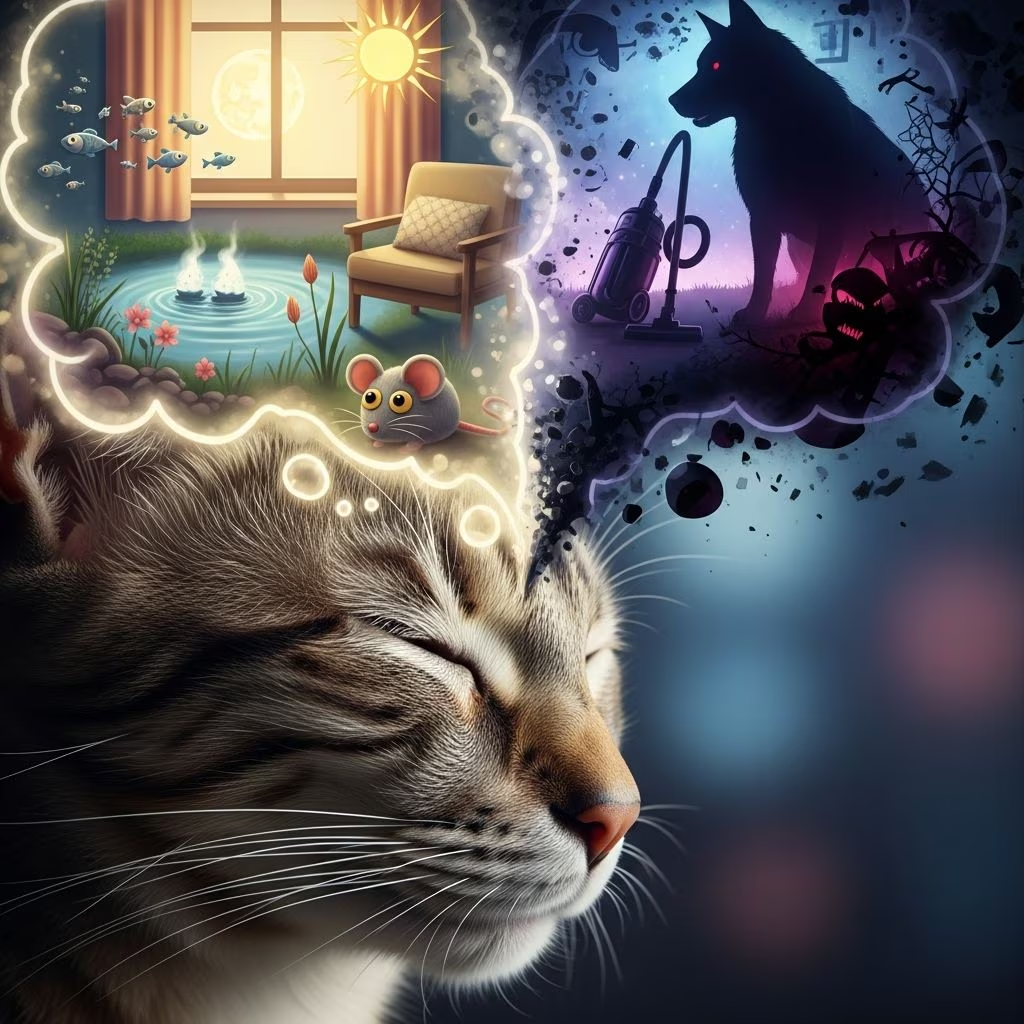
Can Cats Have Nightmares? Understanding Feline Dreams and Sleep
If you’ve ever watched your cat twitch, paddle her paws, or make soft chirping sounds while sleeping, you’ve likely wondered what’s going on in her mind. The question of whether cats experience nightmares is one that intrigues pet owners and scientists alike. While we can’t directly ask our feline companions about their nocturnal experiences, recent research and behavioral observations provide compelling evidence that cats do indeed dream—and may experience nightmares too.
How Much Do Cats Sleep?
Before exploring the world of cat dreams, it’s important to understand feline sleep patterns. Cats are champion sleepers, spending between 12 to 18 hours per day in sleep or rest. This extensive sleep time is significantly more than most other mammals, giving their brains plenty of opportunity to cycle through different sleep stages, including the critical REM (Rapid Eye Movement) phase where dreaming occurs.
The Science of REM Sleep in Cats
During sleep, cats cycle through multiple stages, with the most important being REM sleep—Rapid Eye Movement sleep. This is the phase when the brain becomes exceptionally active, often replaying experiences, emotions, and behaviors from the day. Scientists have studied this activity in cats using EEG (electroencephalogram) machines, and the results are remarkable: cat brainwaves during REM sleep look strikingly similar to those of dreaming humans.
The brain’s activity during REM sleep is not coincidental. The hippocampus, which processes memory and learning, becomes highly active during REM in cats—just as it does in humans. This suggests that cats may be processing memories, replaying daily routines, or reinforcing learned behaviors during these periods.
Breakthrough Research: The Jouvet Study
The most significant evidence supporting cat dreaming comes from a groundbreaking 1960s study by neuroscientist Michel Jouvet, one of the founders of modern dream research. Jouvet’s research focused on understanding why humans don’t physically act out their dreams. He theorized that a specific area of the brain must be responsible for preventing movement during sleep—a state called atonia.
To test his theory, Jouvet surgically removed the part of the cat brain responsible for creating this paralysis during REM sleep. The results were nothing short of revolutionary. The cats that underwent this surgical intervention suddenly began to physically act out their dreams. While asleep, they would pounce, swat, stalk, and hunt invisible prey—behaviors consistent with natural feline hunting instincts.
Videos of these experiments, available online, show cats walking, jumping, and fighting with imaginary enemies while remaining in a sleep state. This dramatic evidence provided the first concrete proof that cats don’t just rest during sleep—they experience vivid, complex dreams grounded in real instincts and behaviors.
What Do Cats Dream About?
Understanding what cats dream about requires examining the theory behind animal dreaming. The leading theory is that animals, including cats and humans, relive natural behaviors during sleep. For cats, this includes:
- Hunting, chasing mice, or birds
- Playing with toys or other cats
- Eating and grooming
- Fighting or defending territory
- Interactions with human companions and other pets
Supporting this theory, a 2001 MIT study examined rats trained to navigate a maze. Researchers recorded their brain activity during the task and again during REM sleep, finding nearly identical patterns. This suggests the rats were dreaming about navigating the maze they had practiced earlier—a pattern likely applicable to cats as well.
Additionally, cats form strong emotional bonds with their human companions and other animals in their home. Many experts believe cats dream about these interactions as a way to reinforce social memories and emotional connections. Even though some cats may never catch live prey, their hunting instincts remain deeply embedded in their neurology, and these may manifest in dreams throughout their lives.
Signs Your Cat Is Dreaming
You don’t need laboratory equipment to observe when your cat is dreaming. During REM sleep, when cats are most likely to be dreaming, you may notice several physical signs:
- Twitching paws or whiskers
- Rapid breathing or subtle body jerks
- Eye movement behind closed eyelids
- Soft vocalizations such as chirping, purring, meowing, or hissing
- Paddling motions with their legs
All of these behaviors are completely normal. They represent physical manifestations of your cat’s brain actively dreaming—likely replaying their daily experiences, instincts, or interactions with their environment and loved ones.
Do Cats Experience Nightmares?
This is where the evidence becomes more speculative. There is no hard scientific proof that cats experience nightmares in the way humans do. However, there’s also no evidence ruling it out. What researchers do have are strong behavioral signs and expert opinions suggesting that cats can experience negative dreams, especially when they’ve been through stressful or traumatic situations.
If cat brains can recreate vivid, instinct-driven dreams during normal sleep, logic suggests they could also replay scary or stressful moments. Cats react to trauma emotionally, just as people do, and nightmares may serve as a way of coping and recovering.
The theory behind human dreaming—that the brain uses memories from daily experiences to rehearse possible responses to common situations—could apply equally to cats. If a cat experiences a frightening encounter with a dog, a visit to the veterinary clinic, or any other stressful event, their brain might process this through dreams, potentially including negative dream experiences.
Age and Dream Patterns in Cats
Just as cats change throughout their lives, their sleeping and dreaming patterns may also evolve. Senior cats may experience changes in their REM sleep patterns, sometimes dreaming less intensely or less frequently due to brain aging. In some cases, changes in dream behavior could relate to cognitive decline or neurological issues that develop with age.
If you notice significant changes in your older cat’s sleep patterns or unusual behaviors during sleep, it’s worth discussing with your veterinarian to rule out any underlying health concerns.
Medications and Dream Activity
Certain medications can affect a cat’s dreaming patterns. Medications affecting the nervous system or those that cause sedation can alter REM sleep and potentially reduce or intensify dream activity. If you notice changes in your cat’s sleep behavior after starting a new medication, it’s important to monitor these changes carefully and discuss them with your veterinarian.
Do Cats Sleepwalk?
Unlike humans, cats don’t truly “sleepwalk”. However, if their brain’s REM atonia (the paralysis that prevents movement during dreams) is disrupted—either experimentally or due to neurological issues—they may move or act out dream scenarios. This phenomenon is rare and typically only observed in scientific studies or in cats with specific neurological conditions, not in healthy house cats under normal circumstances.
The Broader Perspective: Philosophy and Ethics
Beyond the neurological evidence, researchers like philosopher and neuroscientist David M. Peña-Guzmán argue that the implications of animal dreaming extend beyond biology. If cats truly experience dreams—complex, sometimes emotional experiences—this raises profound questions about our ethical relationship with these creatures. Understanding that cats dream can shape how we view and treat them, fostering greater compassion for the richness of their inner lives.
Why Understanding Cat Dreams Matters
Knowing that cats dream helps pet owners build deeper compassion for their feline companions and appreciate how similar we really are to them. Rather than viewing sleep as a simple rest state, we can recognize it as a time when cats process experiences, consolidate memories, and perhaps work through emotional experiences. This understanding enriches our relationship with our cats and may inform how we handle stressful situations they encounter.
Frequently Asked Questions
Q: Do cats actually dream, or is it just movement during sleep?
A: Cats do actually dream. Scientific evidence, particularly Michel Jouvet’s landmark 1960s study, demonstrates that cats experience REM sleep similar to humans and physically act out their dreams when the brain’s paralysis mechanism is disrupted.
Q: Can cats have nightmares like humans do?
A: While there’s no definitive scientific proof that cats experience nightmares exactly like humans, behavioral evidence suggests they can have negative dream experiences, particularly following stressful or traumatic events.
Q: What should I do if my cat seems to be having a nightmare?
A: Generally, it’s best to let your cat wake naturally from their dream. Interrupting sleep can be startling. However, if your cat experiences frequent, intense nightmares or significant behavioral changes during sleep, consult your veterinarian to rule out underlying health issues.
Q: How often do cats dream?
A: Since cats sleep 12 to 18 hours per day and cycle through REM sleep regularly, they likely dream multiple times throughout the day and night. The exact frequency varies by individual cat.
Q: Can medications affect whether my cat dreams?
A: Yes, certain medications—particularly those affecting the nervous system or causing sedation—can alter REM sleep patterns and affect dream activity. Always monitor your cat’s sleep behavior when starting new medications.
Q: Why does my cat twitch and make noises while sleeping?
A: These are normal signs your cat is dreaming during REM sleep. Twitching paws, whisker movements, rapid breathing, and soft vocalizations all indicate active brain activity and dreaming.
Q: Do all cats dream the same way?
A: While all healthy cats likely experience REM sleep and dreams, the intensity and frequency may vary. Age, health status, medications, and individual personality can influence dream patterns.
References
- Understanding Cat Dreams: Memory, Behavior, and Health Links — Michu. Retrieved from https://michu.com.au/blogs/news/do-cats-dream
- Do Animals Dream? with David M. Peña-Guzmán: Big Brains podcast — University of Chicago News. Retrieved from https://news.uchicago.edu/do-animals-dream-david-m-pena-guzman
- Do Cats Dream? — PetMD. Retrieved from https://www.petmd.com/cat/general-health/do-cats-dream
- Do Cats Dream? — Chewy Education. Retrieved from https://www.chewy.com/education/cat/training-and-behavior/do-cats-dream
- Do cats have nightmares or bad dreams? — Way of Cats. Retrieved from https://www.wayofcats.com/blog/do-cats-have-nightmares/250



