

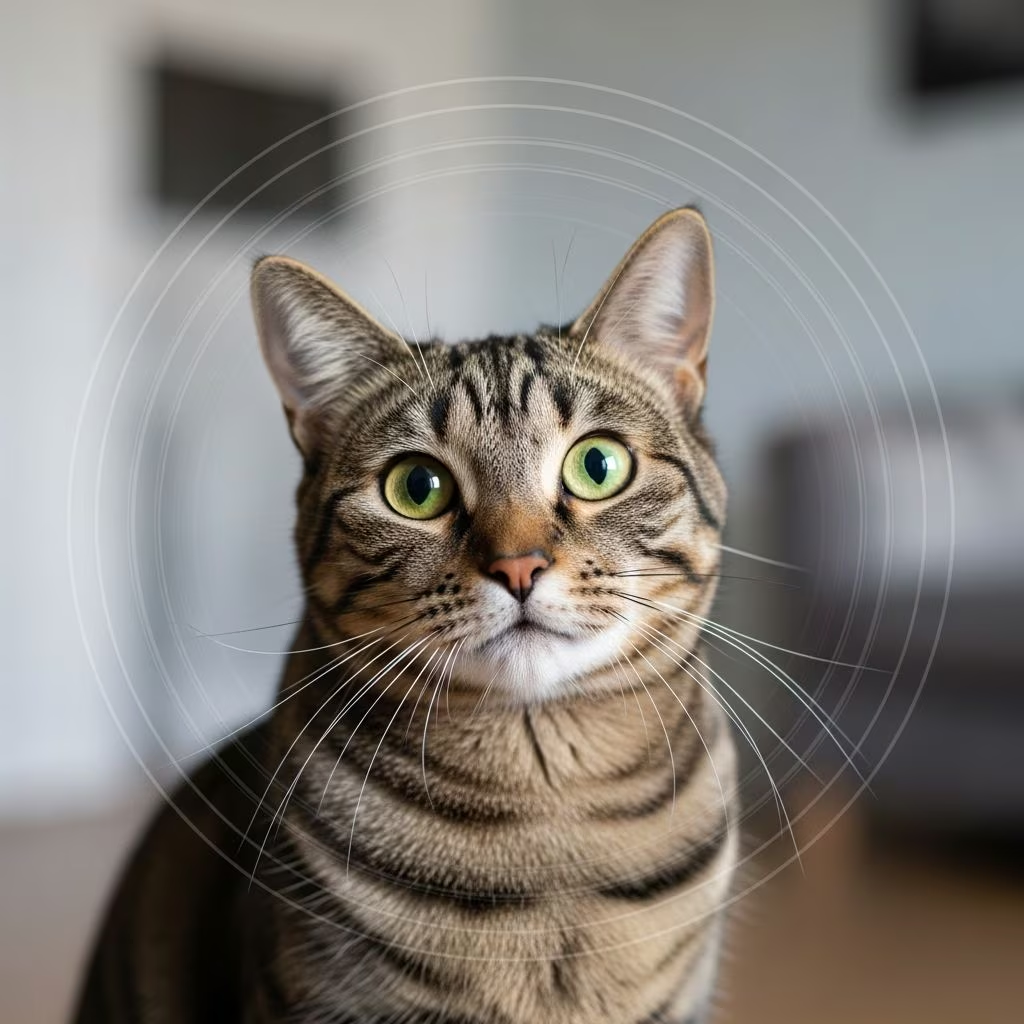
Cats can indeed experience dizziness, primarily through a condition known as **vestibular disease**, which disrupts their balance and spatial orientation. This syndrome affects the vestibular system in the inner ear and brain, leading to symptoms that mimic human vertigo, such as head tilting, rapid eye movements, and stumbling.
What Is the Vestibular System in Cats?
The **vestibular system** is crucial for maintaining balance, coordinating eye movements, and providing spatial awareness in cats. It comprises peripheral components in the inner ear (semicircular canals, utricle, and saccule) and central components in the brainstem and cerebellum. When this system malfunctions, cats exhibit profound disorientation, as their brain receives conflicting signals about head position and movement.
In cats, the inner ear’s balance organs detect rotational and linear accelerations. Damage or disease here causes the brain to perceive constant spinning, even when stationary, resulting in nausea and incoordination. Central involvement affects processing in the brain, often indicating more severe issues.
Symptoms of Vestibular Disease in Cats
Symptoms of vestibular disease in cats onset suddenly, often alarming owners as the cat appears “drunk” or profoundly unsteady. Common signs include:
- Head tilt: A persistent tilt to one side, sometimes severe enough to cause leaning or falling.
- Nystagmus: Involuntary, rapid eye twitching, often horizontal, vertical, or rotary; typically the first symptom to resolve.
- Ataxia (incoordination): Stumbling, circling, falling, or rolling to one side; cats may “alligator roll” uncontrollably.
- Nausea and vomiting: Due to motion sickness from mismatched sensory inputs; may include drooling or retching.
- Loud vocalization: Cats may meow excessively from disorientation or discomfort.
- Circling or falling: Preference for turning in one direction.
Symptoms peak within 24-48 hours and often improve within 72 hours, though full recovery varies.
Causes of Vestibular Disease in Cats
Vestibular disease divides into **peripheral** (inner ear/nerve) and **central** (brainstem/cerebellum) types. Peripheral is more common and has a better prognosis.
Peripheral Vestibular Disease Causes
- Inner/middle ear infections (otitis interna/media): Bacterial or yeast infections inflame the balance organs; common in cats with chronic ear issues.
- Idiopathic (old cat) vestibular disease: Unknown cause, often in seniors; self-resolves like human vertigo.
- Ear polyps or tumors: Benign growths in the middle ear, more frequent in cats.
- Ototoxicity: Certain medications damaging ear receptors.
Central Vestibular Disease Causes
These are more serious and require urgent diagnosis:
- Infections/inflammation: FIP, abscesses, or meningoencephalitis.
- Tumors or cancer: Brain or metastatic tumors, common in older cats.
- Thiamine deficiency: Nutritional issue, especially in cats on unbalanced diets.
- Trauma or stroke: Head injury or vascular events.
- Toxins or drugs: Metronidazole toxicity.
Distinguishing peripheral from central is vital, as central cases may have additional neurological signs like weakness or altered consciousness.
Diagnosis of Vestibular Disease in Cats
Veterinarians diagnose via history, physical/neurological exam, and ruling out mimics. Key steps include:
- Otoscopic exam for ear infections/polyps.
- Neurological assessment for head tilt direction, nystagmus type, and proprioception.
- Diagnostics: Bloodwork, imaging (CT/MRI for central issues), CSF analysis, or ear cytology.
Peripheral disease often shows normal mentation; central may include cranial nerve deficits.
Treatment for Dizzy Cats
Treatment focuses on supportive care and addressing causes. Most idiopathic cases resolve in days without specifics.
Supportive Care
- Antiemetics: Cerenia (maropitant) or ondansetron for nausea/vomiting.
- IV fluids/hospitalization: If dehydrated or non-ambulatory.
- Assisted mobility: Sling/towel support; non-slip surfaces.
- Elevated bowls: Minimize head position changes; night lights for navigation.
Targeted Treatments
| Cause | Treatment |
|---|---|
| Ear infection | Antibiotics (e.g., enrofloxacin), anti-inflammatories. |
| Polyps | Surgical removal if feasible. |
| Thiamine deficiency | Vitamin B1 supplementation. |
| Inflammation/tumors | Steroids, chemo, or surgery per vet. |
Betahistine may aid circulation in some cases, per human analogs.
Recovery and Prognosis for Cats with Vestibular Disease
Peripheral cases often recover fully in 1-3 weeks; some residual head tilt may persist but not impair life. Central prognosis varies by cause—idiopathic good, tumors poor. Monitor for worsening; brain compensation occurs over time.
Home recovery tips:
- Quiet, padded environment.
- Hand-feeding soft food.
- Litter box assistance.
- Prevent falls/injuries.
When to See a Vet for a Dizzy Cat
Seek immediate care if dizziness is sudden/severe, with lethargy, seizures, blindness, or persists >24 hours. Early intervention rules out life-threatening causes.
Prevention of Vestibular Issues in Cats
Prevent ear infections via cleanings, avoid ototoxins, balanced diet for thiamine. Regular senior wellness checks catch issues early.
Frequently Asked Questions (FAQs)
Can cats get vertigo like humans?
Yes, vestibular disease causes similar vertigo sensations from inner ear/brain imbalance.
How long does vestibular disease last in cats?
Symptoms peak in 24-48 hours, improve in 72; full recovery 1-3 weeks.
Is vestibular disease fatal in cats?
Usually not; peripheral self-resolves. Central depends on cause.
Can stress cause dizziness in cats?
Not directly; underlying issues like infections trigger it.
Will my cat’s head tilt go away?
Often yes, but mild permanent tilt common and harmless.
References
- Dizzy dog or cat? It’s probably vestibular disease — Colorado State University Veterinary Teaching Hospital. 2023. https://vetmedbiosci.colostate.edu/vth/animal-health/dizzy-dog-or-cat-its-probably-vestibular-disease/
- Vestibular Disease in Cats: Symptoms & Treatments — Ventura Vets. 2024-08-15. https://www.vmsg.com/site/blog/2024/08/15/vestibular-disease-cats
- Understanding Vestibular Disease in Dogs and Cats — Partner Veterinary Emergency & Specialty. 2025-11-26. https://partnervesc.com/2025/11/26/understanding-vestibular-disease-in-dogs-and-cats/
- Idiopathic Vestibular Disease in Cats — Pet Health Network. N/A. https://www.pethealthnetwork.com/cat-health/cat-diseases-conditions-a-z/idiopathic-vestibular-disease-cats
- Canine & Feline Vestibular Syndrome: Diagnosis & Treatment — PMC (PubMed Central). 2023. https://pmc.ncbi.nlm.nih.gov/articles/PMC10556701/
- Vestibular Disease Cat — Matthews Carolina Vet. 2022-09-15. https://www.matthews.carolinavet.com/site/pet-health-blog/2022/09/15/vestibular-disease-cat
- Vestibular Disease in Cats — PetMD. N/A. https://www.petmd.com/cat/conditions/urinary/vestibular-disease-cats
- Vestibular Syndrome — Cornell University College of Veterinary Medicine. N/A. https://www.vet.cornell.edu/departments-centers-and-institutes/cornell-feline-health-center/health-information/feline-health-topics/vestibular-syndrome



