

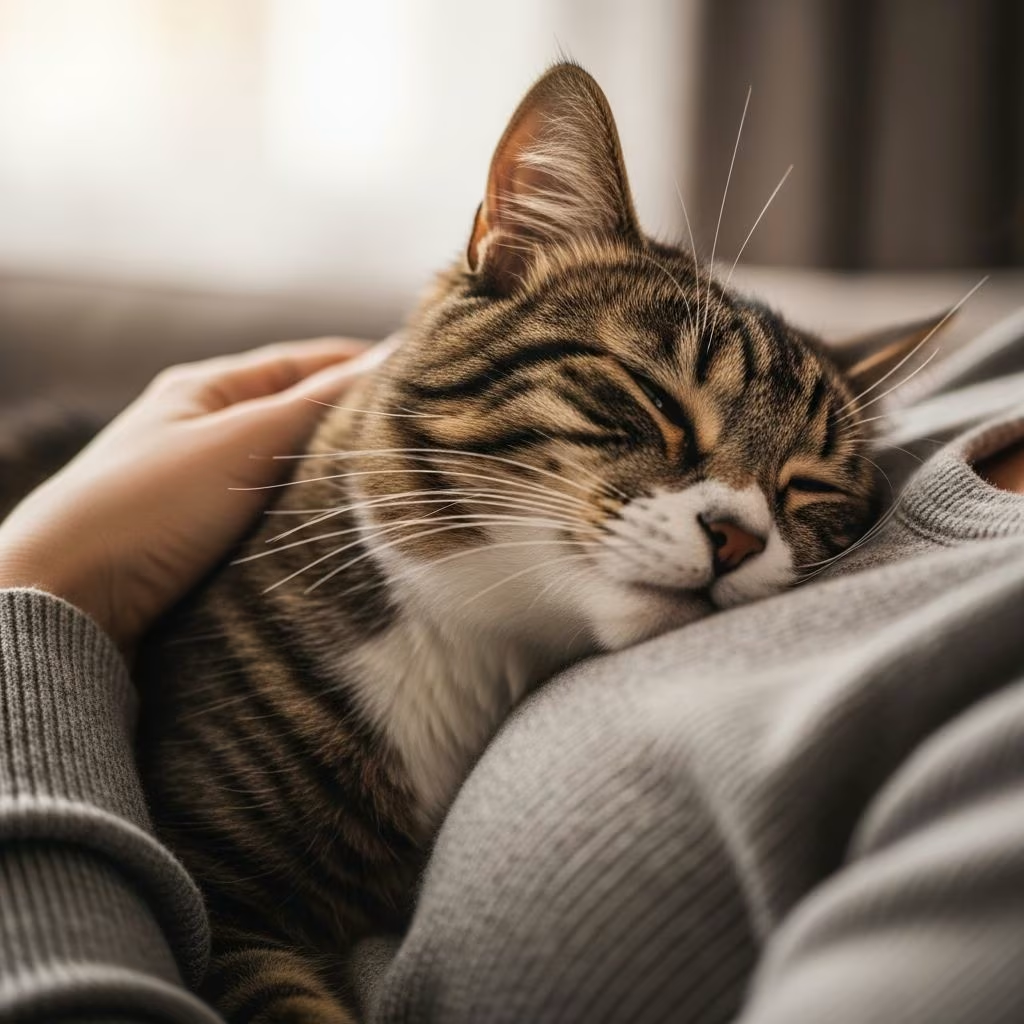
Cats have long been stereotyped as aloof, independent creatures who tolerate humans primarily for food and shelter. But emerging scientific evidence challenges this notion, suggesting that cats form genuine emotional bonds with their owners, akin to those seen in dogs and even human infants. This article examines key studies, behavioral indicators, and expert opinions to answer: Can cats feel love?
The Science Behind Cat-Human Bonds
Modern research has shifted perceptions of cat emotions. A landmark 2019 study published in Current Biology tested 70 kittens using the Secure Base Test (SBT), where kittens were briefly separated from their owners. Upon reunion, many kittens displayed attachment behaviors comparable to dogs, monkeys, and human babies, showing joy and relief at being reunited. This indicates cats view humans as secure bases for exploration and safety.
Further analysis of video footage from 40 adult cats revealed mutual attention and friendly tactile interactions, debunking the one-way affection myth. Cats consistently expressed subtle love signs, proving bonds are reciprocal. A 2021 University of Lincoln survey of 4,000 cat owners identified varying attachment styles, with most cats showing sociability beyond aloof stereotypes. Factors like owner emotional investment and cat sociability strengthen these ties.
How Cats Show Affection: Subtle Signs of Love
Cats communicate love differently from dogs, often through understated cues. Recognizing these helps owners appreciate their feline companions.
- Slow Blinking: Cats ‘slow blink’ at trusted humans, signaling safety and affection. Returning the blink builds trust.
- Head Butting (Bunting): Rubbing heads transfers scent glands, marking you as family.
- Purring: Beyond contentment, purring occurs during healing or bonding, like kneading.
- Tail Positions: Upright tail with a hook tip means happiness; swishing indicates irritation.
- Following You: Trailing owners shows desire for proximity, a love expression.
- Love Bites: Gentle nibbles bond emotionally, distinct from aggressive bites.
- Exposing Belly: Rare vulnerability sign of ultimate trust.
- Grooming: Licking or nibbling hair mimics kitten care from mother.
These behaviors stem from evolutionary adaptations. Domestic cats (Felis catus) retain wild instincts but adapt flexibly to human environments, viewing owners as parental figures.
Attachment Styles in Cats
Like humans, cats exhibit attachment styles: secure, avoidant, anxious, and disorganized. The 2019 Current Biology study found 65% secure (comfort-seeking), 25% avoidant (independent), and others variable.
| Attachment Style | Percentage | Behaviors |
|---|---|---|
| Secure | 65% | Uses owner as base, shows distress on separation, greets warmly. |
| Avoidant | 25% | Minimal interaction, ignores owner. |
| Anxious | 9% | Clingy, vocal distress. |
| Disorganized | 1% | Conflicting behaviors. |
A PMC study on 3,994 owners identified factors like emotional investment, cat proximity needs, and aloofness, confirming diverse bonds. Secure cats thrive with responsive owners.
Myths About Cats and Love Debunked
Myth 1: Cats are aloof and don’t need humans emotionally. Studies show comparable attachments to dogs.
Myth 2: Purring only means hunger. Purring heals and bonds, frequency 25-150 Hz promotes tissue repair.
Myth 3: Cats don’t recognize owners. They distinguish voices, scents uniquely.
Myth 4: Kneading is just habit. ‘Making biscuits’ recalls nursing security.
Myth 5: Tail wagging means happiness. In cats, it signals agitation unlike dogs.
Oxytocin research: Stroking raises levels 12% in cats (vs. 57% dogs), confirming bonding but less intensely.
Oxytocin and the ‘Love Hormone’ in Cats
Oxytocin facilitates social bonds. A 2015 BBC study found stroking elevates it in cats, though less than dogs, affirming affection. The 2019 study reinforced cats as ‘social generalists,’ adapting offspring-caretaker bonds to humans.
Building a Stronger Bond with Your Cat
Enhance love through positive interactions:
- Respect boundaries; let cat initiate contact.
- Play daily with toys mimicking hunt.
- Use clicker training for trust.
- Provide enrichment: scratching posts, perches.
- Speak softly; cats respond to tone.
- Groom gently to mimic social licking.
- Maintain routine for security.
Early socialization (2-7 weeks) fosters secure attachments.
Do Cats Love Us Like Dogs Do?
Cats bond flexibly, solitary-evolved but colony-adapted. They see owners as ‘mommy’ figures, providing food/safety. Differences: dogs pack-oriented, cats independent yet affectionate subtly.
Expert Insights on Feline Emotions
Vets like Dr. Elizabeth Colleran note love bites bond emotionally. Research emphasizes choice/control for comfort.
Frequently Asked Questions (FAQs)
Do cats feel love like humans?
Cats experience attachment love, shown via behaviors and oxytocin, uniquely feline.
Why does my cat follow me everywhere?
It seeks proximity, expressing love and security.
What if my cat seems aloof?
Avoidant style common; patience and respect build trust.
Are love bites harmful?
Gentle ones bond; painful ones need redirection.
Can kittens bond quickly?
Yes, showing strong attachments in SBT.
How to tell if cat loves you?
Watch slow blinks, bunting, purring, belly exposure.
Conclusion: Yes, Cats Can Feel Love
Science affirms cats love owners uniquely, through bonds, behaviors, hormones. Cherish subtle signs; nurture with respect for rewarding companionship.
References
- Science Proves Cats Really Love Us – But For a Surprising Reason! — Feline Fanatics (YouTube). 2025-02-18. https://www.youtube.com/watch?v=fEPMRSvROW0
- Can Science Tell if Our Cats Love Us? — Science and Culture. 2024-01. https://scienceandculture.com/2024/01/can-science-tell-if-our-cats-love-us/
- My Cat and Me—A Study of Cat Owner Perceptions of Their Bond — PMC / National Library of Medicine (.gov). 2021-06-25. https://pmc.ncbi.nlm.nih.gov/articles/PMC8228645/



