

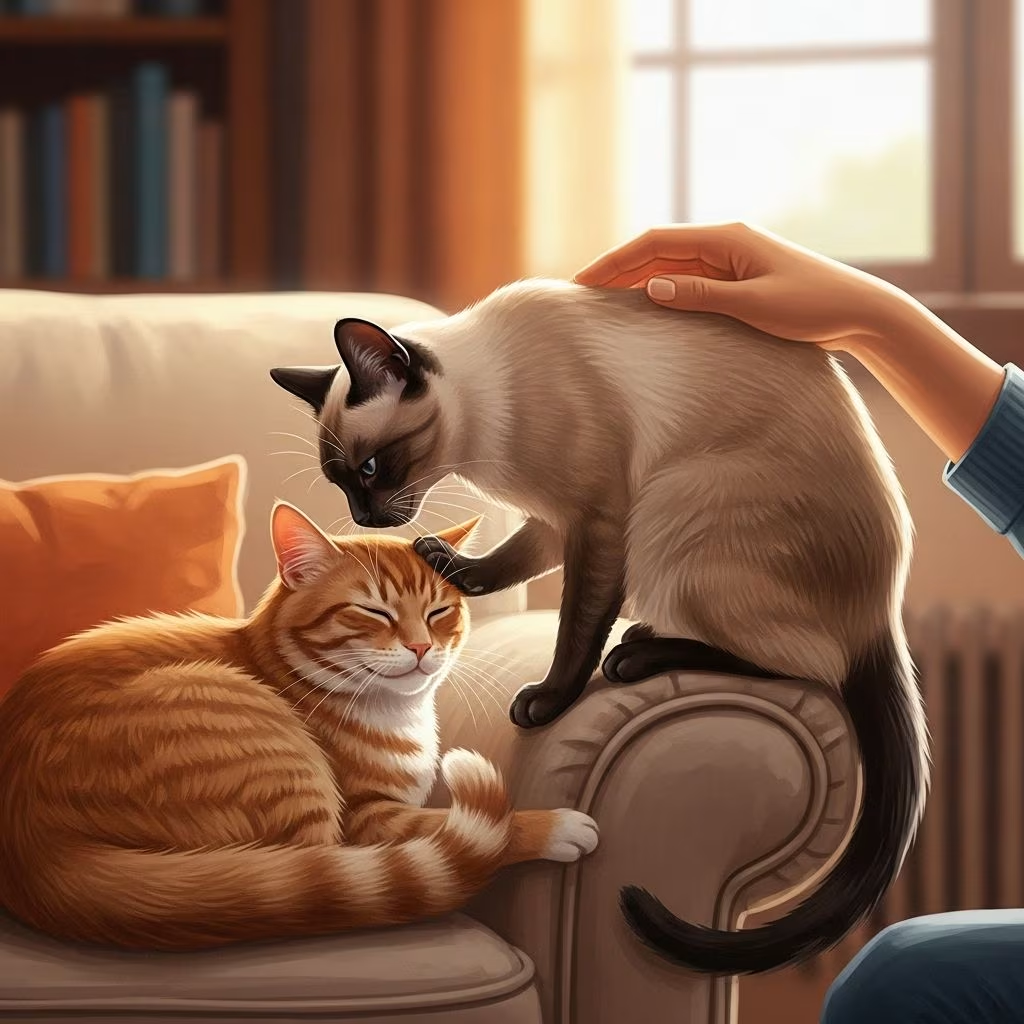
Cats form deep emotional bonds with both humans and other cats, exhibiting attachment behaviors similar to dogs and human infants, though their version of “love” differs from human romantic love. Scientific studies reveal that around 65% of cats display secure attachment to owners, using them as a safe base for exploration.
Table of Contents
- Can Cats Fall in Love with Humans?
- Can Cats Fall in Love with Each Other?
- Signs Your Cat Is in Love with You
- What Science Says About Cats and Love
- Cat Attachment Styles
- Frequently Asked Questions
Can Cats Fall in Love with Humans?
While cats don’t experience romantic love as humans do, they form strong, affectionate bonds with their owners that mirror attachment seen in infants and dogs. Research from Oregon State University’s Human-Animal Interaction Lab demonstrates that cats seek comfort from owners in unfamiliar settings, greeting them enthusiastically upon reunion and balancing contact with exploration. This secure attachment behavior, observed in over 100 cats, indicates cats view humans as a reliable safe base, enhancing their sense of security and survival.
In secure base tests, cats and owners enter a novel room for two minutes, the owner leaves for two minutes (a mild stressor), then returns. Securely attached cats approach, greet, and return periodically to their owner while exploring, much like human toddlers or puppies. Approximately two-thirds of tested cats showed this secure attachment, with bonds proving stable even after socialization training.
Cats also respond to human cues like slow blinking, which strengthens bonds. University of Sussex studies found cats more likely to return slow blinks from owners or strangers, suggesting this mimics feline “smiling” and fosters positive interactions. Compliance in interactions—cats fulfilling human wishes when humans do the same—correlates with longer interaction times and higher affection ratings.
Gender influences dynamics: women often initiate more interactions, leading to higher reciprocity, while cats adjust behaviors to human moods, rubbing more against depressed owners to alleviate negative emotions. Cats prefer stroking on head regions, modifying postures to guide humans, indicating active partnership in affection.
Can Cats Fall in Love with Each Other?
Cats can form profound, loving bonds with fellow felines, often described as sibling-like or companionate love. Multi-cat households frequently observe cats grooming each other, sleeping intertwined, and playing vigorously, signaling deep trust and affection.
Allogrooming (mutual grooming), rubbing, and intertwined sleeping are primary signs of cat-cat love. These behaviors release oxytocin, the “bonding hormone,” similar to human hugs. Studies on feral and domestic cats show stable pair bonds in colonies, where bonded cats vocalize uniquely, defend each other, and show distress upon separation.
However, not all cats bond romantically or platonically; introductions matter. Slow, supervised meetings prevent aggression. Bonded pairs exhibit synchronized behaviors, like eating together or following each other, persisting lifelong. Kittens socialized with littermates develop stronger adult bonds, while singles may take longer to attach to new cats.
Cat-cat love differs by personality: bold cats bond faster, while shy ones need time. Neutering reduces conflicts, promoting harmony. Observational studies confirm cats in positive relationships spend more time in proximity and physical contact, mirroring human-cat dynamics.
Signs Your Cat Is in Love with You
Cats express love subtly but profoundly. Key indicators include:
- Slow Blinking: Cats “smile” by narrowing eyes slowly; reciprocating builds trust.
- Head Butting and Rubbing: Scent-marking claims you as family, mixing scents.
- Purring and Trilling: Contentment vibrations, especially during petting or proximity.
- Kneading: “Making biscuits” recalls nursing, showing comfort and love.
- Bringing Gifts: Dead animals or toys demonstrate hunting prowess and sharing.
- Following You: Shadowing rooms indicates desire for companionship.
- Belly Exposure: Vulnerable position reserved for trusted loved ones.
- Grooming You: Licking mirrors mother-kitten care, ultimate affection sign.
These behaviors, rooted in evolutionary survival, now signify emotional security. Cats showing multiple signs view you as kin.
What Science Says About Cats and Love
Recent research debunks aloof cat myths. Oregon State studies (2019, published in Current Biology) confirm cats attach like dogs/babies, with 65% secure. PMC review details interaction mechanics: positive correlations in affection ratings, compliance, and contact enjoyment.
Oxytocin surges during petting/gazing, paralleling human/primate bonding. fMRI scans show cat brain pleasure centers activate similarly to dogs during owner interactions. Cats distinguish owners by voice, preferring them over strangers.
Secure attachments boost welfare, reducing stress. Insecure cats (clingy/avoidant ~35%) may stem from early weaning or poor socialization. APA notes advancing understanding of cat cognition/sociality.
Cat Attachment Styles
| Style | Percentage | Behavior | Example |
|---|---|---|---|
| Secure | ~65% | Balanced exploration/contact | Greets owner, explores, returns |
| Avoidant | ~20% | Ignores owner, independent | Minimal reunion response |
| Anxious/Ambivalent | ~15% | Clingy, distressed | Overly demanding attention |
Styles akin to Ainsworth’s infant typology; stable post-socialization. Secure cats healthier, less stressed.
Frequently Asked Questions (FAQs)
Do cats feel love for their owners?
Yes, cats form secure attachments, showing love via proximity-seeking and affection.
Can cats love more than one person?
Absolutely; cats bond with multiple household humans, prioritizing primary caregivers.
How do you know if your cat loves you?
Look for slow blinks, purring, rubbing, kneading, gifts, belly exposure.
Do cats get jealous of other pets?
Yes, competing for attention; slow intros help.
Can cats miss their owners?
Yes, displaying stress/depression during absences; reunions joyful.
Do male cats love more?
No; personality/early experiences matter more than sex.
Why do cats follow you to the bathroom?
Secure attachment; ensuring you’re safe/claiming territory.
Can cats sense human emotions?
Yes, responding differentially, especially to owners; cross-modal emotion recognition.
References
- New OSU Research Says Your Cat Loves You Just As Much — OPB. 2019-12-04. https://www.opb.org/news/article/cats-dogs-attachment-love-oregon-state-research/
- New Studies: Cats are Friendlier Than You Think — PetPlace. 2019-12-01. https://www.petplace.com/article/cats/pet-behavior-training/new-studies-cats-friendly-bond-with-owners
- The Mechanics of Social Interactions Between Cats and Their Owners — PMC (PMC8044293). 2021-04-14. https://pmc.ncbi.nlm.nih.gov/articles/PMC8044293/
- What’s going on inside your cat’s head? — American Psychological Association. 2020-01-01. https://www.apa.org/news/podcasts/speaking-of-psychology/cat-human-bond



