

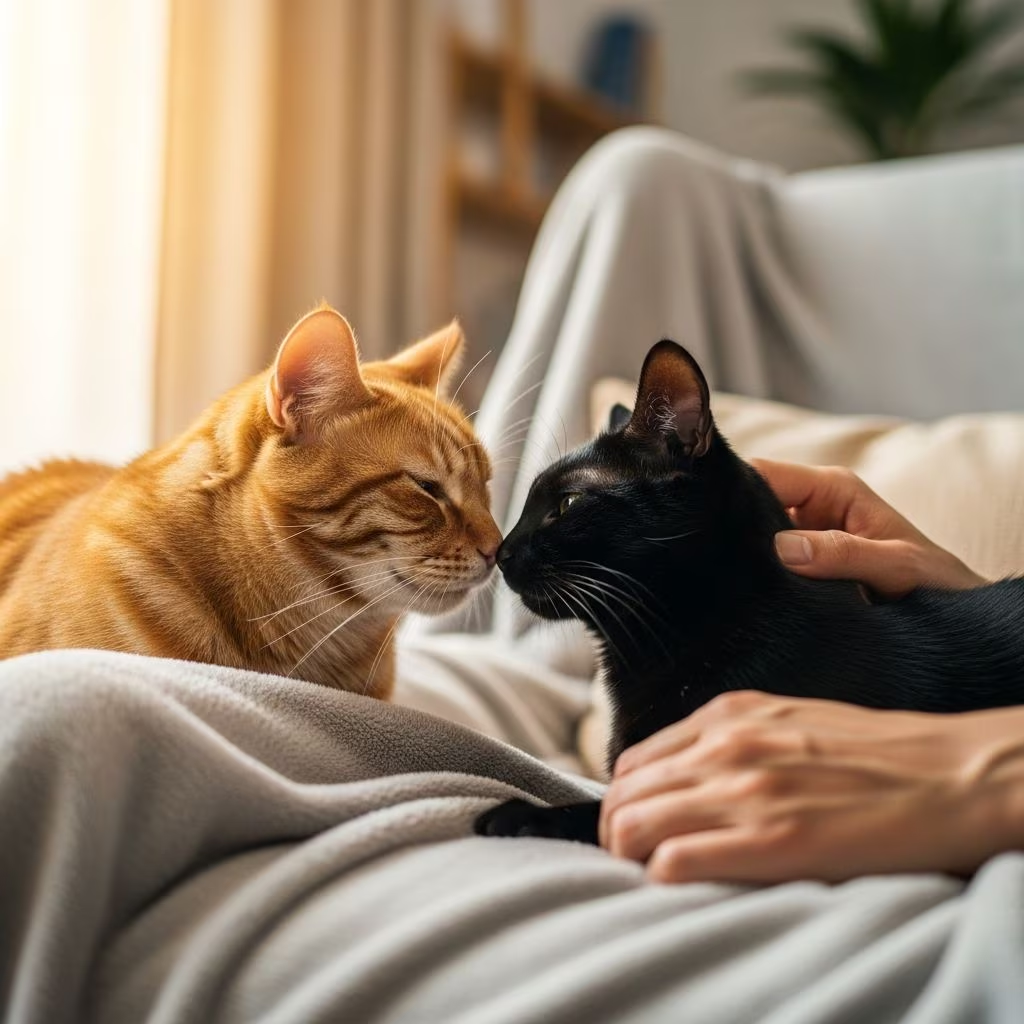
Cats have long been stereotyped as aloof and independent creatures, but emerging research challenges this notion, revealing their capacity for deep emotional connections. While humans romanticize love, feline “love” manifests through attachment, affection, and social bonding rather than overt romance. This article examines whether cats fall in love with each other or humans, drawing from behavioral studies and observational data.
Table of Contents
- Introduction to Cat Love
- Do Cats Fall in Love with Each Other?
- Signs Cats Love Other Cats
- Can Cats Fall in Love with Humans?
- Signs Cats Love Humans
- The Science Behind Cat-Human Bonds
- Why Cats Seem Less Affectionate Than Dogs
- How to Strengthen Your Bond with Your Cat
- Frequently Asked Questions
Introduction to Cat Love
Love in animals isn’t identical to human emotions, but cats display attachment styles akin to infants and dogs. A study from Oregon State University found that around two-thirds of cats exhibit secure attachment to owners, viewing them as a safe base in unfamiliar environments, similar to human toddlers. This suggests cats form profound bonds, though expressed subtly through grooming, rubbing, and proximity rather than grand gestures.
Domestic cats descend from solitary wildcats, yet thousands of years of domestication have enhanced their social nature. Research indicates cats read human emotions, match vocalizations to faces, and sync behaviors with owners, pointing to sophisticated interspecies relationships.
Do Cats Fall in Love with Each Other?
Cats can form strong pair bonds, especially if introduced young or as littermates. Multi-cat households often show “love” through mutual grooming (allogrooming), sleeping intertwined, and play-fighting that reinforces ties. However, cats are not pack animals like dogs; bonds are selective, with some tolerating others while deeply attached to one or two favorites.
Observational studies reveal cats prefer familiar companions, rubbing flanks and sharing scents to affirm bonds. In feral colonies, related females form matrilineal groups, cooperating in nursing and territory defense, a form of kin-based affection. Unrelated cats may bond over time, but conflict arises if resources like food or litter boxes are scarce.
| Bond Type | Characteristics | Examples |
|---|---|---|
| Littermate Bond | Strongest attachment, lifelong grooming | Siblings sleeping curled together |
| Friendship Bond | Mutual play, territory sharing | Unrelated adults rubbing heads |
| Tolerant Coexistence | Avoidance of conflict, no intimacy | Separate sleeping areas |
Signs Cats Love Other Cats
- Allogrooming: Licking another’s fur, a grooming ritual reserved for trusted cats, mimicking mother-kitten care.
- Head Bunting and Rubbing: Exchanging scents via facial glands to mark as family.
- Tail Twitching in Sync: Upright tails with hooks signal greeting and affection among bonded pairs.
- Shared Sleeping: Curling up together for warmth and security.
- Play Wrestling: Gentle roughhousing that strengthens social ties without injury.
These behaviors indicate comfort and preference, akin to love. Cats showing distress (hiding, aggression) when separated from a feline friend demonstrate emotional attachment.
Can Cats Fall in Love with Humans?
Yes, cats form secure attachments to humans comparable to dogs. In secure base tests, 65% of cats rejoined owners calmly after separation, mirroring infant behavior. Cats distinguish owners from strangers, responding more positively to familiar voices and scents.
Studies show cats comply with human interaction wishes reciprocally; high-compliance dyads spend more time together. Cats alter behavior based on owner mood, vocalizing more when depressed and rubbing affectionately. This emotional syncing suggests deep bonds.
Signs Cats Love Humans
- Slow Blinking: Eye narrowing signals trust; cats return slow blinks, strengthening bonds.
- Kneading (Making Biscuits): Paw rhythm mimicking nursing, shown to favorite people.
- Following You Everywhere: Shadowing indicates you’re their secure base.
- Exposing Belly: Vulnerable position reserved for trusted humans.
- Chirping or Trilling: Unique vocalizations expressing joy and greeting.
- Bringing Gifts: Dead prey or toys as tokens of affection and provision.
Galvan and Vonk found cats sensitive to owner emotions via cues, especially familiar ones.
The Science Behind Cat-Human Bonds
Dr. Krysten Vitale’s secure base test involved 120 cats: owners left briefly, then returned. Secure cats (two-thirds) explored confidently, returning casually—matching dog and infant rates. Socialization didn’t alter bonds, indicating innate stability.
Dr. Karen McComb’s slow blink study: Cats reciprocated owner blinks more than neutral stares, even from strangers, suggesting learned communication. Turner et al. observed 158 households, finding mutual compliance correlates with interaction time; cats initiate more in affectionate homes.
Quaranta et al. proved cats match emotional faces to vocalizations cross-modally, forming mental representations of partner emotions.Indoor cats rated higher in curiosity and affection.
Why Cats Seem Less Affectionate Than Dogs
Cats evolved as semi-solitary hunters, expressing affection subtly to avoid vulnerability. Dogs, bred for cooperation, are effusive. Yet, Oregon State research shows cats bond as strongly, just less vocally. Owner gender affects dynamics: women show higher interactivity.
- Cats prefer head stroking; modify postures for access.
- Respond to owner depression with more contact.
- Mirror emotions: curiosity boosts cat exploration, negativity induces caution.
How to Strengthen Your Bond with Your Cat
- Slow Blink Back: Mimic to build trust.
- Respect Their Space: Let them initiate contact.
- Play Daily: Use toys to simulate hunting, release endorphins.
- Groom Gently: Mimic allogrooming on preferred spots.
- Use Their Name: Cats recognize owner names; respond faster domestically.
- Provide Enrichment: Scratching posts, perches for security.
Consistency fosters reciprocity; low-interaction cats adapt but thrive with engagement.
Frequently Asked Questions (FAQs)
Do cats get attached to one person?
Yes, many cats select a primary person as their secure base, though they bond with family members.
Can cats sense human emotions?
Cats mirror owner emotions, looking for cues and adjusting behavior, especially to familiar people.
Why do cats bring dead animals?
It’s a teaching or sharing gesture, instinctual from hunting mothers.
Are male cats more affectionate?
No, sex doesn’t affect interactivity; owner behavior influences more.
Do cats love their kittens forever?
Mothers bond intensely but wean independence; adults may reunite amicably.
References
- New Studies: Cats are Friendlier Than You Think — PetPlace. 2023-05-15. https://www.petplace.com/article/cats/pet-behavior-training/new-studies-cats-friendly-bond-with-owners
- The Mechanics of Social Interactions Between Cats and Their Owners — PMC (National Library of Medicine). 2021-04-15. https://pmc.ncbi.nlm.nih.gov/articles/PMC8044293/
- Cats and science: three studies to explain their behaviour — Oasy. 2022-08-20. https://www.oasy.com/en/pet-news/useful-tips/studies-to-understand-cats-behaviour
- What’s going on inside your cat’s head? — American Psychological Association. 2023-11-10. https://www.apa.org/news/podcasts/speaking-of-psychology/cat-human-bond



