

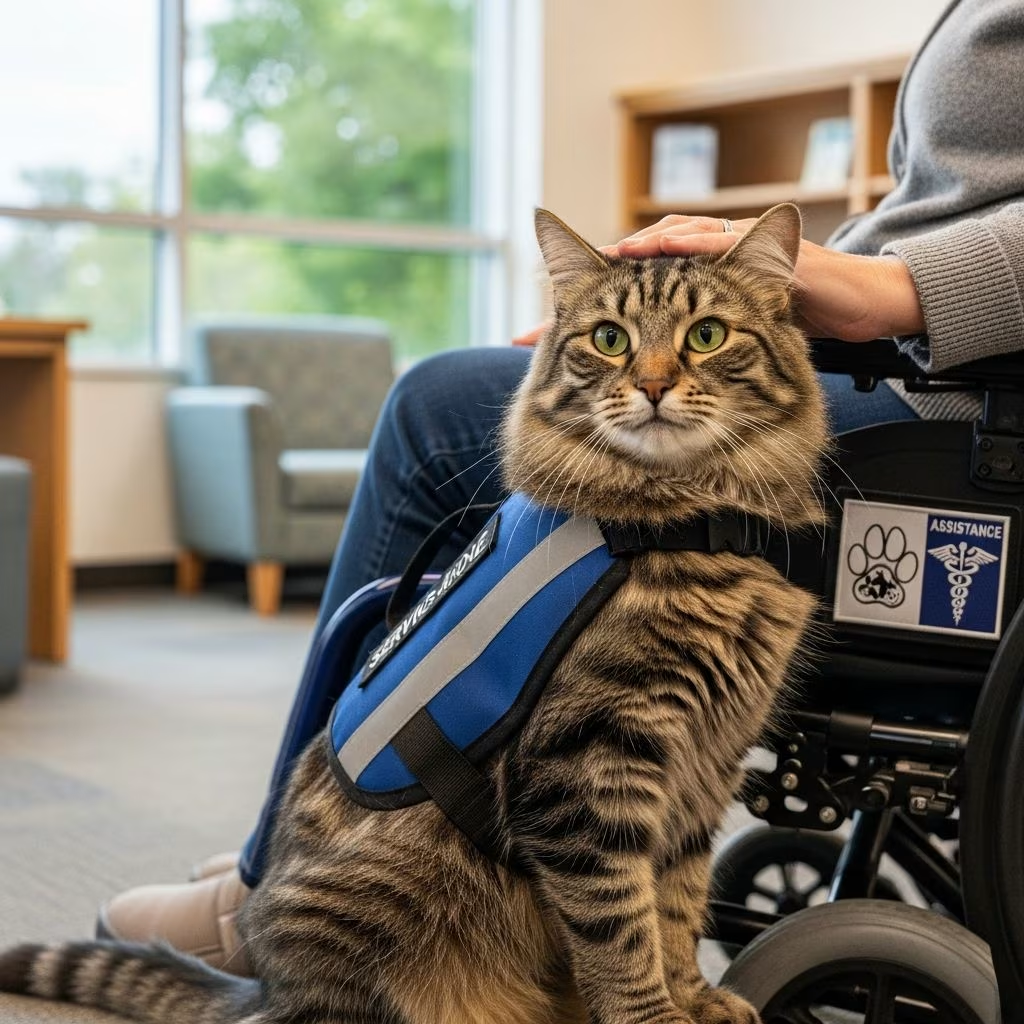
Cats cannot be service animals under the Americans with Disabilities Act (ADA), which limits service animals to dogs (and miniature horses) individually trained to perform specific tasks for people with disabilities.However, cats can serve as emotional support animals (ESAs) under the Fair Housing Act (FHA) and as therapy animals in certain settings. This distinction is crucial for pet owners seeking legal protections for their feline companions.
Service animals provide task-based assistance, such as guiding the blind or alerting to seizures, while ESAs offer emotional comfort without specific training. Therapy animals provide comfort in controlled environments like hospitals. Understanding these categories helps cat owners navigate housing, travel, and public access rights effectively.
What Is a Service Animal?
A **service animal** is defined by the ADA as a dog individually trained to perform work or tasks directly related to a person’s disability. Examples include guiding the visually impaired, alerting the deaf, pulling wheelchairs, or detecting medical emergencies like seizures or low blood sugar. The U.S. Department of Justice specifies that only dogs qualify, with miniature horses allowed in limited cases due to their trainability and size.
Key requirements include:
- The animal must be under the handler’s control, typically via harness, leash, or tether (voice control if equipment interferes).
- No certification or documentation is required; staff may only ask two questions: (1) Is this a service animal required for a disability? (2) What tasks does it perform?
- Service animals must be allowed in public areas where the public is permitted, including hospitals, restaurants, and stores, without extra fees.
Cats do not meet this definition due to challenges in reliable task training, stemming from their independent nature compared to dogs’ pack-oriented evolution.
Can Cats Be Service Animals?
No, cats cannot legally be service animals under federal ADA law. The ADA explicitly limits service animals to dogs for Titles II and III (public services and accommodations), emphasizing dogs’ proven reliability in tasks like retrieval, alerting, and mobility assistance.
While anecdotal evidence shows cats can be trained for tasks—such as fetching items, opening doors, or even dialing 911—their temperament varies widely. Cats require specific personalities and professional training, but federal law does not recognize them, denying public access rights afforded to dogs.
| Aspect | Dogs (Service Animals) | Cats |
|---|---|---|
| Legal Recognition (ADA) | Yes, for task-trained dogs | No |
| Public Access | Guaranteed in public spaces | Not protected |
| Training Feasibility | High reliability | Possible but inconsistent |
| Examples of Tasks | Guide, alert, retrieve | Unofficial: fetch, alert |
This table highlights why dogs dominate service roles, though cats’ potential remains untapped legally.
Emotional Support Animals (ESAs) vs. Service Animals vs. Therapy Animals
These categories differ significantly in training, legal protections, and access:
- Service Animals: Task-trained dogs for disabilities; ADA-protected public access.
- Emotional Support Animals (ESAs): Provide emotional comfort; no tasks required. Protected under FHA for housing (no pet fees/deposits) and formerly ACAA for flights (now limited).
- Therapy Animals: Offer comfort in settings like hospitals/schools; not federally protected but recognized by facilities if evaluated for calm behavior.
Cats excel as ESAs and therapy animals, leveraging their purring and affectionate nature for stress reduction.
Can Cats Be Emotional Support Animals?
Yes, cats qualify as ESAs. A licensed mental health professional must provide an ESA letter confirming the cat alleviates symptoms of a mental/emotional disability, such as anxiety or PTSD.
ESA Rights:
- Housing: FHA mandates no-pet housing accept ESAs without fees/deposits. Landlords may require verification but cannot deny based on species (cats allowed).
- Travel: Post-2021, DOT restricts cabin access to trained service dogs; ESAs (including cats) travel as pets, potentially incurring fees.
- Work/Public: No ADA protections; employer discretion under ADA as reasonable accommodation.
To register: Obtain ESA letter (not purchasable online legitimately); ensure cat is well-behaved. State laws vary—check locally.
Can Cats Be Therapy Animals?
Yes, cats can be therapy animals, visiting facilities to reduce stress/anxiety. No federal law governs; approval comes from organizations via behavioral evaluations.
Training involves:
- Calm demeanor around strangers/noise.
- Basic commands, leash etiquette.
- Health checks, vaccinations.
Organizations like Pet Partners certify therapy cats for hospitals, schools, nursing homes. Benefits include lowered cortisol and blood pressure in patients.
What Tasks Can Cats Be Trained to Perform?
Though not service animals, cats can learn tasks unofficially:
- Retrieval: Fetch meds/objects using clicker training.
- Alerts: Respond to sounds or scents (e.g., doorbell, seizures—less reliable than dogs).
- Mobility: Push lightweight items or activate switches.
- Comfort: Provide deep pressure therapy via sitting/laying.
Success depends on breed (e.g., Siamese more trainable), early socialization, positive reinforcement. Professional trainers adapt dog methods for cats.
Rights and Responsibilities of Cat Owners
Owners must ensure cats are house-trained, vaccinated, non-disruptive. For ESAs:
- Provide ESA letter upon request.
- Cover damages (not exempt).
- Comply with breed restrictions if safety-based.
Misrepresenting a cat as a service animal is illegal, risking fines. Only claim ESA/therapy with proper documentation.
Training Your Cat to Be a Helper
Start young with positive methods:
- Assess temperament: Curious, social cats best.
- Use clicker/treats for commands like ‘sit,’ ‘come.’
- Build to tasks: Harness training, target touching.
- Consult certified trainers specializing in cats.
- Practice consistency daily (10-15 min sessions).
Challenges: Cats tire quickly, distract easily. Patience yields results, enhancing bonds.
Frequently Asked Questions (FAQs)
Can cats go into public places as service animals?
No, only ADA-defined service dogs have automatic public access. Cats as ESAs lack this right.
Do I need to register my cat as an ESA?
No federal registry exists; a valid ESA letter from a professional suffices. Avoid scam sites.
Can landlords charge pet fees for ESAs?
No, under FHA, ESAs are exempt from pet policies, but owners liable for damage.
Are there cat breeds best for emotional support?
Affectionate breeds like Ragdolls, Maine Coons suit well, but any calm cat works.
Can therapy cats fly for free?
No, as non-service animals, they follow pet policies.
How do I know if my cat qualifies for therapy work?
Pass evaluations from groups like Alliance of Therapy Animals for behavior/health.
Cats offer profound support despite ADA limits. Consult professionals for personalized advice on ESAs or therapy roles.
References
- Service Cat | Can a Cat Be a Service Animal — US Service Animals. 2023. https://usserviceanimals.org/blog/service-cat/
- Can a Cat Be a Service Animal? — J. Courtney Cunningham, PLLC. 2024-05-15. https://cunninghampllc.com/blog/can-a-cat-be-a-service-animal/
- ADA Requirements: Service Animals — U.S. Department of Justice. 2024-08-01. https://www.ada.gov/resources/service-animals-2010-requirements/
- Service, Assistance and Emotional Support Animals — ASPCA. 2023-11-20. https://www.aspca.org/about-us/aspca-policy-and-position-statements/service-assistance-and-emotional-support-animals
- Service Animals and Emotional Support Animals — ADA National Network. 2024. https://adata.org/guide/service-animals-and-emotional-support-animals
- § 36-96.3:1. Rights and responsibilities with respect to assistance animals — Virginia Law. 2023. https://law.lis.virginia.gov/vacode/title36/chapter5.1/section36-96.3:1/
- Assistance Animals — U.S. Department of Housing and Urban Development (HUD). 2024. http://www.hud.gov/helping-americans/assistance-animals



