

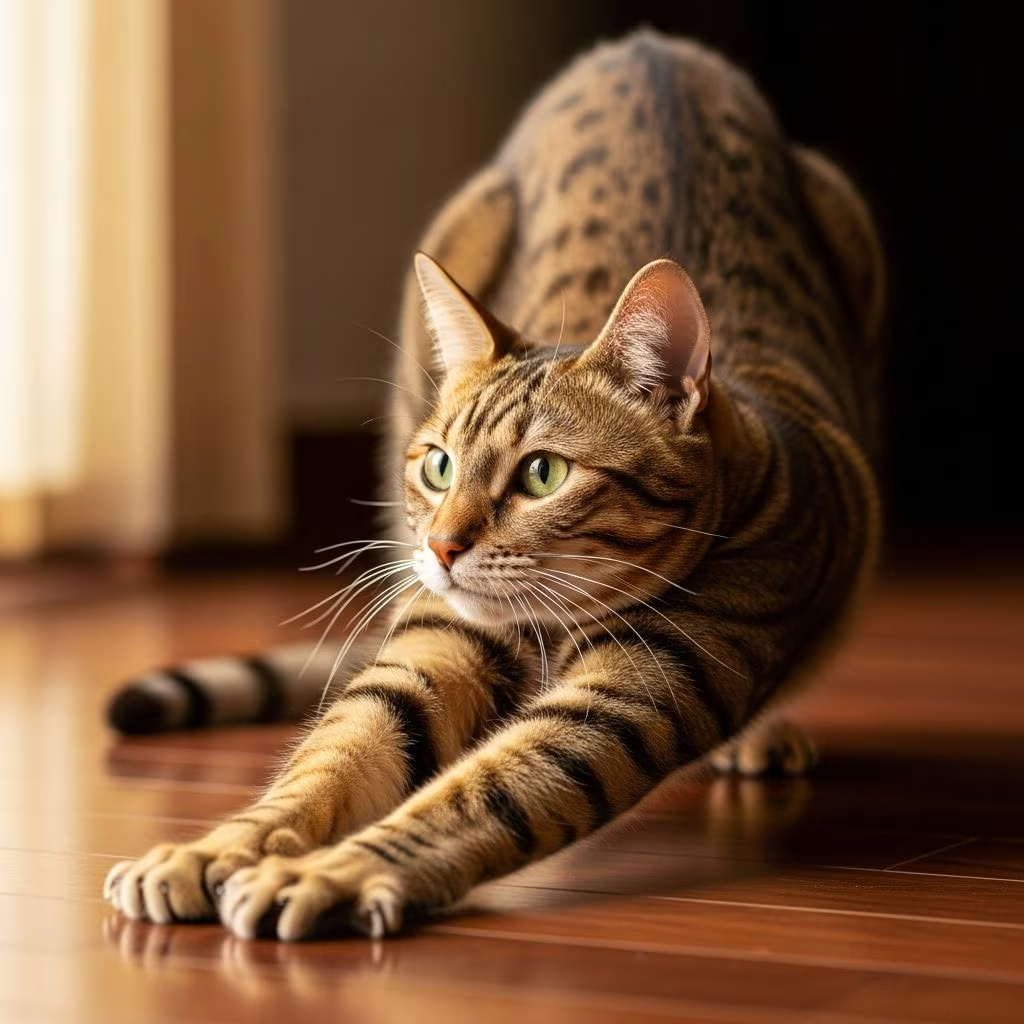
Can Cats Be Double-Jointed? Understanding Feline Flexibility
If you’ve ever watched your cat squeeze through a tiny space or contort into seemingly impossible positions, you might wonder: can cats be double-jointed? While many people believe cats possess this trait, the reality is far more fascinating than fiction. Cats are not actually double-jointed; instead, they possess specialized anatomical features that have evolved over thousands of years to provide extraordinary flexibility and mobility.
The misconception about double-jointed cats is surprisingly common, yet it stems from a fundamental misunderstanding of feline anatomy. What we observe when cats perform their impressive contortions is the result of millions of years of evolutionary adaptation, not an abnormality or medical condition. Understanding the true mechanisms behind feline flexibility helps us appreciate just how remarkable these creatures truly are and how to better care for their joint health.
The Science Behind Cat Flexibility
The foundation of cat flexibility lies in their spine. Cats have approximately 53 vertebrae in their spinal column, compared to humans who have only 33 vertebrae. This dramatic difference in vertebral count is the primary reason cats can achieve movements that seem physically impossible to humans. These vertebrae are connected by elastic tissues and flexible discs, allowing for exceptional movement and contortion that enables cats to twist, turn, and squeeze through surprisingly tight spaces.
One of the most remarkable aspects of feline spinal anatomy is the presence of highly elastic intervertebral discs. These discs act as cushions between the vertebrae and allow cats to rotate their bodies up to 180 degrees to the left or right. For perspective, humans can only rotate their torso approximately 90 degrees. This means a cat can position its head and front legs facing one direction while its hips and back legs face the opposite direction—a capability that aids in balance, hunting, and escape situations.
The muscles connected to a cat’s spine are also uniquely structured. These muscles are attached very flexibly to the spine, allowing cats to increase their stride by extending the spine. This flexible muscular attachment system works in concert with the vertebral structure to create the fluid, seemingly boneless movements that characterize feline locomotion.
Specialized Anatomical Features
Unique Skeletal Structure
Beyond their impressive vertebral count, cats possess several other distinctive skeletal adaptations that enhance their overall flexibility:
- Free-floating collarbone embedded in muscle—Unlike humans whose collarbones are rigidly connected to other bones, cats have collarbones that float freely within their muscle tissue, allowing greater shoulder mobility
- Highly mobile shoulder blades—Cat shoulder blades are attached to the body primarily by muscles rather than bone, providing exceptional range of motion
- Specialized ball-and-socket joints—These joints enable cats to rotate their front limbs through an impressive range of motion
- Loosely connected shoulder blades—This anatomical feature allows cats to stretch, twist, and leap with ease
The shoulder structure deserves particular attention, as it is one of the most noteworthy adaptations in feline anatomy. The design where shoulder blades are attached to the body primarily by muscles rather than bone allows cats to rotate their front limbs through an impressive range of motion and enables them to squeeze through openings barely wider than their heads. This adaptation has profound implications for a cat’s hunting abilities and survival in various environments.
Muscular System
The feline muscular system works in perfect harmony with their skeletal structure. Cats possess several specialized muscular adaptations:
- Strong, elastic muscles—These support flexible movement and enable cats to perform dynamic stretches and movements
- Powerful core muscles—These provide the balance and agility necessary for precise movement and climbing
- Specialized neck muscles—These allow for precise head control, which is essential for hunting and navigation
- Flexible spine muscles—These enable the characteristic “cat stretch” and other spinal movements
The integration of these muscular systems with the skeletal structure creates a biomechanical marvel. When a cat performs its typical stretching routine, multiple muscle groups work together in perfect coordination. The flexibility we observe is not random or haphazard; rather, it represents a sophisticated system of interconnected anatomical features designed through evolution to maximize the cat’s physical capabilities.
Common Misconceptions About Cat Joints
The term “double-jointed” is a significant misnomer when applied to cats. This term is often used to describe people or animals with hypermobility—an abnormal range of motion in their joints beyond what is typical for their species. However, what we observe in cats is not hypermobility but rather the normal, healthy range of motion that their specialized anatomy allows.
Double-jointed conditions do occasionally occur in cats, but these are rare and typically pathological when they do occur. A condition called carpal laxity, which affects the wrist joint, is an example of true joint hypermobility in cats. In this rare condition, the carpus (wrist) has an abnormal or excessive range of motion. Affected kittens may appear flat-footed in the front legs because the wrist collapses toward the ground. However, this is a medical condition requiring veterinary attention, not the normal flexibility that healthy cats display.
The evolutionary adaptations that enable feline flexibility serve important survival purposes. These adaptations allow cats to hunt with greater precision, escape from predators more effectively, and navigate their environment with superior agility compared to other mammals. Understanding that cats aren’t double-jointed but rather possess specialized anatomical features helps us better appreciate their remarkable abilities without attributing their movements to abnormal conditions.
How Cats Land and Absorb Impact
One remarkable demonstration of feline flexibility in action is their famous landing ability. Cats employ sophisticated biomechanical strategies to dissipate impact forces when landing from heights. Research into the falling cat reflex reveals that cats control joint motion through a complex mechanism involving their highly flexible spine and coordinated limb movement.
When a cat lands, its joints work synergistically to absorb tremendous impact forces relative to the cat’s body size. The spine’s rotation plays a crucial role in this process, with the forelimbs actively sharing force with the hindlimbs to distribute the shock evenly throughout the body. As jump heights increase, cats tend to distribute the greater demands to the elbow and hip joints, demonstrating an adaptive system that adjusts to different landing scenarios.
This natural shock-absorption system is another excellent example of how a cat’s flexibility serves practical, life-saving purposes. The ability to land safely from significant heights and walk away uninjured is directly attributable to the anatomical features discussed earlier—the flexible spine, elastic discs, and coordinated muscular system all working together in perfect synchronization.
Joint Health and Care for Your Feline Friend
While cats’ natural flexibility is healthy and normal, they can still experience joint issues as they age or due to injury. Maintaining proper joint health is essential for ensuring your cat remains active and comfortable throughout their life. Here are key strategies for supporting your cat’s joint health:
- Regular exercise and play—Encourage natural movement through play sessions and environmental enrichment
- Maintaining a healthy weight—Excess weight places additional stress on joints and can contribute to mobility issues
- Proper nutrition rich in joint-supporting nutrients—Include foods with omega-3 fatty acids, glucosamine, and other joint-support ingredients
- Regular veterinary check-ups—Professional evaluations can identify joint issues early before they become serious
- Age-appropriate activity levels—Adjust exercise intensity and duration based on your cat’s age and health status
As cats age, their joints may become less flexible, and conditions like arthritis can develop. Senior cats may benefit from orthopaedic cat beds, ramps to reach favorite perches, and pain management strategies discussed with a veterinarian. Providing opportunities for climbing, stretching, and natural movement in your home environment supports joint health and allows your cat to maintain their flexibility well into their senior years.
Signs of Joint Problems in Cats
While normal feline flexibility should not cause concern, certain signs may indicate joint issues requiring veterinary attention. Watch for the following warning signs:
- Limping or favoring one leg—This suggests pain or injury affecting that limb
- Reluctance to jump—Difficulty accessing favorite perches or furniture may indicate joint pain
- Changes in gait—Noticeable alterations in how your cat walks or moves
- Decreased activity levels—Less engagement in play or exploration may signal discomfort
- Signs of discomfort—Vocalization, sensitivity to touch, or behavioral changes
If you notice any of these symptoms, consult your veterinarian for proper evaluation. Early intervention can help prevent conditions from worsening and keep your cat comfortable and active.
Frequently Asked Questions
Q: Can cats really be double-jointed, or is their flexibility due to something else?
A: No, cats are not double-jointed. Their extraordinary flexibility comes from specialized anatomical features, including more vertebrae than humans, flexible connective tissues, and uniquely structured shoulder joints.
Q: What anatomical features make cats more flexible than other animals?
A: Cats have approximately 53 vertebrae compared to humans’ 33, free-floating collarbones, muscle-attached shoulder blades, and specialized ball-and-socket joints that all contribute to their superior flexibility.
Q: Are joint hypermobility or double-jointed conditions common or healthy in cats?
A: True joint hypermobility conditions are actually rare in cats and are usually pathological when they occur. The flexibility we observe in cats is normal for their species and not a medical condition.
Q: How can I tell if my cat has a joint problem like hypermobility or injury?
A: Watch for signs such as limping, reluctance to jump, changes in gait, or decreased activity levels. If you notice any of these symptoms, consult your veterinarian for proper evaluation.
Q: What can I do to support and maintain my cat’s joint health and flexibility?
A: Maintain your cat’s joint health through proper nutrition, regular exercise, weight management, and routine veterinary care. Provide opportunities for climbing, stretching, and natural movement in your home environment.
Q: How flexible can cats rotate their bodies?
A: Cats can rotate their bodies up to 180 degrees to the left or right due to their elastic intervertebral discs. This means they can position their head and front legs facing one direction while their hips and back legs face the opposite direction.
Q: Should I be concerned if my cat moves in very unusual ways?
A: While flexibility is normal, if your cat appears to be in pain or is having difficulty moving, it could indicate a problem warranting a vet visit. Normal flexibility movements should not be accompanied by signs of discomfort or pain.
Conclusion
Understanding that cats aren’t double-jointed but rather possess specialized anatomical features helps us better appreciate their remarkable abilities and recognize what constitutes normal, healthy flexibility versus potential medical concerns. The combination of additional vertebrae, elastic intervertebral discs, freely floating collarbones, muscle-attached shoulder blades, and a sophisticated muscular system creates a biomechanical system unmatched in the animal kingdom. By providing proper care and attention to their joint health through appropriate exercise, nutrition, and veterinary attention, we can help our feline friends maintain their natural flexibility and agility throughout their lives.
References
- Can Cats Be Double-Jointed? Feline Flexibility Explained — PetsCare. Accessed January 14, 2026. https://www.petscare.com/news/post/can-cats-be-double-jointed
- Can my cat be double jointed, or is something wrong if it moves in unusual ways? — Dial A Vet. Accessed January 14, 2026. https://www.dialavet.com/vet-answers/cat-unusual-flexible-movements-21245
- Carpal Laxity in Kittens — VCA Animal Hospitals. Accessed January 14, 2026. https://vcahospitals.com/know-your-pet/carpal-laxity-in-kittens
- Contributions of Limb Joints to Energy Absorption during Landing in Cats — PMC/NCBI. 2019. https://pmc.ncbi.nlm.nih.gov/articles/PMC6721424/
- What Makes Cats So Flexible? — Catonsville Cat Clinic. Accessed January 14, 2026. https://www.catonsvillecatclinic.com/holmes-corner/makes-cats-flexible/



