

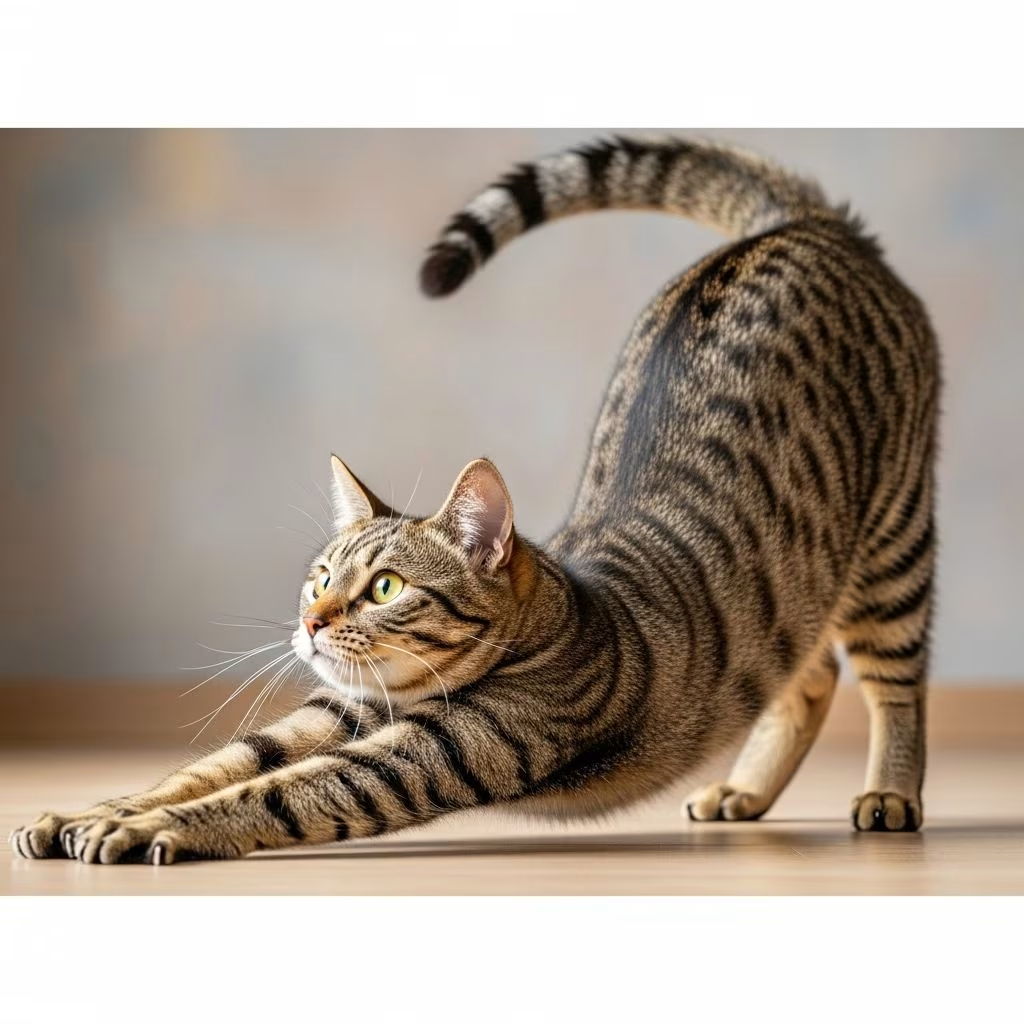
Can Cats Be Double-Jointed? Understanding Feline Flexibility
If you’ve ever watched your cat contort itself into seemingly impossible positions or squeeze through a space barely wider than its head, you might have wondered whether cats possess the ability to be double-jointed. This common misconception has persisted among pet owners for years, leading many to believe that cats have some special skeletal feature that allows them to move in ways that defy the laws of physics. However, the reality is far more fascinating than the myth. Cats are not actually double-jointed, but their extraordinary flexibility and agility stem from highly specialized anatomical features that have evolved over thousands of years to make them exceptional hunters and survivors.
The truth behind a cat’s remarkable range of motion lies in a combination of evolutionary adaptations that work together in perfect harmony. Rather than possessing double joints, cats have developed unique skeletal structures, specialized muscle systems, and incredibly flexible connective tissues that allow them to achieve movements that seem physically impossible to human observers. Understanding the science behind your feline friend’s extraordinary mobility not only helps us appreciate their natural abilities but also allows us to better care for them and recognize when something might be amiss.
The Science Behind Cat Flexibility
The foundation of a cat’s exceptional flexibility lies in its spine and skeletal structure. Cats possess approximately 53 vertebrae in their spinal column, compared to the 33 vertebrae found in humans. This significant difference in the number of vertebrae is one of the primary reasons why cats can twist, turn, and contort their bodies in ways that seem to defy the limitations of the human body. Each of these vertebrae is connected by elastic tissues and flexible discs, known as intervertebral discs, which provide exceptional cushioning and allow for remarkable movement and rotation.
The intervertebral discs in a cat’s spine are particularly noteworthy because of their highly elastic nature. These elastic cushioning discs between the vertebral bones enable cats to rotate their bodies up to 180 degrees to the left or right, a feat that humans cannot replicate, as we are only able to rotate our torso approximately 90 degrees. To understand just how impressive this is, imagine a cat achieving a position where its head and front legs face one direction while its hips and back legs face the opposite direction. This remarkable range of motion is made possible by the specialized structure of the spine and the flexibility of the connective tissues surrounding it.
Beyond the vertebrae themselves, the muscles connected to a cat’s spine play a crucial role in their overall flexibility. These muscles are attached to the spine in an exceptionally flexible manner, allowing cats to increase their stride by extending their spine during movement. This combination of flexible vertebrae, elastic discs, and adaptable muscles creates a system that enables cats to achieve their characteristic grace and agility.
Specialized Anatomical Features
Unique Skeletal Structure
Beyond the spine, cats possess several other distinctive skeletal adaptations that significantly enhance their flexibility and movement capabilities. These anatomical features have been refined through evolution to create one of nature’s most agile land animals.
- Free-floating collarbone embedded in muscle: Unlike many other mammals, cats have a collarbone that is not firmly attached to their skeleton but is instead embedded within muscle tissue. This design allows the collarbone to move more freely, contributing to the cat’s ability to squeeze through tight spaces and achieve unusual body positions.
- More vertebrae than most mammals: The abundance of vertebrae gives cats unparalleled spinal flexibility compared to most other animals, enabling them to achieve extraordinary contortions.
- Highly mobile shoulder blades: Cat shoulder blades are not rigidly connected to the rest of the skeleton like in humans. Instead, they are attached to the body primarily by muscles rather than bone, allowing cats to rotate their front limbs through an impressive range of motion.
- Specialized ball-and-socket joints: These joints provide additional ranges of motion that contribute to overall flexibility.
The Shoulder Structure Advantage
The shoulder structure deserves special attention because it is particularly remarkable. In humans, the shoulder blade is firmly attached to the rib cage through bone and cartilage, which provides stability but limits movement. In cats, however, the shoulder blade attachment is dramatically different. The minimal bony connections allow the shoulder blades to move independently of the spine, which means a cat can position its front limbs in ways that would be impossible for a human. This anatomical feature is especially useful when cats need to squeeze through confined spaces or maneuver during hunting or climbing.
Muscular System
The feline muscular system works in perfect harmony with their skeleton, featuring adaptations that are equally impressive as their skeletal structure:
- Strong, elastic muscles: Cats possess muscles that are both powerful and elastic, supporting their flexible movement patterns and enabling them to stretch extensively.
- Powerful core muscles: These muscles provide excellent balance and agility, allowing cats to maintain stability even in the most unusual positions.
- Specialized neck muscles: Cats have developed specialized muscles in their neck region that allow for precise head control, which is essential for hunting and navigation.
- Flexible spine muscles: The muscles that support the spine are designed to enable the characteristic “cat stretch” and other fluid movements that cats are known for.
Common Misconceptions About Cat Joints
The term “double-jointed” is fundamentally a misnomer when applied to cats. The concept of double joints typically refers to a medical condition in humans known as joint hypermobility, where the joints have an abnormally excessive range of motion beyond what is considered normal. When people observe a cat’s extraordinary flexibility and use the term “double-jointed,” they are usually attempting to describe something that appears abnormal or impossible from a human perspective. However, what we’re actually witnessing is a combination of evolutionary adaptations that allow cats to move in ways that are completely normal and healthy for their species.
True joint hypermobility conditions are actually rare in cats and are usually pathological when they occur. The flexibility we observe in cats is entirely normal for their species and is not a medical condition. It is simply the result of their unique anatomical design, which has been perfected over millions of years of evolution to suit their needs as predators and survivors.
These adaptations serve important survival purposes that go far beyond impressing humans with contortions. They enable cats to hunt effectively, escape predators when necessary, navigate their environment with ease, and maintain balance during falls. The flexibility that seems so extraordinary to us is simply a cat being a cat.
Joint Health and Care
While cats’ natural flexibility is healthy and normal, they can still experience joint issues as they age or due to injury. Maintaining proper joint health is important for ensuring that your cat remains active and pain-free throughout its life. Several strategies can help support your cat’s joint health:
- Regular exercise and play: Keeping your cat active through play sessions and exploration helps maintain muscle strength and joint mobility.
- Maintaining a healthy weight: Excess weight places additional stress on joints, so maintaining an appropriate weight for your cat’s size and breed is crucial.
- Proper nutrition rich in joint-supporting nutrients: Foods containing omega-3 fatty acids, glucosamine, and other joint-supporting nutrients can help maintain cartilage health.
- Regular veterinary check-ups: Routine veterinary visits allow your veterinarian to assess your cat’s mobility and identify any emerging joint problems early.
- Age-appropriate activity levels: As cats age, their activity levels may naturally decline, and adjusting play sessions and exercise to match your cat’s age and ability is important.
Signs of Joint Problems in Cats
While flexibility is normal and healthy for cats, it’s important to recognize when something might be wrong. Watch for signs such as limping, reluctance to jump, changes in gait, or decreased activity levels. If you notice any of these symptoms in your cat, consulting your veterinarian for proper evaluation is important. Additionally, if your cat’s movements appear to be in pain or if your cat is having difficulty moving, it could indicate a problem warranting a vet visit. It’s especially important to seek veterinary attention if your cat stops using one of its limbs or appears to be experiencing discomfort.
Understanding Carpal Laxity
One specific condition that relates to joint flexibility in cats is carpal laxity, which is worth understanding. Carpal laxity is a condition in which the carpus (wrist) has an abnormal or excessive range of motion. Normally, when a cat puts weight on its leg, you should be able to draw a nearly straight line vertically through the carpus. However, in a cat with carpal laxity, the wrist is lax (loose) and doesn’t stay in its normal position.
Carpal laxity can manifest in two primary ways: carpal hyperextension, where the wrist bends beyond its normal range and the cat appears flat-footed in the front legs, and carpal flexion, where the wrist bends forward when the cat puts weight on it. This condition is extremely rare in kittens. If you suspect your kitten has this condition, veterinary evaluation is necessary to determine the appropriate course of action.
Supporting Your Cat’s Joint Health and Flexibility
You can support your cat’s joint health through proper nutrition, regular exercise, weight management, and routine veterinary care. Providing opportunities for climbing, stretching, and natural movement in your home environment is also beneficial. Cats have evolved as climbers and explorers, so creating an enriched environment with vertical spaces, scratching posts, and areas for climbing helps keep them active and supports their natural range of motion.
Frequently Asked Questions (FAQs)
Q: Can cats really be double-jointed, or is their flexibility due to something else?
A: No, cats are not double-jointed. Their extraordinary flexibility comes from specialized anatomical features, including more vertebrae than humans, flexible connective tissues, and uniquely structured shoulder joints. The term “double-jointed” is a misconception; cats’ flexibility is simply normal for their species due to their unique anatomy.
Q: What anatomical features make cats more flexible than other animals?
A: Cats have approximately 53 vertebrae (compared to humans’ 33), free-floating collarbones, muscle-attached shoulder blades, specialized ball-and-socket joints, and highly elastic intervertebral discs. These features work together to create their remarkable range of motion and flexibility.
Q: Are joint hypermobility or double-jointed conditions common or healthy in cats?
A: True joint hypermobility conditions are actually rare in cats and are usually pathological when they occur. The flexibility we observe in cats is normal for their species and not a medical condition.
Q: How can I tell if my cat has a joint problem like hypermobility or injury?
A: Watch for signs such as limping, reluctance to jump, changes in gait, or decreased activity levels. If you notice any of these symptoms, consult your veterinarian for proper evaluation.
Q: What can I do to support and maintain my cat’s joint health and flexibility?
A: Maintain your cat’s joint health through proper nutrition, regular exercise, weight management, and routine veterinary care. Provide opportunities for climbing, stretching, and natural movement in your home environment.
Q: How flexible are cats supposed to be?
A: Cats are naturally very flexible due to their anatomy, which enables them to perform impressive stretching and leaping activities. Normal feline flexibility allows them to rotate their bodies up to 180 degrees and contort into various positions.
Q: Could my cat’s unusual movements indicate a health issue?
A: While flexibility is normal, if your cat appears to be in pain or is having difficulty moving, it could indicate a problem. Unusual movements accompanied by limping, reluctance to move, or other signs of discomfort warrant a veterinary visit.
Conclusion
Understanding that cats aren’t double-jointed but rather possess specialized anatomical features helps us better appreciate their remarkable abilities and evolved adaptations. Their flexibility is not a medical anomaly or abnormal condition but rather a perfectly designed system that has evolved to serve their needs as hunters, climbers, and survivors. By providing proper care and attention to their joint health through appropriate nutrition, regular exercise, weight management, and routine veterinary check-ups, we can help our feline friends maintain their natural flexibility and mobility throughout their lives. The next time you watch your cat squeeze through a tight space or twist into an impossible-seeming position, you can appreciate the remarkable engineering of their unique skeletal and muscular systems.
References
- Are Cats Double-Jointed? Understanding Feline Flexibility — PetsCare. 2025. https://www.petscare.com/news/post/can-cats-be-double-jointed
- Can my cat be double jointed, or is something wrong if it moves in unusual ways? — Dial A Vet. https://www.dialavet.com/vet-answers/cat-unusual-flexible-movements-21245
- Carpal Laxity in Kittens — VCA Animal Hospitals. https://vcahospitals.com/know-your-pet/carpal-laxity-in-kittens
- What Makes Cats So Flexible? — Catonsville Cat Clinic. https://www.catonsvillecatclinic.com/holmes-corner/makes-cats-flexible/
- Contributions of Limb Joints to Energy Absorption during Landing in Cats — National Center for Biotechnology Information. 2019. https://pmc.ncbi.nlm.nih.gov/articles/PMC6721424/



