

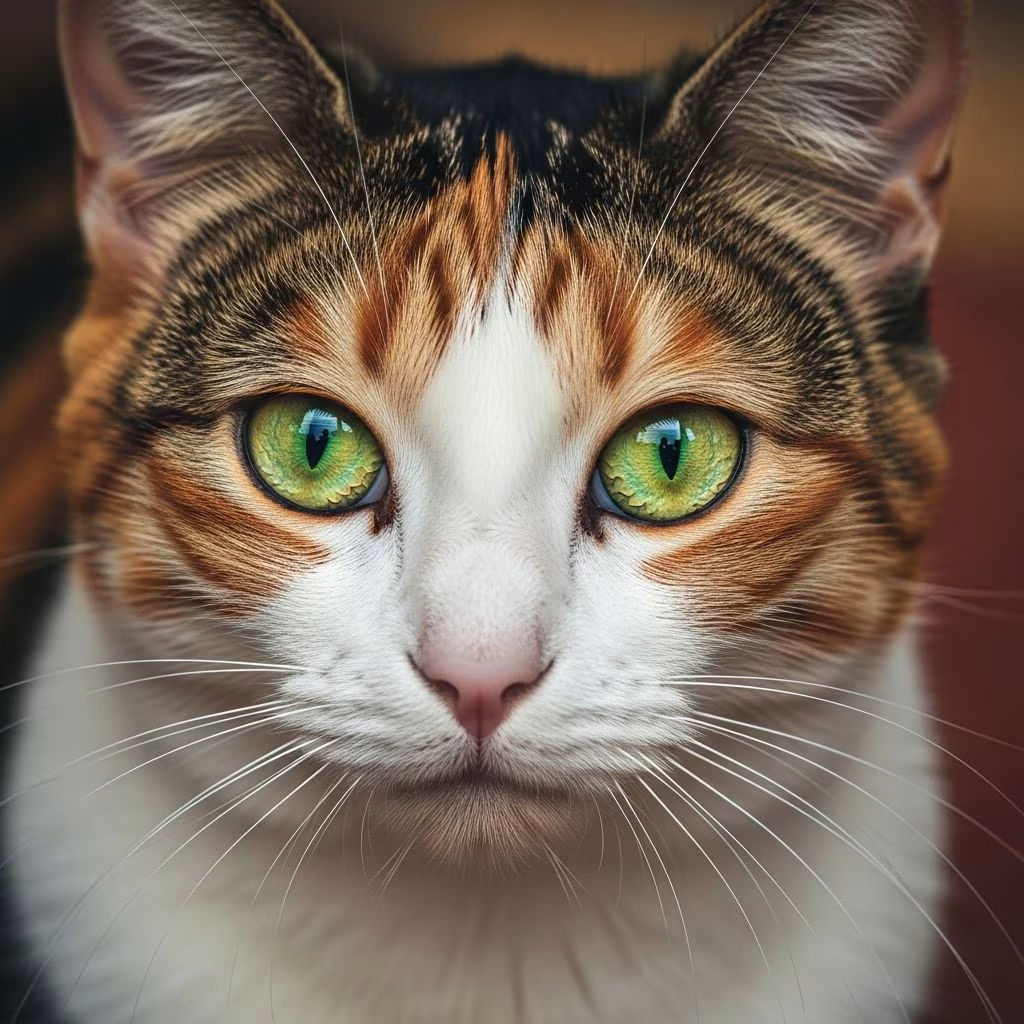
Calico cats captivate with their striking tricolor coats featuring bold patches of orange, black, and white against a mottled background. This pattern arises from a rare interplay of genetic factors, primarily X-chromosome inactivation in females, making them almost exclusively female. Their story weaves through ancient trade routes, scientific discoveries, and cultural lore, highlighting human fascination with these beautiful felines.
The Genetic Foundation of Tricolor Coats
The hallmark of calico cats is their patchwork fur, where white covers 25-75% of the body, interspersed with distinct orange and black regions. This differs from tortoiseshell cats, which lack significant white and show a brindled mix. Both patterns stem from the same genetic basis but diverge due to an additional white-spotting gene.
At the core, orange and black fur colors are alleles on the X chromosome. Females, with two X chromosomes (XX), can inherit one for orange and one for black. Early in embryonic development, one X chromosome randomly inactivates in each cell—a process called X-inactivation or Lyonization—leading to clonal patches where either color dominates. The white areas result from a separate autosomal gene (often called the piebald or spotting gene) that disrupts melanocyte migration, creating unpigmented fur.
This mosaicism exemplifies epigenetic regulation, where identical X chromosomes diverge transcriptionally and maintain that state through cell divisions. Mary Lyon proposed this hypothesis in 1961, using calico cats as a model, noting how patch discreteness reflects stable inactivation in progenitor cells.
Why Calico Cats Are Predominantly Female
Nearly 99.9% of calico cats are female because males typically have one X and one Y chromosome (XY), allowing only one color allele expression—either orange or black, but not both. White spotting can occur independently, but true tricolor requires dual X-linked colors.
| Gender | Chromosomes | Calico Possibility | Reason |
|---|---|---|---|
| Female | XX | Common | Two X chromosomes enable orange + black + white spotting |
| Male | XY | Rare (1 in 3000) | Only one X; needs XXY anomaly (Klinefelter syndrome) |
Rare male calicos arise from XXY Klinefelter syndrome, where nondisjunction during meiosis adds an extra X. These males are usually sterile due to impaired testicular development, though some fertile exceptions exist with chimerism (fusion of two embryos). Studies from the 1940s identified Barr bodies—condensed inactive X chromosomes—in female calico nerve cells, confirmed in the 1950s as coiled X chromatin.
Ancient Origins and Global Spread
Calico cats likely trace to ancient Egypt, where the orange mutation emerged around 1000 BCE. Historians like Neil Todd link them to port cities along Mediterranean trade routes: Greece, France, Spain, and Italy. Egyptian merchants carried these cats on ships as rat-catchers, protecting grain stores from pests during voyages.
Genetic evidence supports this: the orange gene (O locus) frequency peaks in these regions, decreasing northward. From Egypt, calicos dispersed worldwide via colonial trade, appearing in Europe by the Middle Ages. No single pinpoint origin exists, but North African domestication aligns with feline archaeology.
- Egypt (Primary Origin): Orange mutation site; cats as shipboard pest control.
- Mediterranean Ports: Spread to Europe via trade ships.
- Global Dissemination: Colonial era introductions to Americas and Asia.
Cultural Symbolism and Folklore Worldwide
Beyond genetics, calicos hold deep cultural resonance. In Japanese folklore, the mi-ke (three-furred) cat, like Maneki-neko, beckons fortune and wards off evil. Beckoning calico figurines adorn businesses for prosperity.
In the US, they symbolize good luck; early settlers viewed them as harbingers of fortune. Celtic lore from Ireland and Scotland casts calicos as fairy cats with magical powers. Islamic traditions in the Middle East honor them for Prophet Muhammad’s fondness for cats, regardless of color.
Conversely, some European superstitions deemed male calicos witches’ familiars due to rarity. Today, calicos feature in art, memes, and as beloved pets, their charm transcending borders.
Scientific Milestones: From Barr Bodies to Cloning
Calicos propelled genetics research. 1940s studies by Murray Barr revealed “drumstick” structures in female nerve cells—Barr bodies—absent in males, hinting at sex chromatin differences.
1950s Japanese work decoded these as inactive X chromosomes. By the 1960s, Lyon formalized X-inactivation, explaining calico patches as clonal expansions post-inactivation (around 100-cell embryo stage).
In 2001, a Texas A&M team cloned Rainbow, a calico, producing CC (CopyCat)—genetically identical but tabby-striped, not calico. This demonstrated X-inactivation’s randomness: clones inherit DNA but not epigenetic patterns, as inactivation recurs independently in embryos.
Calico Cats Across Breeds and Variations
Calico is a color pattern, not a breed, appearing in American Shorthair, British Shorthair, Maine Coon, Persian, and Japanese Bobtail. Breed standards (e.g., CFA, TICA) recognize calico divisions requiring >25% white with balanced orange/black patches.
Variations include:
- Dilute Calico: Softer blue/cream instead of black/orange.
- Calimanco: Dense, separated patches.
- Brindle Calico: Tortoiseshell-like intermixing with white.
No breed exclusivity; domestic shorthairs dominate shelters (70% female calicos).
Care Essentials for Calico Cats
Despite genetic quirks, calicos share domestic cat needs: high-protein diet (chicken/fish-based), dental care (weekly brushing), and play for mental stimulation. Females face higher mammary cancer risk if unspayed; spay by 6 months prevents 90% cases.
Male calicos need vet screening for Klinefelter issues (heart/kidney anomalies). Average lifespan: 12-15 years, matching peers. Grooming suits long/short coats; weekly brushing curbs hairballs.
| Health Concern | Prevalence in Calicos | Prevention |
|---|---|---|
| Mammary Cancer (Females) | Higher if intact | Early spay |
| Klinefelter Syndrome (Males) | 100% of male calicos | Genetic testing |
| Obesity | Common | Portion control |
Calico Personality: Fact or Fiction?
Anecdotes paint calicos as spirited, vocal, and dog-like—greeting owners, demanding attention. No peer-reviewed studies confirm color-personality links; behavior ties more to early socialization. Shelters report calicos as friendly adoptees, with females’ confidence shining.
FAQs About Calico Cats
Can male calico cats reproduce?
Most cannot due to XXY sterility, but chimeric males (XY/XY fusion) may sire kittens. Incidence: 1 in 3000 births.
Are calico cats hypoallergenic?
No; allergen is salivary Fel d1 protein, unrelated to coat. Sphynx or Devons offer low-shed options.
What breeds commonly have calico patterns?
American Shorthair, Persian, Maine Coon, Exotic Shorthair, and mixed breeds.
Why isn’t my calico clone identical in color?
X-inactivation randomizes per embryo; epigenetics prevent perfect replication.
Do calicos have special luck-bringing powers?
Cultural belief, not science—Japanese Maneki-neko embodies this myth.
References
- History of Calico Cats – Taking a Look at Their Past — Catster. 2023. https://www.catster.com/lifestyle/calico-cat-history/
- Calico Cat Facts to Know — Cat Town Oakland. 2021-04-01. https://www.cattownoakland.org/cat-town-blog/2021/04/calico-cat-facts-to-know
- Calico Cat – X-inactivation — University of Michigan Kalantry Lab (.edu). Accessed 2026. https://kalantry.lab.medicine.umich.edu/research/calico-cat
- Calico Cat: Types, Breeds, and Personality Traits — Litter-Robot. 2023. https://www.litter-robot.com/blog/7-calico-cat-facts/
- Calico Cat Facts — ASPCA Pet Insurance. 2023. https://www.aspcapetinsurance.com/resources/calico-cat-facts/



