

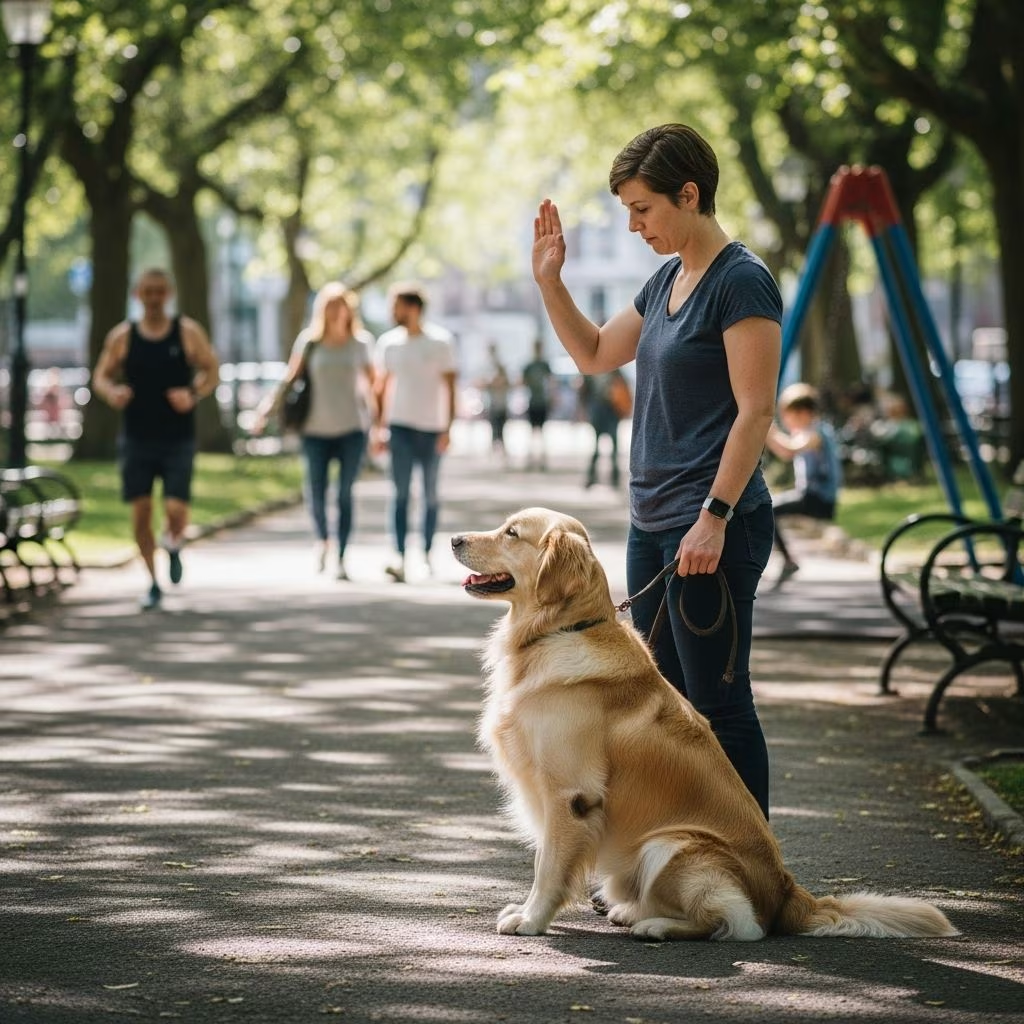
Many dog owners successfully teach their pets basic commands in controlled environments, only to discover that these same commands fail when applied in unpredictable situations. Your dog may sit perfectly in your living room but ignore the command at a busy park. This common frustration stems from a fundamental principle of animal learning: behaviors learned in specific contexts don’t automatically transfer to new environments. Understanding why this happens and how to bridge this gap is essential for developing truly reliable obedience.
Understanding Context-Specific Learning in Dogs
Dogs learn through association and repetition, but their understanding is deeply tied to environmental factors. When you teach a command in your kitchen with minimal distractions, your dog learns not just the command itself but also the entire context surrounding that learning experience. The familiar kitchen becomes part of the behavioral equation. When you move to a new location with different sights, sounds, and smells, your dog may not recognize that the same rules apply.
This context-specific learning reflects how canine brains process information. Dogs are remarkably perceptive to environmental cues and use these cues as part of their decision-making process. At home, your dog learns that responding to “sit” in the kitchen results in positive outcomes. At the park, the same command exists in a completely different sensory landscape, and your dog must essentially relearn the connection between the command and the desired response.
The Foundation: Mastering the Three Fundamental Variables
Professional trainers have developed a systematic framework called the “Three Ds” to address the challenge of building reliable obedience. These three variables—duration, distance, and distraction—form the foundation of effective training progression.
Duration: Extending Command Hold Time
Duration refers to how long your dog maintains a behavior once commanded. Initially, a dog may hold a “stay” for only a few seconds. Building duration means gradually extending this time until your dog can maintain the behavior for several minutes. This progression requires patience and consistent practice. Start by asking for very brief holds and incrementally increase the time, always rewarding successful extensions.
Distance: Creating Space Between Handler and Dog
Distance involves increasing the physical space between you and your dog while maintaining command reliability. Many dogs respond well when their handler is directly beside them but struggle when the handler moves away. Proofing distance means teaching your dog to obey commands even when you’re not immediately adjacent. Begin with minimal distance and gradually increase the separation as your dog demonstrates consistent reliability.
Distraction: Introducing Environmental Challenges
Distraction encompasses all external stimuli that might compete with your dog’s focus on you. This includes other dogs, moving objects, loud noises, interesting smells, and human activity. Training with distractions teaches your dog to maintain focus and obedience regardless of environmental chaos. The key is introducing distractions gradually rather than overwhelming your dog with too much stimulation too quickly.
Progressive Training: Building Reliability Layer by Layer
Effective obedience development follows a progressive structure. Rather than combining all three variables simultaneously, successful trainers work with one element at a time. This layered approach prevents confusion and builds your dog’s confidence incrementally.
Stage One: Foundation Building in Controlled Settings
Begin all training in quiet, familiar environments with minimal distractions. Your home or a private yard provides ideal starting conditions. Focus on clear communication and consistent reward timing. Your dog should achieve reliable responses to commands before progressing to more challenging environments. Use high-value rewards—treats your dog finds particularly motivating—to strengthen the association between command and compliance.
Stage Two: Introducing Minimal Distractions
Once your dog reliably responds in controlled settings, gradually introduce low-level distractions. This might mean training in your yard with a family member present or practicing in a quieter area of your neighborhood. Keep these sessions brief and maintain high reward value. Your dog should experience success more often than not during this phase.
Stage Three: Transitioning to Real-World Environments
Progress to busier locations only after your dog demonstrates solid reliability in moderately distracting environments. Empty parking lots, quiet park edges, and calm walking trails serve as excellent intermediate training venues. These locations provide environmental variety without overwhelming stimulation. Your dog learns that commands apply across different contexts while still experiencing manageable levels of distraction.
Stage Four: Advanced Environmental Challenges
The final stage involves training in genuinely challenging environments—busy parks, pet-friendly stores, crowded sidewalks, and events with multiple dogs and people. At this point, your dog should demonstrate strong foundational reliability that withstands significant environmental pressure.
Incorporating Obedience Into Daily Life
One of the most effective training strategies involves integrating obedience practice into everyday routines. Rather than conducting separate training sessions isolated from normal life, weave commands into daily activities. Ask your dog to sit before meals, wait at doorways, or maintain a stay while you prepare their food. These real-life applications strengthen neural pathways and help your dog generalize commands across various situations.
Daily integration offers several advantages. First, it provides frequent reinforcement without requiring dedicated training time. Second, your dog learns that obedience applies to everyday circumstances rather than only during formal training sessions. Third, real-world practice exposes your dog to the distractions they’ll encounter in actual life, gradually building resilience and focus.
The Critical Role of Owner Consistency
No training technique succeeds without owner consistency. This principle represents perhaps the most important factor in developing reliable obedience. Consistency means enforcing commands every single time you issue them and maintaining the same expectations regardless of circumstance or your emotional state.
When you issue a command inconsistently—sometimes enforcing it, sometimes not—your dog learns that compliance is optional. They come to view commands as suggestions rather than requirements. This inconsistency fundamentally undermines reliability and creates confusion about behavioral expectations.
True consistency requires a lifelong commitment. Training isn’t a finite process with a completion point; rather, it’s an ongoing aspect of responsible dog ownership. You remain “always training” your dog through the choices you make and the behaviors you reward or permit. If you allow your dog to jump on guests occasionally but reprimand jumping at other times, you’re delivering inconsistent messages about the acceptability of this behavior.
Strategic Use of Rewards and Motivation
High-value rewards play a crucial role in building reliable obedience, particularly when training in challenging environments. What constitutes a high-value reward varies by individual dog but typically includes special treats reserved only for training, favorite toys, or enthusiastic praise. When your dog competes with significant environmental stimulation, generic rewards often prove insufficient to maintain focus and motivation.
The reward system should evolve as your dog demonstrates increasing reliability. In early stages, frequent high-value rewards reinforce the desired behavior. As reliability improves, you can gradually reduce reward frequency while maintaining consistency. However, reliable dogs still deserve periodic rewards to maintain motivation and reinforce that obedience pays off.
Managing Equipment: Leashes and Long Lines
Appropriate equipment supports reliable obedience training and ensures safety. During early stages, keeping your dog leashed allows you to enforce commands and prevent mistakes. As reliability improves and you progress to more distracting environments, long-line leashes (15 to 20 feet) provide freedom for exploration while maintaining your ability to guide behavior and prevent dangerous situations.
Never allow your dog off-leash in public areas until you’ve thoroughly proofed reliability across multiple high-distraction environments. Even then, respect local leash laws and maintain awareness that no dog possesses perfect reliability under all circumstances. Responsible ownership means taking additional safety precautions rather than trusting exclusively in training.
Building Confidence Through Controlled Exposure
Dogs build obedience confidence through successful experiences in progressively challenging situations. When your dog frequently experiences success—commands reliably obeyed, rewards consistently received—they develop confidence in their ability to navigate different environments while maintaining focus on you.
Conversely, overwhelming your dog with excessive distractions too quickly can damage confidence and create learned helplessness. Your dog may become uncertain about what behaviors you expect and may stop trying to comply. This damage requires significant time and effort to reverse, making prevention through gradual progression far preferable.
Advanced Techniques for Enhanced Reliability
Once your dog demonstrates solid foundational obedience, several advanced techniques can further enhance reliability. Clicker training uses a specific auditory marker to precisely identify the exact moment your dog performs the desired behavior, followed immediately by reward. This clarity helps dogs understand exactly which action produced the reward.
Distance commands represent another advanced focus area. Begin with strong reliability at close range, then gradually increase distance using long leads while maintaining clear marker words or clicker signals. This progression teaches your dog that distance doesn’t reduce the expectation of obedience.
Practicing in varied environments strengthens generalization—your dog learns that commands apply across different contexts rather than only where they were initially trained. Each new environment requires some adjustment, but previous training experience accelerates the learning process.
Common Pitfalls to Avoid
Several mistakes can undermine obedience development:
- Progressing too quickly through difficulty levels before achieving reliability at current stages
- Combining multiple variables simultaneously rather than working with one element at a time
- Using inconsistent commands or cues, which confuses dogs about what behavior you expect
- Failing to enforce commands, inadvertently teaching that compliance is optional
- Relying exclusively on generic rewards rather than high-value motivators in challenging environments
- Punishing your dog for mistakes rather than redirecting to correct behavior
- Abandoning training consistency during the dog’s lifetime
Measuring Progress and Adjusting Approach
Track your dog’s performance across different environments and distraction levels. Reliable obedience means consistent compliance regardless of circumstances, not occasional success. If your dog demonstrates reliability at 80% or below in any environment, invest additional practice before progressing to more challenging scenarios.
Be prepared to adjust your training approach based on your dog’s individual needs. Some dogs respond strongly to food rewards while others prioritize play or praise. Some learn quickly with rapid progression; others require more time at each stage. Observing your dog’s behavior patterns helps you customize the training approach for maximum effectiveness.
The Long-Term Commitment
Building truly reliable obedience represents an ongoing investment rather than a finite project. Dogs naturally test boundaries and may experience regression if training emphasis diminishes. Maintaining reliability requires continued practice, consistent reinforcement, and regular real-world application of commands throughout your dog’s lifetime.
The effort invested in building reliable obedience yields substantial dividends. A dog that reliably responds to commands enjoys greater freedom and more opportunities for enriching experiences. You can venture into new environments with confidence, manage emergency situations more effectively, and strengthen your relationship through effective communication. Most importantly, obedience directly contributes to your dog’s safety and the safety of other animals and people in your community.
References
- Proofing Dog Training for Real-World Reliability — Precision Dog Training. 2023. https://precisiondogtrainer.com/proofing-dog-training-for-real-world-reliability-precision-dog-training/
- How to Train a Reliable Recall for Your Dog — American Kennel Club. https://www.akc.org/expert-advice/training/reliable-recall-train-dogs-to-come-when-called/
- Reliable Dog Training — Perfect Manners Dog Training. https://perfectdogtraining.com/articles/dog-training/dog-training-reliability/
- Advanced Training Techniques for Experienced Dogs — Gingr. https://www.gingrapp.com/blog/advanced-training-techniques-for-experienced-dogs



