
Budgie (Parakeet) Personality, Food & Care
Complete guide to budgie care, personality, and dietary needs for pet owners.
Understanding Budgies: The Perfect Small Pet Bird
The budgie, or budgerigar, is often mistakenly considered a “beginner bird” that requires minimal care and attention. However, this social and outgoing little bird deserves just as much consideration and care as larger parrot species. Budgies are playful creatures with remarkable personalities, an impressive love for food, and talking abilities that can rival many larger parrots. Whether you’re considering adopting your first budgie or adding to your existing flock, understanding these delightful birds is essential for providing them with optimal care and creating a fulfilling companionship.
What Is a Budgie (Parakeet)?
The budgie, scientifically known as Melopsittacus undulatus, is most commonly referred to by the generic term “parakeet” in the United States. The name “budgerigar” is derived from the Aboriginal Australian word meaning “good eating,” though today these birds are valued as beloved companions rather than food sources. The Latin name of the species roughly translates to “song bird with wavy lines,” which beautifully describes the distinctive appearance of these popular birds.
Wild budgies are notably similar to the birds commonly seen in pet shops today, though they tend to be smaller, measuring between 6 and 7 inches in length compared to their captive-bred counterparts. In their natural state, wild budgies are found exclusively in the nominate color pattern of green, with characteristic yellow markings and black scalloped patterns.
Native Region and Natural Habitat
The budgie is native to Australia, where it continues to dominate the grasslands in large, undulating flocks that move dynamically across the landscape. These nomadic birds are found in open habitats, primarily in scrublands, open woodlands, and grasslands throughout the Australian continent. The nomadic wild parakeet travels in large flocks that are constantly searching for water, a resource that is limited in the scrublands that comprise much of the budgie’s natural range.
Budgies breed during the rainy season when water and food are plentiful. During this period, they nest in hollowed-out trees or tree limbs, creating safe spaces for their young to develop. In their native habitat, these birds can sometimes be considered pesky to farmers and are particularly dangerous to grain crops, as their flocks can consume significant quantities of seeds and grains.
Behavioral Patterns in the Wild
In their natural environment, budgerigars display fascinating daily behavioral patterns. Their activity typically begins just before sunrise with preening, singing, and movement within trees. After sunrise, the birds fly to foraging areas and feed throughout the day. During the hottest parts of the day, they seek shade and remain relatively motionless to conserve energy. As evening approaches, they gather in groups with loud calling and fast flying around trees before returning to their roosting sites shortly after sunset.
Physical Characteristics and Appearance
The average wild budgerigar measures 18 centimeters (7 inches) long, weighs 30 to 40 grams (1.1 to 1.4 ounces), and has a wingspan of 30 centimeters (12 inches). Due to their diminutive stature, pointed wings and tails, distinctive plumage patterns, they are unlikely to be mistaken for any other parrot species.
Coloration and Plumage
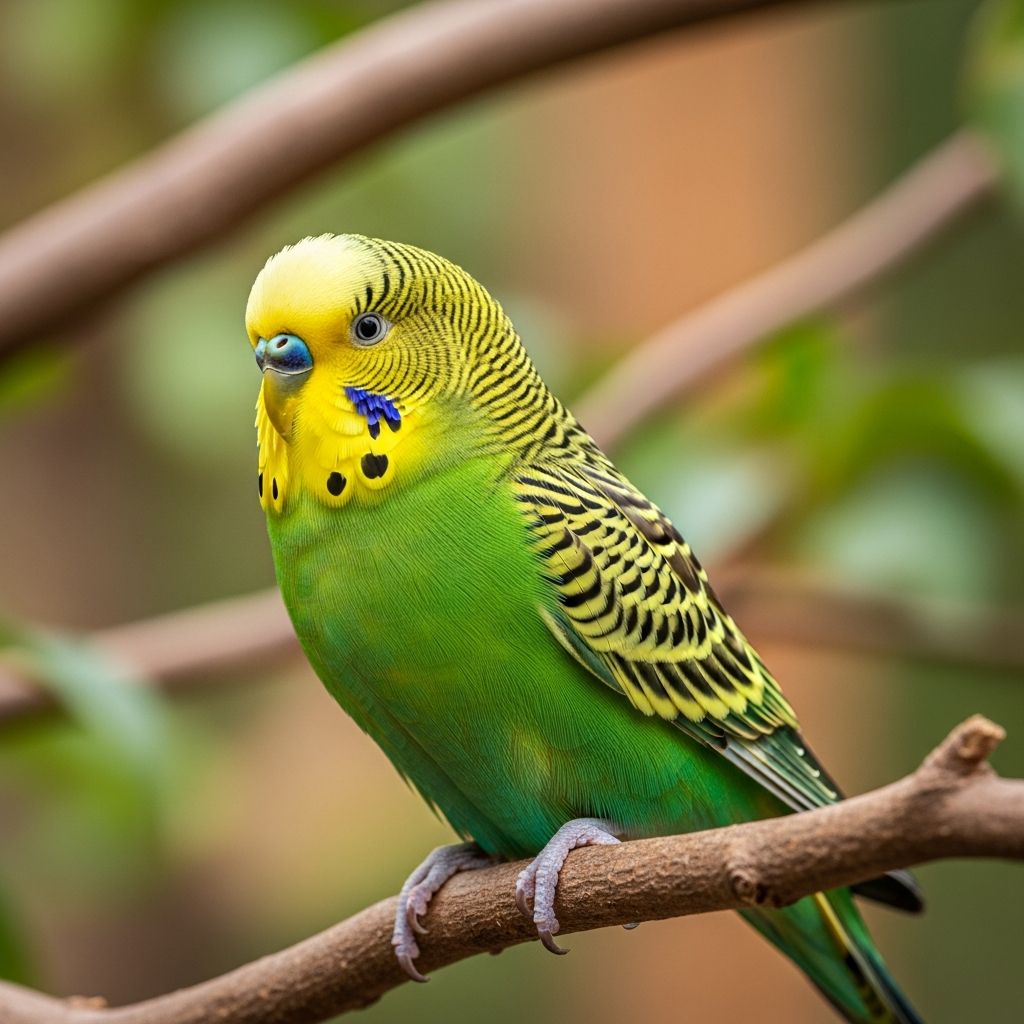
In their natural state, wild budgerigars display a light green body color, with their mantles (back and wing coverts) featuring pitch-black mantle markings edged in clear yellow undulations. Their abdomen and rumps are light green, creating a subtle color gradient across the body. In adults, the face and forehead are bright yellow. Young birds display blackish stripes that extend down to their cere (the area around the nostrils), which they retain until approximately three to four months of age.
The tail is cobalt blue, and the outside tail feathers display central yellow flashes visible when the bird is in flight. The wings feature greenish-black flight feathers and black coverts with yellow fringes, along with central yellow flashes that only become visible when the wings are spread out or during flight. Bills are olive grey, and legs are blueish-grey with specialized zygodactyl toes designed for gripping.
Distinctive Markings
Budgies possess three black spots across either side of their throats, known as throat patches, and small iridescent blue-violet cheek patches. These throat spots and cheek patches reflect ultraviolet light and can be used to distinguish individual birds. The cheek patches and neck spots are the main anatomical characteristics that distinguish budgies from other bird species, and all wild budgies naturally possess them.
In captivity, budgies have been bred in many other colors and shades, including blue, grey, grey-green, pieds, violet, white, and yellow-blue combinations. Pet store budgies commonly display blue, green, or yellow coloration. Like most parrot species, budgerigar plumage fluoresces under ultraviolet light, a phenomenon possibly related to courtship and mate selection.
Personality and Behavioral Traits
The budgie is often underestimated as a hands-on pet, though it is certainly valuable as a “watching only” pet, especially if kept in pairs or in a colony. These birds are easily hand-tamed and can become loyal, loving little friends to patient owners who invest time in their socialization and care.
Budgies are inherently social birds and won’t thrive in a life of isolation. They require regular interaction and mental stimulation to maintain their psychological well-being. When budgies are housed together, they remain friendly if given enough contact and attention from their caregivers. However, a lone parakeet is often the best choice if you desire a “pet-quality” bird that will bond closely with its human companion.
Social Structure and Compatibility
These birds form complex social bonds both with other budgies and with their human caretakers. In flocks, budgerigars feed one another by eating seeds and regurgitating them into their flockmate’s mouth, demonstrating their strong social and nurturing behaviors. This feeding behavior can also occur between bonded pet budgies and their owners.
Gender Identification
Budgies are sexually dimorphic, making it easy to determine the difference between genders at about six to eight months of age when they reach maturity. The adult male’s cere (the fleshy area above the beak) is generally blue, while the hen’s cere is pink or brown. Young birds cannot be reliably sexed using this method—an educated guess is your only chance of accurately buying a young pair without waiting for maturation.
Communication and Vocalization Abilities
Despite their small size, budgies possess impressive communication and talking abilities that can rival larger parrot species. These intelligent birds are capable of learning to mimic human speech and can develop extensive vocabularies when properly trained. Their natural vocalizations include chirping, singing, and the characteristic loud calling that occurs during their social gatherings in the wild.
Budgies use vocalizations not only to communicate with their flock but also to bond with their human companions. Many pet budgies learn their owner’s name and will call out greetings when their person enters the room. Their talking ability is a major factor in their popularity as pet birds.
Housing and Environmental Needs
Providing an appropriate living environment is crucial for maintaining your budgie’s health and happiness. The housing requirements for budgies differ somewhat depending on whether you’re keeping a single bird or multiple birds in a colony.
Cage Requirements
A single budgie requires a cage that provides adequate space for flight and exercise. The minimum recommended cage size should allow the bird to spread its wings fully without touching the sides. For multiple birds, the cage must be proportionally larger to prevent territorial disputes and stress. The cage should include multiple perches of varying diameters to promote foot health and exercise.
Proper ventilation and lighting are essential components of a budgie’s environment. Ultraviolet light exposure is particularly important for caged and pet birds, as it supports their physiological processes and overall health. However, inadequate darkness or rest can result in overstimulation and behavioral problems.
Diet and Nutritional Requirements
Budgies are seed-eating birds in their natural habitat, but captive budgies require a balanced diet that extends beyond seeds alone. A proper diet should include high-quality pellets, fresh vegetables, fruits, and seeds in appropriate proportions to ensure complete nutrition.
Primary Food Sources
High-quality commercial pellets should form the foundation of your budgie’s diet, providing essential vitamins and minerals in concentrated form. Seeds should be offered as supplements rather than the primary food source, as seeds alone can lead to nutritional deficiencies. Fresh vegetables such as leafy greens, carrots, and broccoli should be offered daily, along with occasional fruits in moderation.
Foods to Avoid
Certain foods are toxic to budgies and should be strictly avoided. Avocado, chocolate, salt, caffeine, and foods containing high amounts of sugar or fat can be harmful or fatal to these small birds. Always research any new food before offering it to your budgie.
Health Considerations and Veterinary Care
Regular veterinary check-ups with an avian veterinarian are essential for maintaining your budgie’s health. These professionals can identify health issues early and provide appropriate treatment. Common health concerns in budgies include respiratory infections, feather plucking, obesity, and reproductive issues in females.
Signs of good health in budgies include bright, alert eyes, smooth plumage, regular eating and drinking habits, and active behavior. Any changes in behavior, appetite, or appearance should prompt a visit to an avian veterinarian.
Frequently Asked Questions
Q: How long do budgies live?
A: With proper care, budgies typically live 8 to 12 years in captivity, with some living even longer. Good nutrition, veterinary care, and appropriate environmental conditions all contribute to longevity.
Q: Can budgies be kept alone, or do they need companions?
A: Budgies are social birds that can thrive with human interaction and companionship. While they can be kept alone and may bond more closely with their owner, pair-housed budgies need sufficient contact to remain friendly. A lone parakeet is often the best choice for someone seeking a pet-quality bird.
Q: How can I teach my budgie to talk?
A: Budgies are intelligent and capable learners. Begin training in a quiet environment, repeat words or phrases consistently, reward your budgie for vocalizations, and maintain patience. Young birds typically learn more readily than older birds.
Q: What is the difference between a budgie and other parakeets?
A: Budgies are a specific species of parakeet. While all budgies are parakeets, not all parakeets are budgies. Budgies are generally smaller and more commonly kept as pets than other parakeet species.
Q: How often should I take my budgie to the veterinarian?
A: Annual check-ups with an avian veterinarian are recommended for healthy budgies. Birds showing signs of illness or those over five years old should be examined twice yearly to catch potential health issues early.
Q: What’s the best way to socialize a young budgie?
A: Begin socialization early with regular, gentle handling. Spend time talking to your budgie, offer treats from your hand, and gradually introduce the bird to different environments and sounds. Consistent, patient interaction builds trust and creates a strong bond.
References
- Budgie (Parakeet) Personality, Food & Care – Pet Birds by Lafeber Co. — Lafeber Company. Accessed November 2025. https://lafeber.com/pet-birds/species/budgie-parakeet/
- Budgie Worksheets & Facts | Features, Behavior, Diet, As Pets — Kids Konnect. Accessed November 2025. https://kidskonnect.com/animals/budgie/
- Budgerigar — Wikipedia. Accessed November 2025. https://en.wikipedia.org/wiki/Budgerigar
- What to Know About the Budgerigar — WebMD Pets. Accessed November 2025. https://www.webmd.com/pets/what-to-know-about-the-budgerigar
- 8 Budgerigar Facts: What to Know About the Budgerigar — PetMD. Accessed November 2025. https://www.petmd.com/bird/care/budgerigar-facts-what-to-know-about-budgerigar
Similar Articles








Read full bio of medha deb


