

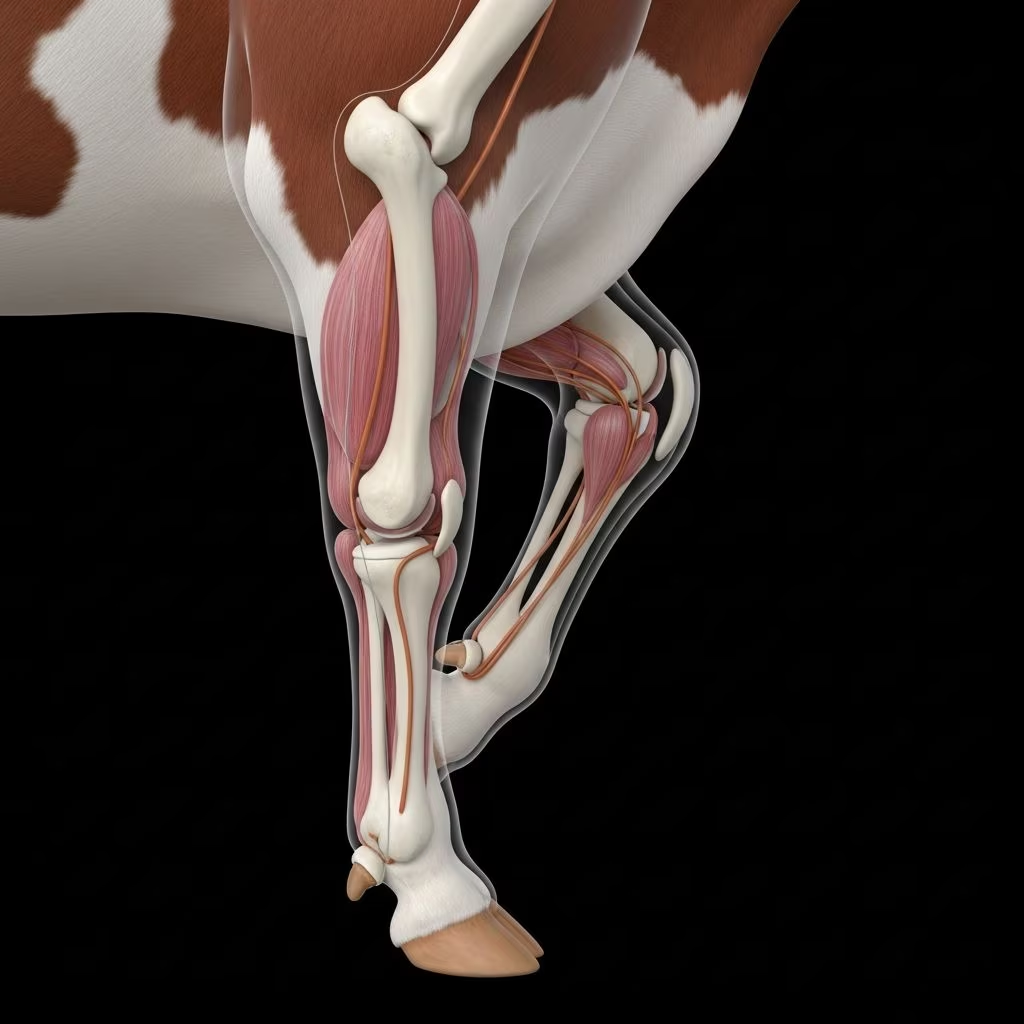
The distal limb of cattle plays a critical role in weight-bearing and locomotion, making its anatomy essential for diagnosing and treating common issues like lameness. This region, from the cannon bone downward, features specialized bones, joints, tendons, and hoof structures adapted for the cow’s cloven foot and heavy body weight.
Overview of the Lower Leg Structure
Cattle possess a unique distal limb configuration suited to their ruminant physiology. The fore and hind limbs share similarities but differ in tendon insertions and muscle attachments. The fused metacarpals and metatarsals form the robust cannon bone, supporting the dual digits that contact the ground. This setup allows for efficient movement across varied terrains while distributing the animal’s substantial mass.
Key adaptations include the interlocking sagittal ridge and groove at the fetlock, enabling over 200 degrees of flexion while preventing lateral slippage. Understanding these features aids in identifying pathologies such as fractures or infections that compromise mobility.
Bones of the Distal Extremity
The skeletal framework begins with the cannon bone, a fusion of the third and fourth metacarpals (Mc3 and Mc4) in the forelimb or metatarsals (Mt3 and Mt4) in the hindlimb. This composite bone provides stability and shock absorption.
- Cannon Bone (Mc3/Mc4 or Mt3/Mt4): Fully developed and fused, it ends distally in two condyles separated by an intertrochlear notch. A prominent sagittal ridge on each condyle articulates with the proximal phalanx, ensuring precise alignment.
- Proximal Phalanx (P1): Known as the long pastern bone, it features a complementary sagittal groove that interlocks with the cannon bone, restricting sideways motion while permitting extensive rotation.
- Middle Phalanx (P2): The short pastern bone articulates proximally with P1 and distally with P3. Its dorsal surface connects to P2, with minor contact to the coffin bone.
- Distal Phalanx (P3): Called the pedal or coffin bone, it is encased by the hoof capsule. A prominent extensor process receives the common digital extensor tendon in forelimbs or long digital extensor in hindlimbs.
Sesamoid bones enhance joint efficiency. Four proximal sesamoids (two axial and two abaxial per limb) lie palmarly at the fetlock, doubling the equine count due to the cloven structure. Two distal sesamoids, or navicular bones, support the deep digital flexor tendon at the coffin joint.
| Bone | Bovine Feature | Equine Counterpart |
|---|---|---|
| Proximal Phalanx (P1) | Two per limb, sagittal groove | Single, similar groove |
| Middle Phalanx (P2) | Two, short pastern | Single |
| Distal Phalanx (P3) | Two pedal bones, extensor process | Single coffin bone |
| Sesamoids | 4 proximal, 2 distal per limb | 2 proximal, 1 distal |
Sesamoid Bones and Their Functions
Proximal sesamoids flank the fetlock joint’s palmar aspect, embedded in the suspensory ligament (interosseous tendon). A dorsal groove on these bones interdigitates with the cannon bone’s sagittal ridge, augmenting stability. Distally, the navicular bone facilitates smooth gliding of the deep digital flexor tendon via the navicular bursa.
These sesamoids act as pulleys for flexor tendons, optimizing force transmission during stance and swing phases. In cattle, their duplication per digit underscores the need for bilateral support in weight distribution.
Joints and Articulations
The distal limb hosts three main joints per digit:
- Fetlock (Metacarpo/Metatarso-Phalangeal Joint): Between cannon bone and P1. Its extensive articular surface (>200 degrees) allows wide flexion, critical for grazing postures.
- Pastern (Proximal Interphalangeal Joint): P1-P2 articulation, providing flexibility.
- Coffin (Distal Interphalangeal Joint): P2-P3, with collateral ligaments attaching to parietal surface facets on P3.
A distal sesamoidean impar ligament binds P3 to the navicular bone, ensuring coordinated movement. These joints’ design minimizes shear forces but predisposes to issues like sole ulcers if overloaded.
Tendons and Ligaments
Flexor and extensor units drive digit motion. The deep digital flexor tendon, sheathed caudal to the fetlock, glides over the navicular bursa before inserting on P3’s solar surface. Its proximity to the skin heightens infection risk from foot rot.
The suspensory ligament branches distally into four parts, supporting the fetlock. Collateral cartilages on P3’s heels, occasionally ossifying into sidebones, aid cushioning.
Hoof Capsule and Internal Features
The hoof comprises perioplic horn, wall, sole, and white line. The wall is hardest anteriorly, softening caudally. Axial walls are thinner and flatter than abaxial ones, with higher coronets abaxially.
- Digital Cushion: Absorbs shock beneath the heel bulb.
- Collateral Cartilages: Flexible structures at P3 wings, prone to sidebone formation.
- White Line: Junction of wall and sole, vulnerable to abscesses.
Hoof growth varies, faster on abaxial walls, influencing trimming practices.
Vascular and Neural Supply
Longitudinal grooves on the cannon bone house dorsal and palmar metacarpal vessels, connected via proximal and distal canals. This network nourishes the distal structures, with clinical relevance in diagnosing vascular compromises.
Nerves follow similar paths, innervating skin and joints for sensory feedback during ambulation.
Clinical Relevance in Lameness Prevention
Knowledge of this anatomy informs interventions. Fetlock fractures often involve the sagittal ridge, while deep flexor tendon infections ascend from interdigital spaces. Routine hoof trimming targets sole and heel regions, preserving the digital cushion’s role.
Conditions like foot rot exploit the tendon’s superficial course, emphasizing hygiene in housed cattle.
Common Pathologies and Anatomical Links
| Condition | Anatomical Site | Common Cause |
|---|---|---|
| Sole Ulcer | P3 solar surface | |
| Sidebones | Collateral cartilages | Chronic inflammation |
| White Line Disease | Hoof wall-sole junction | Overgrowth, trauma |
| Fetlock Fracture | Cannon condyle/sagittal ridge | Slipping |
FAQs
What is the cannon bone in cows?
The cannon bone is the fused Mc3/Mc4 (fore) or Mt3/Mt4 (hind), forming the main weight-bearing shaft distal to the carpus or tarsus.
How many sesamoid bones does a bovine limb have?
Four proximal and two distal sesamoids per limb, supporting the dual digits.
Why is the sagittal ridge important?
It interlocks with P1’s groove, preventing lateral deviation and allowing >200° flexion.
What protects the deep digital flexor tendon?
The navicular bursa and impar ligament facilitate smooth passage over the navicular bone to P3.
How does hoof asymmetry affect cattle?
Abaxial walls are thicker with higher coronets, influencing growth rates and trimming needs.
References
- Distal Limb – CVM Large Animal Anatomy — University of Minnesota. Accessed 2026. https://pressbooks.umn.edu/largeanimalanatomy/chapter/distal-limb/
- The Forelimb – Veterian Key — Veterian Key. Accessed 2026. https://veteriankey.com/the-forelimb-2/
- Bovine Foot Anatomy – Large Animal Surgery — University of Minnesota. Accessed 2026. https://open.lib.umn.edu/largeanimalsurgery/chapter/bovine-foot-conditions/
- Lameness Wetlab: Hoof Anatomy and Basic Hoof Trimming — AABP/TAMU. 2026. https://bovine-ojs-tamu.tdl.org/AABP/article/view/4107/4031
- Anatomy of the distal limb — PubMed/Université de Montréal. 2001-05-01. https://pubmed.ncbi.nlm.nih.gov/11320697/



