
Bone Cysts in Horse Hooves: Causes and Treatment
Understanding osseous cyst-like lesions affecting equine pedal bones
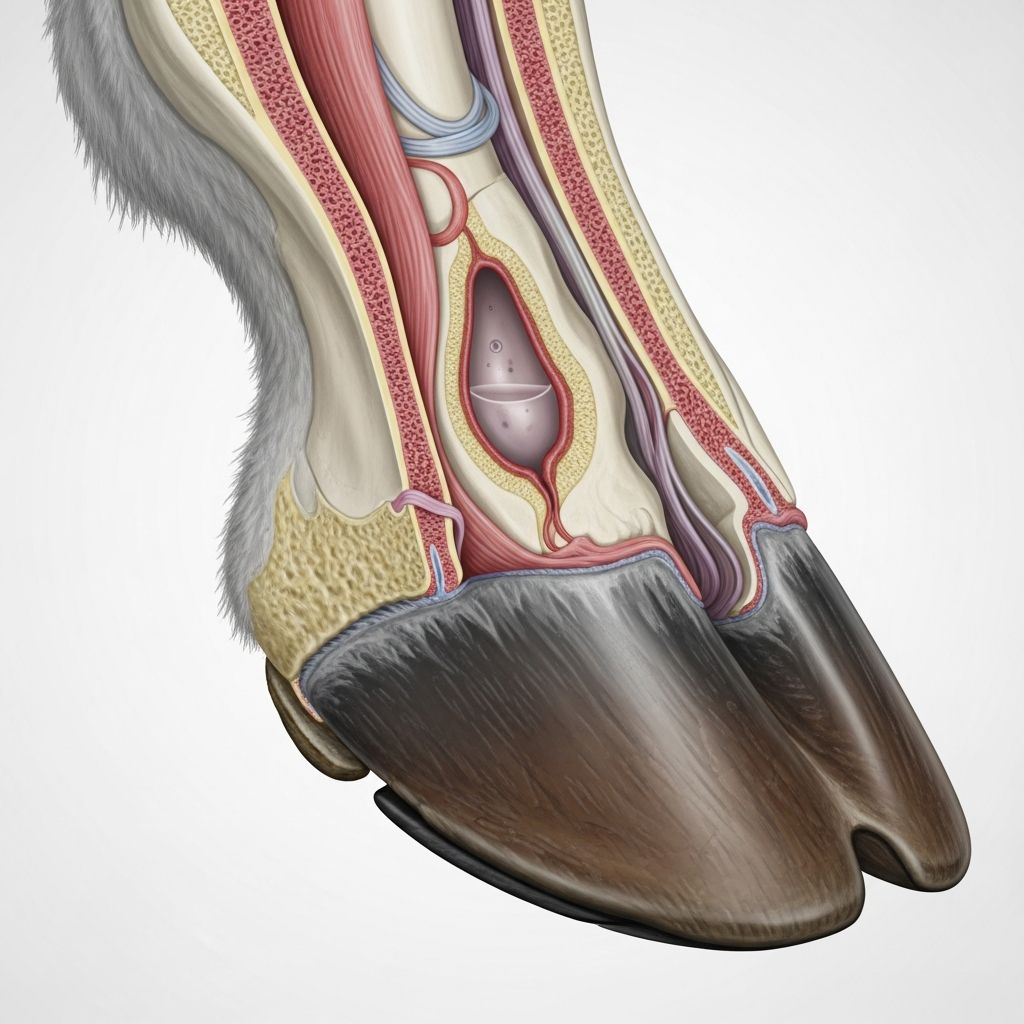
Osseous cyst-like lesions (OCLLs) represent a significant concern in equine veterinary medicine, particularly when they develop within the distal phalanx, commonly referred to as the coffin bone or pedal bone. These focal bone abnormalities have become increasingly recognized as a source of lameness in horses across various breeds and age groups. The distal phalanx serves as the foundation for weight-bearing and movement in horses, making any structural compromise a matter of considerable clinical importance. Understanding the nature of these lesions, their potential causes, and available management strategies is essential for veterinarians and horse owners seeking to maintain equine athletic performance and quality of life.
Definition and Anatomical Characteristics
Osseous cyst-like lesions are focal areas of bone that appear radiolucent on radiographic imaging, typically surrounded by a rim of sclerotic or denser bone tissue. These lesions can take on various shapes, including dome, conical, or spherical configurations. The term “cyst-like” is used because despite their appearance, these lesions lack the epithelial lining characteristic of true bone cysts, distinguishing them from classical cystic pathology.
Within the distal phalanx, OCLLs most frequently develop in the subchondral bone region, which is the bone layer immediately beneath the articular cartilage of the distal interphalangeal joint. These lesions often establish direct communication with the coffin joint, though some develop in isolation without joint involvement. Additional locations within the distal phalanx include areas adjacent to ligament insertion sites, such as the collateral ligaments of the distal phalanx and the distal impar ligament, as well as the solar surface of the bone.
Prevalence and Distribution Patterns
While OCLLs can develop in numerous skeletal locations throughout the horse’s body, including the carpal bones, metacarpal and metatarsal bones, tibia, radius, talus, sesamoid bones, humerus, patella, scapula, tarsal bones, femoral head, and even the mandible, the most commonly affected site is the medial femoral condyle of the femur. The distal phalanx represents the second most frequent location for these lesions.
OCLLs affecting the distal phalanx appear to demonstrate a predilection for the forefeet compared to the hindfeet, and have been documented across various horse breeds and ages. The center of the proximal aspect of the distal phalanx, particularly at midline locations, represents the most typical site for lesion development within this bone.
Underlying Mechanisms and Proposed Etiology
The exact pathogenesis of OCLLs remains incompletely understood, though veterinary researchers have identified several potential contributing mechanisms. In young horses, these lesions are frequently characterized as developmental in nature, suggesting they may result from disruptions in normal bone formation processes during skeletal maturation. Conversely, OCLLs diagnosed in older horses tend to be classified as traumatic in origin, indicating that repetitive stress or single traumatic events may initiate lesion formation.
Several pathomechanisms have been proposed as potential contributors to OCLL development:
- Failure of endochondral ossification, the normal process by which cartilage is converted to bone during skeletal development
- Traumatic injury to the bone, either from repetitive impact loading or acute injury events
- Focal areas of infection (sepsis) within bone tissue
- Ischemia or impaired blood supply to localized bone regions
The complexity of distal phalanx anatomy and its critical role in weight-bearing may predispose this bone to the development of these lesions under certain biomechanical or developmental circumstances.
Clinical Presentation and Lameness Manifestations
The clinical expression of OCLLs in the distal phalanx varies considerably among affected horses. Some horses demonstrate no clinical signs whatsoever and are discovered to have these lesions incidentally when radiographs are taken for unrelated reasons or routine screening. In contrast, other horses experience mild to severe lameness that significantly impacts their athletic capacity.
When lameness does occur, it is thought to result from synovitis (joint inflammation) and elevated intra-cystic or intra-osseous pressures that create pain and discomfort during weight-bearing and movement. The severity of lameness does not always correlate directly with lesion size or location, suggesting that individual horse factors influence clinical manifestation.
Physical examination findings in lame horses may include:
- Positive response to hoof testers, particularly in areas overlying the lesion
- Positive response to distal limb flexion tests
- Improvement in lameness following regional anesthesia of the palmar or plantar digital nerves (abaxial nerve block)
- Relief of lameness after anesthesia of the distal interphalangeal joint itself, when the lesion communicates with the joint space
Diagnostic Imaging Approaches
Radiography represents the primary diagnostic tool for identifying OCLLs within the distal phalanx. Standard radiographic projections may reveal the characteristic radiolucent lesion with its surrounding sclerotic rim. However, depending on the specific location of the OCLL within the distal phalanx, additional oblique radiographic views may be necessary to visualize the lesion completely and determine its relationship to adjacent structures.
For lesions located in atypical positions or when standard radiography fails to definitively characterize the pathology, advanced diagnostic imaging becomes invaluable. Computed tomography (CT) and magnetic resonance imaging (MRI) provide three-dimensional visualization of bone architecture and surrounding soft tissue structures, enabling more precise lesion characterization and treatment planning.
Imaging assessment should also evaluate for concurrent pathology commonly associated with distal phalanx OCLLs, including:
- Enthesophyte formation at the dorsodistal aspect of the middle phalanx
- Osteophyte formation affecting the distal interphalangeal joint
- Increased soft tissue opacity dorsal to the distal interphalangeal joint
- Additional concurrent pathology within the distal interphalangeal joint and surrounding soft tissue structures
Conservative Management Strategies
Conservative treatment approaches represent a non-surgical option for horses with OCLLs in the distal phalanx. These strategies focus on managing inflammation and pain while allowing natural healing processes to occur. Conservative management typically involves intra-articular joint injections when the OCLL communicates with the distal interphalangeal joint.
Common pharmaceutical agents used in conservative treatment include:
- Triamcinolone, a corticosteroid that reduces inflammation and joint pain
- Hyaluronic acid, a natural joint component that may improve synovial fluid quality and joint lubrication
- Platelet-rich plasma (PRP), a biologic agent containing growth factors and anti-inflammatory components
The combination of triamcinolone with hyaluronic acid has been employed in clinical practice, as has triamcinolone administered alone or platelet-rich plasma as standalone treatments. While corticosteroid injection directly into the cyst lining represents a treatment option for OCLLs in other anatomical locations, this approach is not applicable to lesions within the distal phalanx due to the surrounding hoof capsule’s anatomical constraints.
Surgical Treatment Considerations
For horses that fail to respond adequately to conservative management, surgical intervention offers an alternative therapeutic approach. Arthroscopic debridement represents an established surgical technique for treating OCLLs in the distal phalanx when conservative treatment proves unsuccessful. This minimally invasive procedure involves using an arthroscope (a specialized camera and surgical instrument) to visualize the lesion and remove abnormal tissue.
Research has demonstrated encouraging outcomes with arthroscopic debridement for distal phalanx OCLLs. In one study examining 11 horses that underwent this procedure after conservative treatment failure, 91 percent of horses successfully returned to athletic performance. Among Thoroughbred racehorses specifically, seven of nine treated animals achieved successful athletic performance, indicating a high success rate in this performance-oriented population.
Surgical options may also include packing the debrided lesion with bone grafting material, bone substitutes, or biological agents such as mesenchymal stem cells or platelet-rich plasma to promote healing and bone regeneration. Extra-articular surgical approaches represent another option depending on the specific lesion location and extent.
Prognosis and Performance Outcomes
The prognosis for horses diagnosed with OCLLs in the distal phalanx varies considerably and depends on multiple factors including lesion location, size, presence of joint communication, severity of clinical signs, and selected treatment approach. Some horses successfully return to athletic function, though others may face limitations in performance capacity.
Research examining lameness outcomes in Thoroughbred racehorses with distal phalanx OCLLs treated conservatively revealed that affected horses were approximately three times less likely to race at least once compared to their unaffected maternal siblings. This finding reflects the significant impact these lesions can have on athletic performance. However, a surprising observation emerged: the majority of horses with OCLLs in the distal phalanx (62 percent) were able to race at least once, despite their diagnosis.
Among horses that did race following OCLL detection, their racing performance metrics were comparable to those of their unaffected siblings, suggesting that horses able to overcome the initial lameness challenge can achieve normal competitive performance levels. This distinction is clinically important, as it indicates that many horses with these lesions retain considerable athletic potential if they respond to treatment.
Distinguishing Factors in Lesion Characteristics
OCLLs within the distal phalanx demonstrate variable presentations that may influence clinical significance and treatment decisions. Lesions can be classified based on their anatomical relationship to articular structures. Subchondral lesions that communicate with the distal interphalangeal joint present different treatment considerations than non-communicating lesions or those at ligament insertions.
The specific location within the distal phalanx carries clinical implications. Midline locations represent the most common presentation, though lesions occurring in unusual positions, such as the palmar processes of the distal phalanx, represent uncommon variants that may present diagnostic challenges. Dorsopalmar locations can be particularly challenging to visualize on standard radiographic projections.
Frequently Asked Questions
Can a horse with a distal phalanx OCLL continue performing athletically?
Yes, many horses can continue athletic performance after diagnosis. While these lesions increase the likelihood of initial lameness, horses that respond to treatment—whether conservative or surgical—often achieve competitive performance levels comparable to unaffected animals.
Are OCLLs in the distal phalanx inherited or genetic?
While OCLLs have been documented across various breeds, the specific genetic basis for their development has not been clearly established. The involvement of developmental factors in young horses suggests possible hereditary components, though this remains an area requiring further research.
What is the difference between an OCLL and a true bone cyst?
The critical distinction lies in epithelial lining. True bone cysts possess an epithelial lining, while OCLLs, despite their cyst-like appearance on radiographs, lack this characteristic tissue layer.
How often should horses with diagnosed OCLLs undergo re-evaluation?
Re-evaluation protocols should be determined by the treating veterinarian based on clinical response to initial treatment, lameness severity, and performance goals. Periodic radiographic reassessment may be warranted to monitor lesion progression or response to therapy.
Can both forefeet and hindfeet be affected by OCLLs?
Yes, OCLLs can develop in both forefeet and hindfeet, though they appear more commonly in the forefeet.
References
- Osseous Cyst-Like Lesions in the Distal Phalanx in 22 Lame Thoroughbred Horses — National Center for Biotechnology Information. 2018. https://pmc.ncbi.nlm.nih.gov/articles/PMC6262755/
- Osseous Cystlike Lesions in the Distal Phalanx in Horses — Merck & Co., Inc. and MSD Veterinary Manual. 2025. https://www.msdvetmanual.com/musculoskeletal-system/disorders-of-the-foot-in-horses/osseous-cystlike-lesions-in-the-distal-phalanx-in-horses
- Osseous Cyst-Like Lesions in an Unusual Location in the Equine Distal Phalanx — American Association of Equine Practitioners. https://aaep.org/post/osseous-cyst-like-lesions-in-an-unusual-location-in-the-equine-distal-phalanx/
- Treatment of Osseous Cyst-Like Lesions — British Equine Veterinary Association. 2021. https://beva.onlinelibrary.wiley.com/doi/10.1111/eve.13269
Similar Articles








Read full bio of medha deb


