

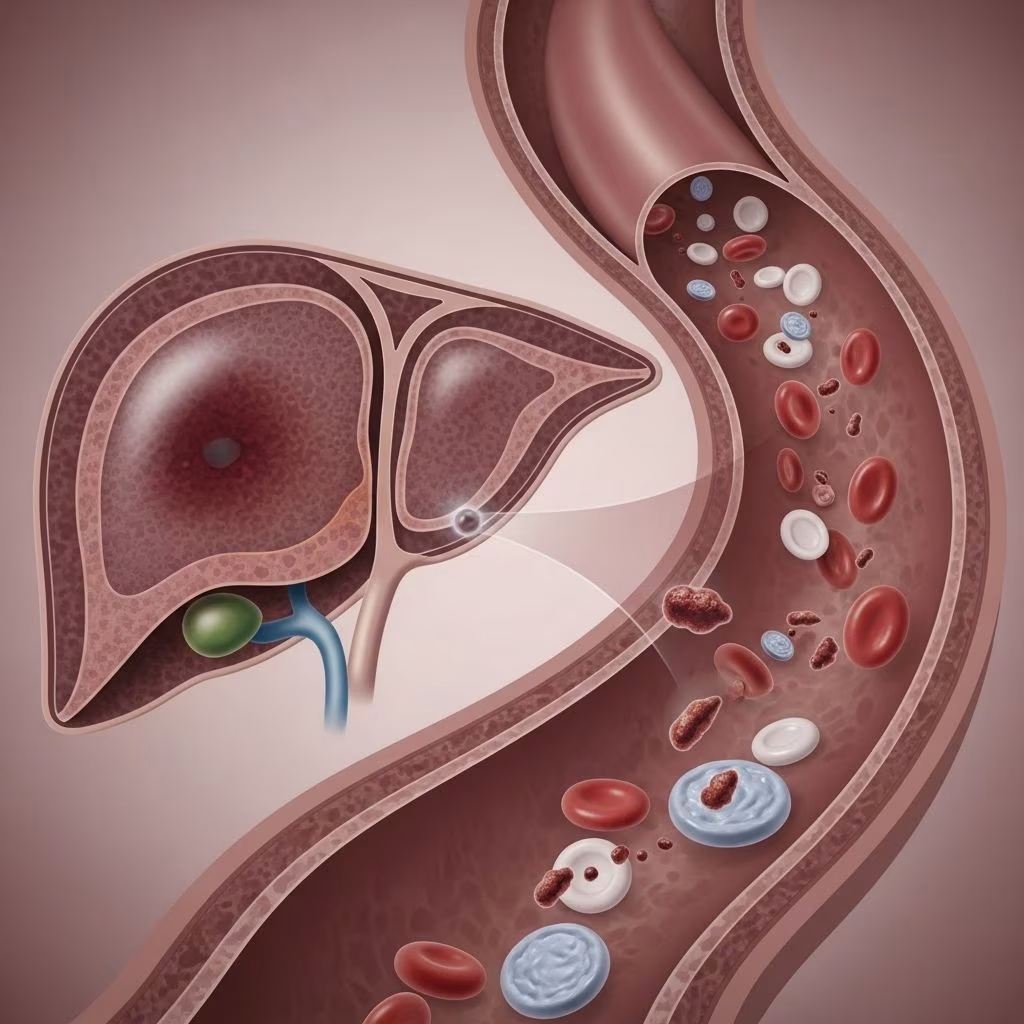
The liver plays a central role in maintaining blood clotting balance in small animals like dogs and cats. When hepatic function declines, it can lead to both excessive bleeding and unexpected clot formation, complicating diagnosis and treatment. This article delves into the mechanisms, diagnostic approaches, and management strategies for coagulation disturbances linked to liver disease.
The Liver’s Vital Role in Hemostasis
Hemostasis, the process of stopping bleeding and preventing clots, relies heavily on the liver. This organ synthesizes most clotting factors, including proteins II, VII, IX, and X, which depend on vitamin K for activation. It also produces anticoagulants like protein C and S, and regulators of fibrinolysis. In liver disease, reduced synthesis disrupts this delicate equilibrium, often resulting in prolonged clotting times or hypercoagulable states.
Dogs and cats with chronic or acute liver issues, such as hepatitis, cholestasis, or lipidosis, frequently show altered hemostasis. While traditional views emphasized bleeding risks from factor deficiencies, recent evidence reveals a more nuanced picture, including thrombotic tendencies due to endothelial damage and inflammation.
Common Coagulation Abnormalities Observed
Liver dysfunction manifests in diverse clotting changes. Key abnormalities include:
- Prolonged prothrombin time (PT) and activated partial thromboplastin time (aPTT): These indicate deficiencies in multiple factors, especially vitamin K-dependent ones, common in severe cases.
- Thrombocytopenia and platelet dysfunction: Reduced platelet counts occur from splenic sequestration or decreased production, yet elevated von Willebrand factor (VWF) often compensates.
- Fibrinogen fluctuations: Levels drop below 100 mg/dL in dogs or 70 mg/dL in cats during synthetic failure, signaling high bleeding risk; elevations promote thrombosis.
- Hyperfibrinolysis: Increased clot breakdown, detected by elevated D-dimers or lysis markers, heightens bleeding tendencies.
In cats with cholestatic liver disease (CLD), up to 72% show abnormalities on advanced tests, with 50% hypercoagulable despite normal standard panels.
Standard Diagnostic Tests: Strengths and Limitations
Conventional coagulation panels form the backbone of initial assessments. Here’s a breakdown:
| Test | What it Measures | Relevance to Liver Disease | Normal Ranges (Dogs/Cats) |
|---|---|---|---|
| PT | Extrinsic pathway (factors VII, X, V, II, fibrinogen) | Prolongs with vitamin K deficiency or synthetic failure | 6-8 sec / 6-10 sec |
| aPTT | Intrinsic/common pathways (factors XII, XI, IX, VIII, X, V, II, fibrinogen) | Sensitive to multiple factor reductions | 10-20 sec / 15-25 sec |
| Fibrinogen | Clotting factor levels | Low in failure; high in inflammation | 200-400 mg/dL / 100-300 mg/dL |
| Platelet Count | Number of platelets | Often low, but VWF compensates | 200-500 x10^3/µL / 300-800 x10^3/µL |
These tests excel at identifying hypocoagulability but miss hypercoagulable states, as seen in only 17% of CLD cats versus 72% on TEG.
Advanced Testing: Thromboelastography (TEG) Revolution
TEG provides a dynamic view of clot formation, strength, and breakdown, outperforming static tests. Key parameters include:
- R time: Clot initiation.
- K and Alpha angle: Clot kinetics.
- MA: Maximum amplitude (clot strength).
- G: Overall clot firmness.
- LY30/LY60: Lysis at 30/60 minutes (fibrinolysis).
In dogs with acute liver disease (ALD), TEG reveals hypocoagulability and hyperfibrinolysis correlating with bilirubin levels and functional impairment. Cats with CLD often appear hypercoagulable (50%), especially with biliary obstruction, highlighting TEG’s sensitivity.
Hypercoagulability: The Hidden Threat
Contrary to classic assumptions, many liver patients are prone to clots. Mechanisms include:
- Neutrophil extracellular traps (NETs) promoting thrombosis in sinusoids.
- Elevated VWF (5-10x normal) compensating for thrombocytopenia, yet risking decompensation.
- Endothelial damage from inflammation and vasoconstrictors like vasopressin.
Portal vein thrombosis (PVT), though rare, signals advanced disease with portal hypertension. In humans and dogs, high fibrinogen links to PVT risk.
Species-Specific Insights: Dogs vs. Cats
| Aspect | Dogs | Cats |
|---|---|---|
| Common Liver Issues | Chronic hepatitis, copper hepatopathy | Cholangitis, hepatic lipidosis |
| Coag Profile | Hypo- to hypercoagulable; hyperfibrinolysis in ALD | Hypercoagulable in 50% CLD; hyperfibrinolysis in hypo cases |
| Testing Sensitivity | TEG detects trends with severity | TEG > PT/aPTT (72% vs 17% abnormal) |
| VWF Role | Elevated, predicts decompensation | Similar increases noted |
Dogs undergo more biopsies due to enzyme elevations, with normal ultrasound in 64% of cases. Cats pretreated with vitamin K show distinct TEG patterns.
Interpreting Results for Clinical Decisions
Integrate tests judiciously:
- Hypocoagulable (prolonged R/K, low MA): Risk bleeding; consider fresh frozen plasma or vitamin K.
- Hypercoagulable (short R, high G): Thrombosis risk; avoid procoagulants like cryoprecipitate if VWF high.
- Hyperfibrinolytic (high LY30): Use antifibrinolytics like tranexamic acid cautiously.
VWF testing, traditionally for breed defects, now gauges balance in liver cases.
Treatment Strategies and Supportive Care
Address underlying liver issues alongside hemostasis:
- Vitamin K1 supplementation for deficiencies (subcutaneous, 2-5 mg/kg q12-24h).
- Plasma transfusions for active bleeding or pre-biopsy if PT/aPTT >1.5x normal.
- Monitor for PVT with ultrasound; anticoagulants like heparin if confirmed.
- Nutritional support to bolster synthesis, especially in lipidosis cats.
Avoid unnecessary cryoprecipitate in high VWF scenarios to prevent thrombosis.
FAQs
Why do liver disease pets bleed easily?
Liver failure reduces clotting factor production, prolonging PT/aPTT and weakening clots.
Can liver patients clot too much?
Yes, hypercoagulability from inflammation and high VWF leads to thrombosis risks.
Is TEG better than PT/aPTT?
TEG detects more abnormalities (72% vs 17% in cats) and assesses clot strength/dissolution.
When to test coagulation in liver cases?
Before invasive procedures like biopsy, or with unexplained bleeding/thrombosis signs.
How does vitamin K fit in?
Essential for factors II, VII, IX, X; deficiency mimics synthetic failure—treat empirically.
Prognostic Indicators from Coagulation Data
Clotting profiles predict outcomes. In ALD dogs, low MA/G and high LY30 correlate with severity and mortality. Elevated VWF signals decompensation risk. Regular monitoring guides therapy adjustments.
References
- Coagulation Tests in Hepatic Disease in Small Animals — Merck Veterinary Manual. 2023. https://www.merckvetmanual.com/digestive-system/laboratory-analyses-and-imaging-in-hepatic-disease-in-small-animals/coagulation-tests-in-hepatic-disease-in-small-animals
- Evaluating the Coagulation Process in Cats with Liver Disease — EveryCat Health Foundation. 2023. https://everycat.org/cat-health/evaluating-the-coagulation-process-in-cats-with-liver-disease/
- Thromboelastographic Evaluation of Dogs with Acute Liver Disease — Journal of Veterinary Internal Medicine (PubMed). 2015-07-01. https://pubmed.ncbi.nlm.nih.gov/26179169/
- Coagulation Tests — VCA Animal Hospitals. 2023. https://vcahospitals.com/know-your-pet/coagulation-tests
- Coagulation Assays — eClinPath. 2023. https://eclinpath.com/hemostasis/tests/screening-coagulation-assays/



