

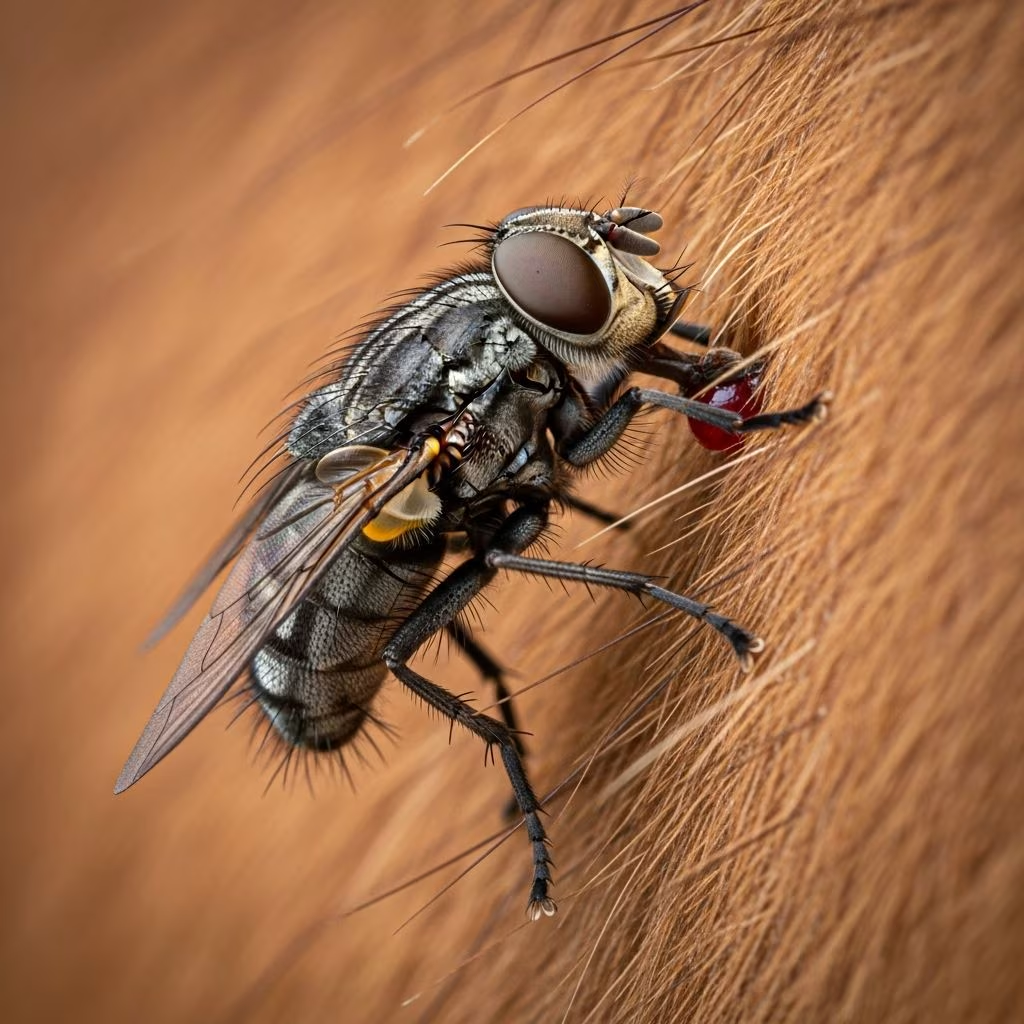
Flies equipped with specialized piercing mouthparts represent significant challenges in veterinary medicine, particularly for livestock and outdoor companion animals. These insects, belonging to the order Diptera, inflict painful bites, cause skin damage, and serve as vectors for serious diseases, leading to substantial economic losses in agriculture.
Anatomy of Piercing Mouthparts in Dipterans
Dipterans with biting capabilities possess highly evolved mouthparts designed for penetrating skin and accessing blood or tissue fluids. Unlike sponging flies that lap up liquids, these species feature elongated stylets formed from mandibles, maxillae, and other structures that create a tubular channel for fluid intake. For instance, the labium hardens into a proboscis in some flies, enabling precise incisions, while prestomal teeth—sclerotized projections near the oral opening—rasp surfaces to expose nourishing liquids.
These adaptations allow efficient blood-feeding. In females of many species, mandibles function as sharp blades overlying a groove, forming a siphon for sucking blood. Evolutionary changes have led to diverse piercing mechanisms: some use the hypopharynx, others envelop prey with labella equipped with crushing teeth. Material analysis reveals prestomal teeth with hardness akin to polycarbonate, heavily sclerotized yet containing minimal inorganic elements, correlating with feeding behaviors like tissue piercing over surface lapping.
Key Species Impacting Animal Health
Several dipteran families pose veterinary risks through biting. Tsetse flies (Glossinidae) are notorious in Africa for transmitting trypanosomes causing nagana in cattle. Horse flies (Tabanidae), including deer flies, deliver deep, cross-shaped wounds with knife-like mandibles and maxillae, lapping pooling blood. Stable flies (Stomoxys calcitrans) bite around legs, udders, and mucous membranes, mimicking mosquito impacts but with greater persistence.
- Horse flies (Tabanidae): Large, robust fliers targeting large mammals; mechanical vectors for anthrax and trypanosomes.
- Stable flies (Muscidae): Resemble house flies but with bayonet-like proboscides; thrive in decaying organic matter.
- Tsetse flies (Glossinidae): Viviparous, larvipositing; primary trypanosomiasis vectors.
- Black flies (Simuliidae): Small, humpbacked; cluster bites cause toxic reactions.
- Sand flies (Psychodidae): Minute, moth-like; transmit leishmaniasis.
These species vary in size, activity patterns, and host preferences, but all exploit animal hosts for bloodmeals essential for egg production.
Life Cycles and Seasonal Dynamics
Biting flies undergo complete metamorphosis: egg, larva, pupa, adult. Aquatic or semi-aquatic larvae predominate in Simuliidae and Culicidae, developing in fast-flowing water, while Tabanidae and Muscidae favor moist soil or manure. Stable fly eggs hatch in 1-3 days under warm conditions, with full cycles completing in 2-4 weeks.
Seasonality peaks in summer, driven by temperature and humidity. Tsetse flies maintain populations year-round in tropical climates via viviparity, producing one larva per cycle that pupates immediately. Understanding these cycles aids in timing interventions.
| Species | Eggs | Larvae Habitat | Adult Lifespan | Peak Activity |
|---|---|---|---|---|
| Horse flies | 100-1000 per female | Moist soil, ponds | 30-60 days | Summer daytime |
| Stable flies | 300-500 per female | Feedlots, hay | 20-40 days | Spring-fall |
| Tsetse flies | 1 larva per cycle | Soil pupae | 30-90 days | Year-round tropics |
| Black flies | 400-1000 per female | Running water | 2-4 weeks | Spring-early summer |
Clinical Manifestations in Animals
Bites from these flies provoke immediate pain and irritation due to salivary anticoagulants and vasodilators. Horses exhibit “stomoxys dermatitis” from stable flies: crusty, bleeding lesions on legs and flanks, leading to stamping and weight loss. Cattle suffer anemia from tabanid swarms, with open wounds inviting secondary infections.
Allergic responses include edema, urticaria, and anaphylaxis in sensitive individuals. Black fly toxins cause rapid swelling and respiratory distress in mass attacks. Chronic exposure results in hide damage, reducing leather quality, and behavioral changes like reduced grazing.
Pathogen Transmission Mechanisms
Biting flies mechanically transfer bacteria (Anaplasma, anthrax) on mouthparts between hosts. Tsetse flies biologically transmit trypanosomes, with parasites multiplying in the gut before migration to salivary glands. Sand flies harbor Leishmania promastigotes, injecting infective forms during bites.
- Mechanical: Pathogens smeared from one wound to another (e.g., tabanids with equine infectious anemia virus).
- Biological: Cycle within fly (e.g., trypanosomes in tsetse).
This dual mode amplifies disease outbreaks in herds.
Veterinary Diagnosis Approaches
Diagnosis combines history, clinical signs, and entomological identification. Skin biopsies reveal fly bite patterns: Y-shaped tabanid wounds versus clustered simuliid punctures. Serology detects vector-borne diseases like besnoitiosis from horse flies. Trap catches confirm local species.
Prevention and Management Strategies
Integrated pest management (IPM) is key. Cultural controls reduce breeding: remove manure, drain standing water. Insecticide applications include pour-ons (permethrin), ear tags, and sprays, though resistance emerges.
Biological agents like entomopathogenic fungi target larvae. Traps—visual (blue-black for tabanids), odor-baited (ammonia for stable flies)—capture adults effectively. Sterile insect technique suppresses tsetse populations.
- Repellents: Oil of citronella, DEET analogs for horses.
- Breeding site elimination: Essential for muscoids.
- Vaccines: Emerging for trypanosomiasis.
Regional Prevalence and Economic Impact
In the U.S., stable flies cost dairy farms millions annually via milk drop. African trypanosomiasis affects 50 million cattle. Climate change expands ranges, increasing risks.
FAQs
What distinguishes biting flies from non-biting ones?
Biting species have piercing stylets; others sponge liquids.
Can biting flies transmit diseases to pets?
Yes, sand flies spread leishmaniasis to dogs.
How to protect livestock from horse fly attacks?
Use traps, repellents, and shaded housing.
Are there natural predators for these flies?
Yes, birds, spiders, and parasitic wasps.
What’s the best time to apply insecticides?
Early morning or evening when flies are active.
References
- Dipteran – Flight, Metamorphosis, Insects — Britannica. 2023-10-15. https://www.britannica.com/animal/dipteran/Form-and-function
- Mouthparts – Knowledge and References — Taylor & Francis. 2024-01-20. https://taylorandfrancis.com/knowledge/Medicine_and_healthcare/Anatomy/Mouthparts/
- Material Properties and Morphology of Prestomal Teeth in Dipterans — PMC (NCBI). 2022-02-14. https://pmc.ncbi.nlm.nih.gov/articles/PMC8880167/
- Fly — Wikipedia (background, primary refs used). 2026-02-20. https://en.wikipedia.org/wiki/Fly
- Order Diptera – ENT 425 – General Entomology — NCSU (CALS). 2023-05-10. https://genent.cals.ncsu.edu/insect-identification/order-diptera/



