

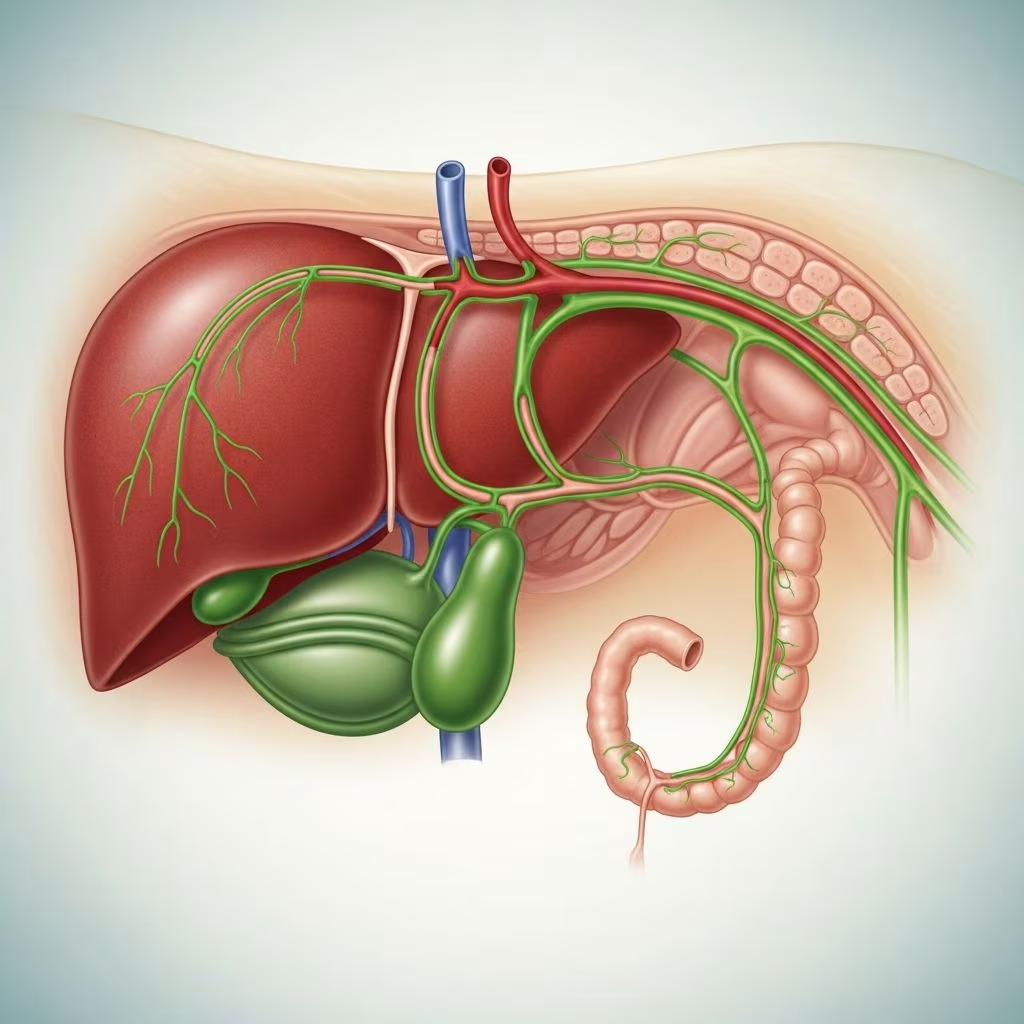
The biliary system, often called the biliary tree, forms a critical network in animals responsible for transporting bile—a vital digestive fluid—from the liver to the intestines. This complex pathway ensures proper fat digestion and waste elimination, with structures varying across species to adapt to dietary and physiological needs.
Fundamentals of Bile Production and Initial Transport
Bile originates in hepatocytes, the primary liver cells, where it is synthesized as a mixture of water, bile salts, pigments, cholesterol, and electrolytes. These components aid in emulsifying fats and excreting waste products like bilirubin. From hepatocytes, bile enters the smallest conduits known as canaliculi, microscopic channels approximately 1 micrometer in diameter formed by specialized hepatocyte membranes sealed by tight junctions.
Contractile microfilaments around canaliculi actively propel bile toward larger structures called cholangioles. These ductules, lined by cuboidal epithelial cells called cholangiocytes, represent the entry to the intrahepatic biliary tree. Cholangiocytes modify bile composition by secreting bicarbonate and water, regulating pH and flow.
- Canaliculi: Hepatocyte-derived channels for initial bile secretion.
- Cholangioles: Transitional ductules connecting to portal triads.
- Key function: Prevent bile reflux into bloodstream via tight junctions.
Intrahepatic Biliary Network: From Ductules to Major Ducts
Within the liver, the biliary tree branches progressively. Cholangioles merge into interlobular bile ducts, the smallest named intrahepatic ducts, located in portal triads alongside hepatic artery branches and portal veins. These ducts feature cuboidal epithelium and drain individual liver lobules.
Interlobular ducts converge into septal bile ducts, larger structures with cylindrical cuboidal lining. Further union forms segmental bile ducts, which consolidate into hepatic ducts. In dogs and cats, hepatic ducts are minimal, often just 3-4 main ones emerging from liver lobes.
| Duct Type | Epithelial Lining | Location | Function |
|---|---|---|---|
| Canaliculi | Hepatocyte membranes | Intra-lobular | Bile secretion |
| Interlobular | Cuboidal | Portal triads | Lobule drainage |
| Septal/Segmental | Cylindrical cuboidal | Inter-lobar | Convergence |
| Hepatic | Columnar | Extrahepatic transition | Main lobe drainage |
This hierarchical organization ensures efficient collection, with epithelial morphology adapting to increasing lumen size: flattened in small ducts to columnar in larger ones.
Extrahepatic Components: Gallbladder and Beyond
Exiting the liver, right and left hepatic ducts unite into the common hepatic duct. This joins the cystic duct from the gallbladder, forming the common bile duct (CBD). The gallbladder, absent in horses and rats, stores and concentrates bile in species like dogs, cats, and ruminants.
Located in a fossa between liver lobes, the gallbladder receives bile via the cystic duct—a narrow, tortuous tube. Its mucosa absorbs water, concentrating bile up to 10-fold. The CBD, about 5 cm long and 2.5 mm diameter in medium dogs, travels alongside pancreatic ducts before entering the duodenum at the major duodenal papilla.
The sphincter of Oddi, a smooth muscle valve, regulates flow and prevents duodenal reflux. In cats, pancreatic duct variations occur, with accessory ducts entering nearby minor papillae in 20% of cases.
Species-Specific Variations in Biliary Anatomy
Biliary architecture differs markedly among animals, reflecting evolutionary adaptations.
- Dogs: 3-4 hepatic ducts; cystic duct joins central or right duct; CBD separate from pancreatic duct, entering major papilla 1.5-6 cm post-pylorus.
- Cats: Similar to dogs but with frequent dual pancreatic duct entries; shorter intramural CBD segment.
- Ruminants (goats, buffalo): Multiple intrahepatic ducts (3-6) drain to gallbladder; CBD forms from extrahepatic and pancreatic merger.
- Gallbladder-less species (horses, alpacas): Bile flows directly via hepatic ducts to CBD without storage.
These variations impact surgical approaches and disease susceptibility. For instance, dogs may have dual cystic ducts, complicating procedures.
Vascular Supply and Clinical Implications
Intrahepatic ducts receive blood from peribiliary arterial plexuses, anastomosing with portal vein branches, enabling pathogen spread and chronic infections. Gallbladder perfusion comes via cystic artery. Mucins in larger ducts and gallbladder, especially gel-forming types in dogs, influence bile viscosity, affected by hydration.
Physiological Roles and Regulatory Mechanisms
Beyond transport, the biliary system regulates bile flow via hormones like cholecystokinin (CCK), which contracts gallbladder and relaxes sphincter of Oddi post-meal. Cholangiocytes sense flow via microvilli, proliferating or secreting in response.
Bile facilitates fat digestion by solubilizing lipids and neutralizes gastric acid in the duodenum. Obstruction leads to jaundice, cholangitis, or pancreatitis due to CBD-pancreas proximity.
Common Pathologies and Veterinary Relevance
Biliary disorders are prevalent in veterinary practice:
- Cholecystitis: Gallbladder inflammation from bacteria harbored in mucosal biofilms.
- Choledocholithiasis: CBD stones causing obstruction.
- Cholangiohepatitis: Intrahepatic infection from hematogenous spread.
Imaging (ultrasound) reveals gallbladder as anechoic structure; histopathology confirms epithelial changes. Treatment involves antibiotics, ursodeoxycholic acid, or surgery.
Diagnostic Approaches to Biliary Disorders
- Biochemistry: Elevated ALP, GGT, bilirubin indicate cholestasis.
- Imaging: Ultrasound for dilation, sludge; CT for masses.
- Cytology: Aspirates reveal bacteria, neoplasia.
- Biopsy: Confirms cholangitis, fibrosis.
FAQs
What is the primary function of the biliary tree?
It transports bile from liver hepatocytes to the duodenum for digestion.
Do all animals have a gallbladder?
No, species like horses lack it, relying on continuous hepatic bile flow.
How does the sphincter of Oddi function?
It controls bile/pancreatic juice entry into duodenum, preventing reflux.
Why is biliary anatomy important in veterinary surgery?
Species variations affect procedures like cholecystectomy.
What causes jaundice in animals with biliary issues?
Bile flow obstruction elevates bilirubin.
Advances in Biliary Research
Recent studies highlight cholangiocyte roles in regeneration and fibrosis. Stem cell therapies target cholangiopathies. Comparative anatomy informs xenotransplantation.
References
- Anatomical differences in the biliary duct system between canines — PMC. 2024. https://pmc.ncbi.nlm.nih.gov/articles/PMC12124803/
- The biliary system – Veterinary Histology — Ohio State Pressbooks. 2023. https://ohiostate.pressbooks.pub/vethisto/chapter/9-the-biliary-system/
- Gallbladder, Cystic Duct, and Common Bile Duct in Animals — MSD Veterinary Manual. 2023. https://www.msdvetmanual.com/digestive-system/liver-structure-and-function/gallbladder-cystic-duct-and-common-bile-duct-in-animals
- Biliary Tree (Biliary Tract): Intrahepatic and Extrahepatic Components in Animals — Merck Veterinary Manual. 2023. https://www.merckvetmanual.com/digestive-system/liver-structure-and-function/biliary-tree-biliary-tract-intrahepatic-and-extrahepatic-components-in-animals
- The Liver part 3: The Gall Bladder — IMV Imaging. 2020-05-01. https://www.imv-imaging.com/en/2020/05/news-the-liver-part-3-the-gall-bladder/



