

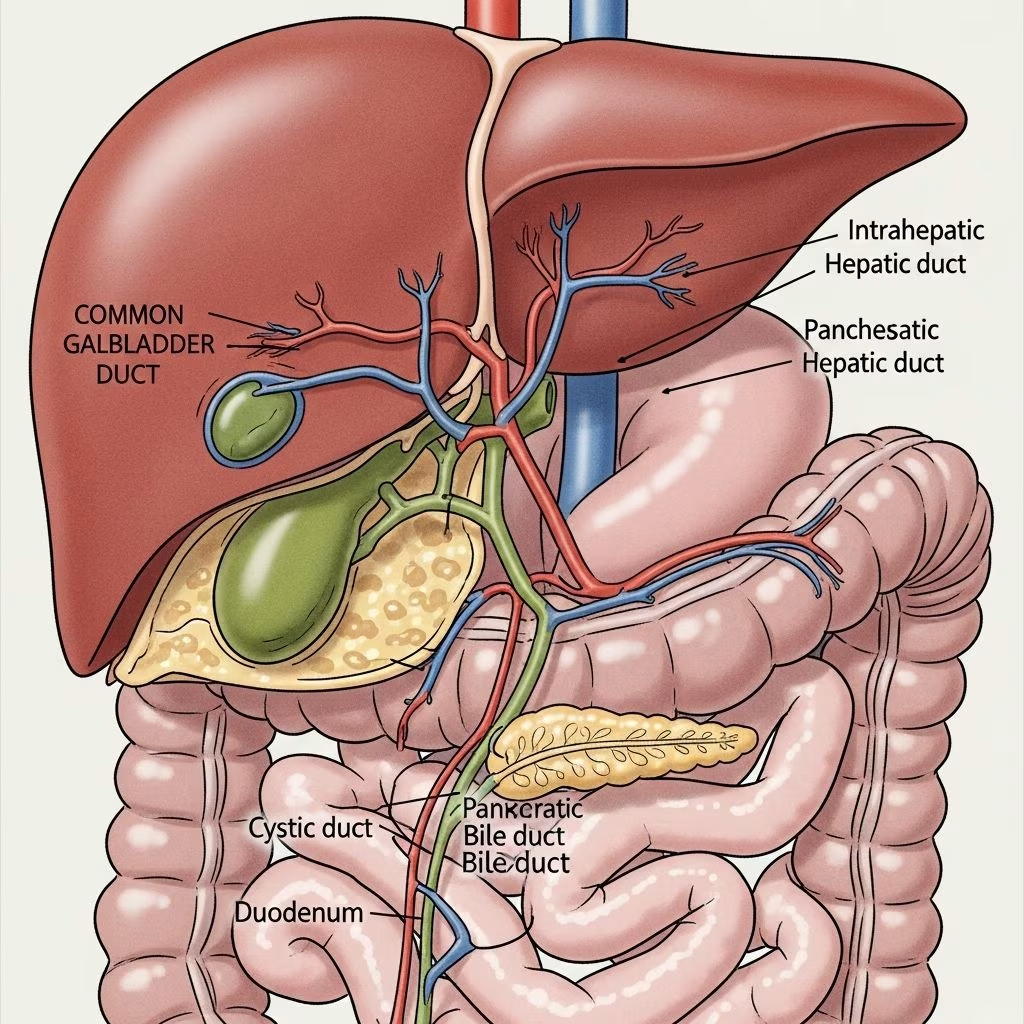
The biliary system plays a crucial role in digestion by managing bile production, storage, and release in various animal species. This network includes the **gallbladder**, **cystic duct**, and **common bile duct**, which work together to concentrate and deliver bile to the intestines for fat emulsification.
Anatomical Foundations of the Biliary Apparatus
In most vertebrates, the gallbladder is a pear-shaped sac nestled within the liver’s lobes, primarily designed for bile storage. Bile, synthesized by liver hepatocytes, travels through canaliculi, bile ductules, and larger hepatic ducts before reaching this organ. The cystic duct connects the gallbladder to the common bile duct, allowing controlled bile flow, while the common bile duct merges hepatic secretions with gallbladder contents to empty into the duodenum.
Species-specific positioning varies: in dogs, the gallbladder resides between the right medial and quadrate liver lobes, embedded in a hepatic fossa with limited vascular supply from the cystic artery. Its capacity averages about 15 mL in medium-sized canines, filled passively under low pressure. In cats, it lies between divisions of the right medial lobe, appearing anechoic on ultrasound due to its fluid-filled nature.
Physiological Mechanisms of Bile Management
Bile facilitates fat digestion by emulsifying lipids into smaller particles accessible to pancreatic lipase and aids in cholesterol excretion and nutrient absorption. Within the gallbladder, bile undergoes concentration as water, electrolytes, lipids, and proteins are absorbed, rendering it more potent. Mucin-secreting glands in the mucosa protect against bile acids’ cytotoxic effects.
Gallbladder contraction, triggered by cholecystokinin (CCK) from intestinal enterocytes in response to fats and proteins, propels bile into the duodenum via the major duodenal papilla in dogs. This hormone-mediated process ensures timely bile release during meals.
- Bile composition: Water, bile acids, bilirubin, cholesterol, electrolytes.
- Concentration process: Active reabsorption of fluids, enhancing potency up to 10-fold.
- Protective features: Mucosal mucin layer shields epithelium from bile salts.
Species Variations in Biliary Structures
Not all mammals possess a gallbladder; rats, for instance, lack it entirely along with the cystic duct, yet their extrahepatic biliary tract mirrors that of mice topographically. In mice, the gallbladder sits between left and right medial lobes, with the cystic and common hepatic ducts branching at portal vein bifurcations. Rats show no vestige of this gallbladder-cystic duct (Gb-Cd) domain, resulting from absent biliary bud formation in embryos.
This absence represents evolutionary modularity, where the Gb-Cd region can be lost without remodeling the rest of the hepatobiliary system. Genes like Sox17 influence this developmental module, explaining recurrent gallbladder loss in mammals and birds. Canines and felines retain the organ, but anatomical nuances differ, such as duct merging patterns.
| Species | Gallbladder Presence | Cystic Duct | Key Location |
|---|---|---|---|
| Dogs | Present | Joins hepatic ducts | Right medial/quadrate lobes |
| Cats | Present | Similar to dogs | Right medial lobe divisions |
| Mice | Present | Branches with hepatic duct | Left/right medial lobes |
| Rats | Absent | Absent | N/A; direct hepatic to common bile duct |
Developmental Origins and Evolutionary Insights
The gallbladder arises from an endodermal outpouching of the embryonic foregut during early organogenesis. In vertebrates, this biliary bud forms the Gb-Cd domain, but in species like rats, it fails to develop due to regulatory gene alterations, leading to complete absence. This modularity highlights evolvability, as other biliary components remain conserved.
Embryonic studies reveal SOX17-positive buds as key precursors; their absence correlates with gallbladder loss. Unlike birds, where buds may form transiently before regression, mammalian losses often stem from early developmental skips, preserving overall biliary topology.
Diagnostic Approaches to Biliary Evaluation
Veterinary ultrasound is pivotal for assessing gallbladder integrity. The organ appears uniformly black (anechoic) with a thin echogenic wall. Positioning the probe intercostally or subcostally visualizes it between liver lobes. Abnormalities like mucoceles show thickened walls and immobile contents from mucus hypersecretion and stasis.
Other imaging confirms duct patency and detects dilatations or obstructions. In dogs, gallbladder disorders like mucoceles involve mucosal hyperplasia, possibly from motility impairment exposing tissues to bile salts.
Clinical Disorders and Pathophysiological Considerations
Gallbladder mucoceles in dogs feature excessive mucus production, leading to biliary stasis and solid content formation. Histology reveals glandular hyperplasia, with proposed etiologies including reduced contractility and bile acid toxicity.
Obstructions of the cystic or common bile duct can cause cholangitis or hepatitis. In agallbladder species like rats, direct hepatic drainage minimizes such risks but alters bile dynamics. Surgical interventions, like cholecystectomy, rely on understanding vascular limitations and fossa positioning.
Comparative Functional Adaptations
Species without gallbladders, such as rats and horses, rely on continuous hepatic bile secretion, suiting low-fat diets. Gallbladder-equipped animals handle intermittent high-fat meals via storage. This adaptation underscores dietary evolution ties.
In carnivores like dogs and cats, robust gallbladder function supports fat-rich diets, with CCK ensuring postprandial release.
FAQs
What is the primary function of the animal gallbladder?
It stores and concentrates bile from the liver, releasing it for fat digestion when stimulated by CCK.
Which animals lack a gallbladder?
Rats, horses, and certain rodents; their bile flows directly from liver to intestine.
How does the cystic duct contribute to bile flow?
It links the gallbladder to the common bile duct, enabling concentrated bile mixing with hepatic bile.
Why do some dogs develop gallbladder mucoceles?
Likely due to mucus gland hyperplasia and stasis, impairing normal emptying.
Can ultrasound detect biliary issues?
Yes, it reveals gallbladder shape, wall thickness, and contents effectively in small animals.
Advanced Research Directions
Ongoing studies explore genetic regulators like Sox17 in biliary modularity, potentially informing congenital anomalies. Comparative anatomy across vertebrates aids understanding evolutionary losses, with implications for regenerative medicine and surgical techniques.
Therapeutic advancements target mucocele prevention via motility enhancers or anti-inflammatory agents, emphasizing early detection through imaging.
References
- Anatomy and development of the extrahepatic biliary system in the mouse and rat — Higashiyama H, et al. 2017-11-23. https://pmc.ncbi.nlm.nih.gov/articles/PMC5735046/
- Managing disorders of the gallbladder in dogs — dvm360. 2023. https://www.dvm360.com/view/managing-disorders-gallbladder-dogs-proceedings
- Canine Gallbladder Disease: A Surgeon’s Perspective — Dugat K. 2023. https://vetmed.okstate.edu/site-files/documents/continuing-education/fall-conference_2023/proceedings_dugat_gallbladder.pdf
- Gallbladder — Wikipedia (informational, primary sources referenced). N/A. https://en.wikipedia.org/wiki/Gallbladder
- How to Use Veterinary Ultrasound to Scan the Gallbladder of a Small Animal — Clarius. N/A. https://clarius.com/blog/video-how-to-use-veterinary-ultrasound-to-scan-the-gallbladder-of-a-small-animal/



