

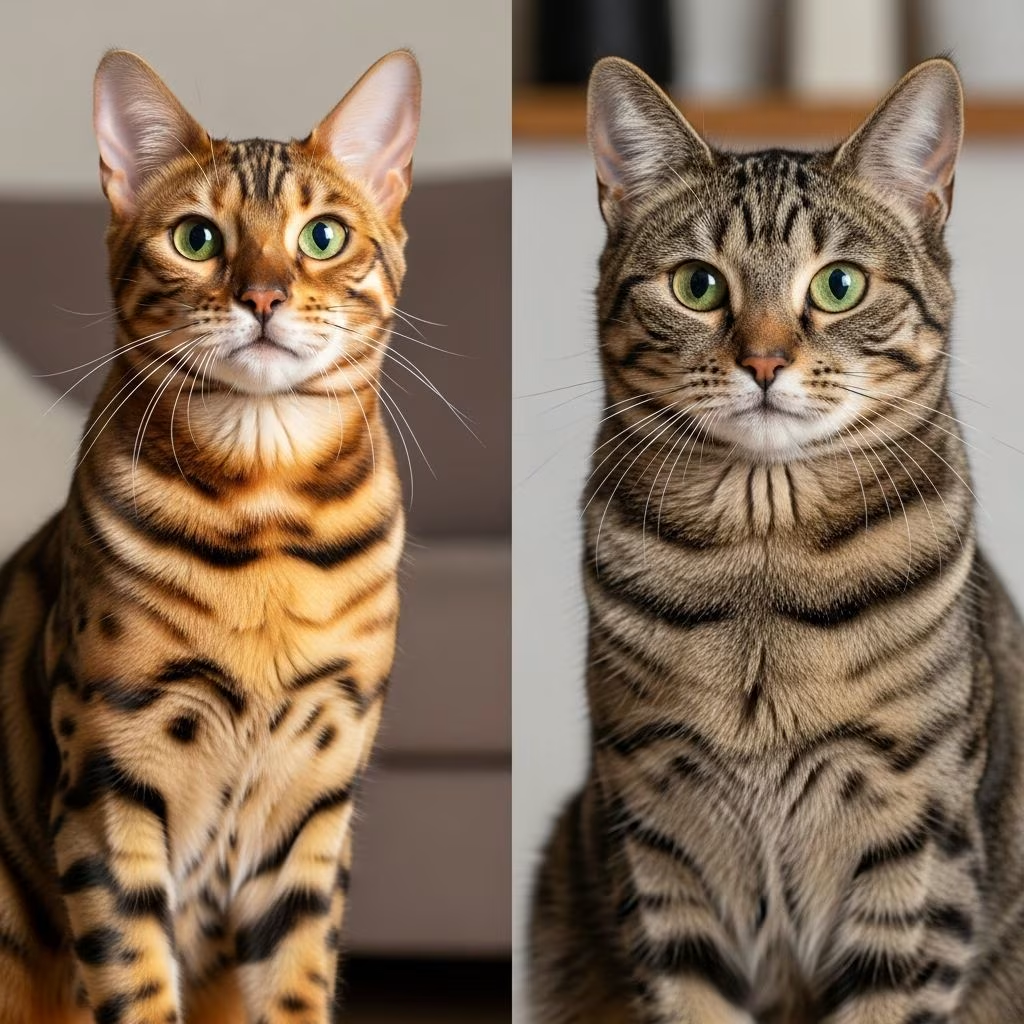
While Bengal cats and tabby cats share striking, exotic-looking coat markings, they differ fundamentally: the Bengal is a specific hybrid breed known for its athletic build and wild ancestry, whereas tabby refers solely to a common coat pattern appearing in many breeds and mixed cats. This leads to vast variations in size, temperament, and care needs for tabbies compared to the consistent traits of Bengals. Understanding these distinctions helps cat lovers choose the right companion, whether seeking an energetic adventurer or a more variable patterned pet.
Bengal vs Tabby Cat: At a Glance
| Feature | Bengal | Tabby |
|---|---|---|
| Average Height (Adult) | 13–16 inches | Depends on breed |
| Average Weight (Adult) | 8–15 pounds | Depends on breed |
| Lifespan | 12–16 years | 13–17 years (average across breeds) |
| Active | Very | Depends on breed |
| Grooming Needs | Low | Depends on breed |
| Family-Friendly | Yes | Depends on breed |
| Other Pet-Friendly | Often | Depends on breed |
| Trainability | Very good | Depends on breed |
This comparison table highlights the predictability of Bengal traits versus the variability of tabby-patterned cats, which inherit characteristics from their underlying breed genetics.
Bengal Overview
The Bengal cat stands out as a large, athletic breed with a rugged, muscular appearance derived from its unique heritage. Crossbred from domestic cats and the Asian Leopard Cat (Prionailurus bengalensis), Bengals retain wild-like features such as a thick tail, spotted or marbled coat, and exceptional agility. This ancestry fuels their high energy levels, making them adept climbers, runners, and even swimmers—traits uncommon in most domestic cats. Despite their wild roots, Bengals have been selectively bred over generations to enhance domestic companionship qualities, resulting in affectionate family pets that thrive in active households.
History
The Bengal breed originated in the 1970s when geneticist Jean Sugden Mill developed the first hybrids by mating a domestic cat with an Asian Leopard Cat. The goal was to capture the wildcat’s stunning spotted coat while producing a fully domestic temperament. Early generations (F1-F3) closely resembled wildcats and faced breeding restrictions due to hybridization concerns, but by the 1980s, later filial generations (F4+) gained recognition from cat registries like The International Cat Association (TICA). Today, Bengals are celebrated for “breaking the tabby pattern,” evolving beyond traditional domestic stripes into rosettes, spots, and marbles that mimic small forest wildcats.
Appearance
Bengals boast a sleek, short coat with a signature “glitter” effect—tiny sparkling particles that shimmer in light, a genetic holdover from their wild parent. Common patterns include spotted (rosette-shaped spots), marbled (swirling, chaotic patterns derived from classic tabby genes), and charcoal variants. Their bodies are long and substantial, with large paws, puffy whisker pads, small rounded ears, and thick tails often tipped with spots rather than rings. Unlike standard tabbies, ideal Bengals show broken stripes on legs (more spots than lines) and minimal traditional tabby markings like the full “M” forehead or bullseye swirls. Males typically weigh 10–15 pounds, females 8–12 pounds, standing 13–16 inches tall at the shoulder.
Personality/Character
Bengals are intelligent, playful dynamos that bond deeply with their families. Often called “dog-like,” they retrieve toys, follow owners room-to-room, and learn tricks like leash-walking or fetch. Their love of heights leads them to perches on shelves, trees, or rafters, while their water affinity prompts splashing in sinks or baths. Highly social and vocal, Bengals demand interaction and stimulation; boredom can lead to mischief like door-scratching. They suit experienced owners providing enrichment like cat trees, puzzle feeders, and playtime.
Health & Care
Bengals enjoy a lifespan of 12–16 years with proper care. Common concerns include hypertrophic cardiomyopathy (HCM), a heart condition screened via genetic testing by responsible breeders, and patellar luxation. Their short coat requires minimal weekly brushing to manage shedding and distribute natural oils. Provide a high-protein diet supporting their active metabolism, ample vertical spaces, and interactive toys. Early socialization ensures compatibility with children and other pets.
Tabby Cat Overview
Unlike the Bengal breed, a tabby cat is defined purely by its coat pattern, not genetics or pedigree. This versatile marking appears in purebreds (e.g., American Shorthair, Abyssinian) and domestic mixes, leading to diverse sizes, shapes, and behaviors. The classic tabby features bold swirls, stripes, and an “M” on the forehead, evoking tiger or jaguar aesthetics without the hybrid vigor of Bengals.
History
The term “tabby” traces to “attabiya,” Arabic for a Baghdad district famous for striped silk fabrics in the 15th century. As cats spread globally, this pattern became ubiquitous in domestic populations. Four main tabby types evolved: mackerel (narrow stripes), classic (swirls/bullseyes), spotted, and ticked (banded hairs masking patterns). Unlike Bengals, which selectively “break” these for wildcat mimicry, tabbies retain ancestral domestic feline aesthetics.
Appearance
Tabby patterns vary widely:
- Mackerel: Vertical stripes with thinner lines on legs/tail.
- Classic: Thick, circular swirls forming a “bullseye” on flanks; common in British and American Shorthairs.
- Spotted: Discrete spots instead of stripes.
- Ticked: Uniform color with subtle banding, as in Abyssinians.
All feature an “M” forehead mark, agouti banding (alternating light/dark hairs), and ringed tails. Sizes range from petite (5 pounds) to hefty (20+ pounds), with coats from short to long depending on the base breed.
Personality/Character
Tabby personality hinges on breed, not pattern. An Abyssinian tabby might be hyperactive and curious, mirroring Bengal energy, while a Persian tabby prefers lap-sitting. Mixed tabbies range from mischievous explorers to laid-back cuddlers. Influences include age, sex, and environment; early handling fosters sociability.
Health & Care
Expect 13–17 years lifespan, varying by breed (e.g., Persians prone to respiratory issues). Grooming matches coat length: low for shorthairs, high for longhairs. Feed breed-appropriate diets; provide scratching posts and play to suit energy levels.
Visual Differences
Bengals exhibit wild-derived traits: glittery coats, rosettes over stripes, muscular builds, and spot-heavy legs/tails breaking tabby norms. Tabbies show uniform domestic patterns like even stripes or bullseyes, often with white spotting absent in pure Bengals. Bengals appear larger and more athletic overall.
Do Bengals Have an “M” on Their Foreheads?
Yes, Bengals possess a subtle tabby “M” as all Bengals are technically tabbies, but selective breeding minimizes it for a wilder look. It’s fainter than in classic tabbies.
Is My Cat a Bengal or a Tabby?
Check for glitter, no white coat, muscularity, vocal/athletic nature, and rosettes. Bengals lack tabby whites and excel in activity. DNA testing or breeder verification confirms purebred status; most patterned cats are simply tabbies.
Bengal vs Tabby: Which Is Right for You?
Choose Bengal for high-energy homes craving an interactive, trainable athlete loving water and heights—ideal for active families but demanding commitment. Opt for tabby if seeking variability: energetic breeds like Abyssinians or chill Persians. Consider lifestyle, experience, and space; Bengals need more stimulation.
Frequently Asked Questions
What is the main difference between a Bengal and a tabby cat?
A Bengal is a hybrid breed with consistent athletic traits and wild-like markings; tabby is a coat pattern varying by underlying breed.
Can a Bengal be a tabby?
Yes, all Bengals have tabby genetics but are bred to diverge with rosettes and glitter.
Are tabby cats hypoallergenic?
No, it depends on the breed; Bengals have low shedding but aren’t truly hypoallergenic.
Do Bengals get along with other pets?
Often yes, with proper socialization, due to their social nature.
How do I care for a Bengal cat?
Provide exercise, climbing spaces, water play, high-protein food, and regular vet checkups for HCM screening.
References
- Bengal vs Tabby Cat: Vet-Verified Differences (With Pictures) — Catster. 2023. https://www.catster.com/cat-breeds/bengal-vs-tabby-cat/
- Classic Tabbies vs. Marble Bengals — TheCatSite. 2014-07-15. https://thecatsite.com/threads/classic-tabbies-vs-marble-bengals.136968/
- Breaking the Tabby Patterns — Quality Bengal Kittens. Accessed 2026. https://quality-bengal-kittens.com/blogs/musing-on-creating-the-look-of-the-small-forest-dwelling-wildcat/posts/5653380/breaking-the-tabby-patterns



