

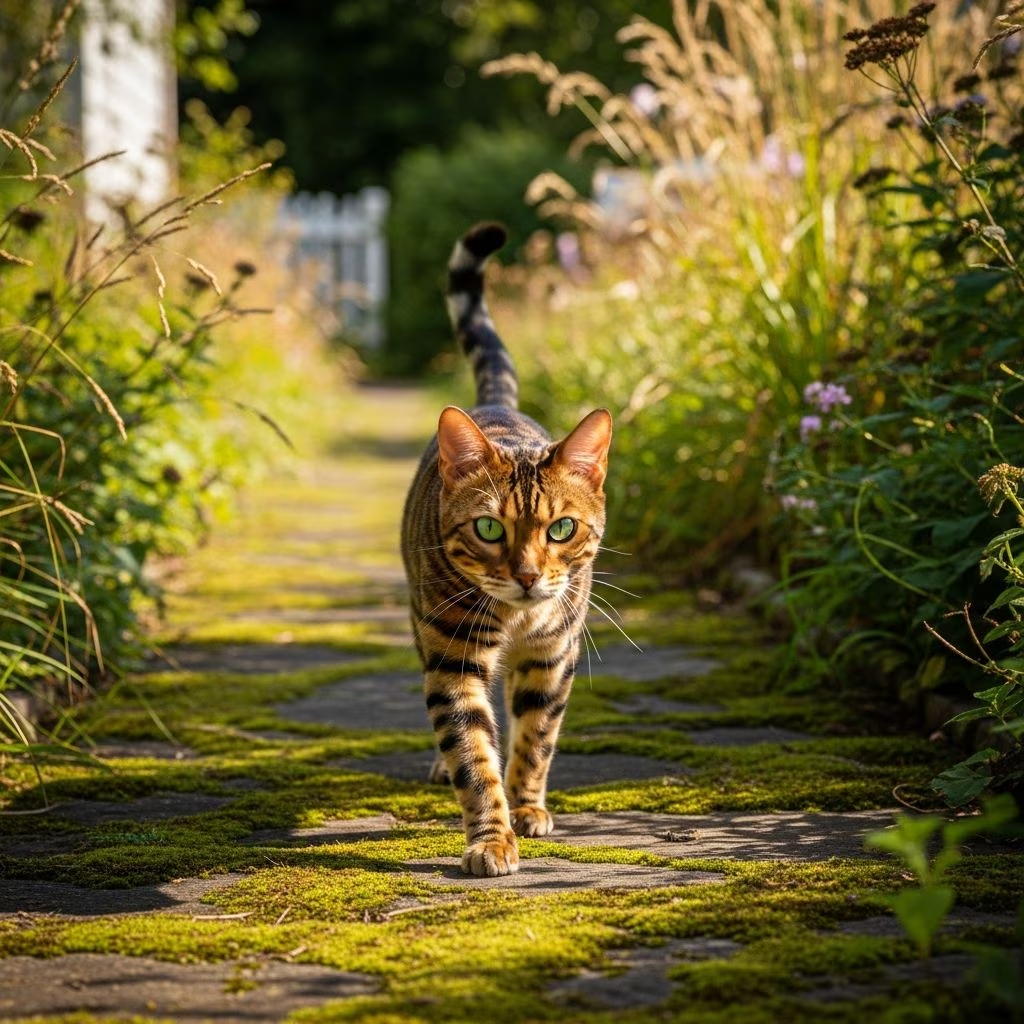
Bengal cats captivate pet lovers with their striking leopard-like coats and playful energy, but their wild heritage triggers varied legal restrictions nationwide. Ownership legality hinges on filial generations from the Asian leopard cat ancestor and state-specific statutes.
The Unique Heritage Fueling Legal Debates
Bengal cats emerged from crosses between domestic shorthairs and Asian leopard cats (Prionailurus bengalensis), blending wild aesthetics with tame temperaments. Early generations (F1-F3) retain more wild traits, prompting concerns over safety and invasiveness, though later ones (F4+) behave like standard felines.
Legislators classify them under exotic animal rules to curb potential escapes or aggression, despite registrations from bodies like The International Cat Association (TICA) or Cat Fanciers’ Association (CFA) certifying domestication. Without papers proving lineage, even advanced generations risk seizure.
Why Restrictions Persist: Safety, Ecology, and Ignorance
Prohibitions stem from fears of wild hybrids escaping and disrupting ecosystems, hybrid vigor leading to unpredictability, or simple conflation with true exotics like servals. Hawaii’s total ban guards its fragile biodiversity, while urban areas like Seattle prioritize public safety.
Misunderstandings amplify issues; a New York tiger incident spurred Bengal curbs despite vast differences. Evolving federal laws, like the Big Cat Public Safety Act, indirectly influence state policies by tightening exotic trade.
State-by-State Legal Breakdown
Laws diverge sharply: some ban outright, others demand permits or generational proofs. Always verify municipal codes, as cities override states.
| State | Status | Key Requirements |
|---|---|---|
| Alaska | Regulated | F4+ only; registered pedigree for prior four generations |
| California | Legal | No specific rules |
| Connecticut | Illegal | All generations prohibited |
| Delaware | Regulated | Permit required |
| Colorado | Legal (with caveats) | No state law; Denver needs five captive generations |
| Georgia | Regulated | Permit needed |
| Hawaii | Illegal | All Bengals banned |
| Iowa | Regulated | F4+; prior four generations domestic crosses |
| Indiana | Legal | No restrictions |
| Massachusetts | Regulated | Three-generation wild-free registry certification |
| New York | Regulated | F5+; TICA/CFA registered; NYC ban |
| Washington | Regulated | Illegal in Seattle; varies elsewhere |
| Utah | Legal | TICA-recognized exempt from hybrid ban |
This table highlights patterns: Western states lean permissive, while Northeastern and island ones impose hurdles. Unlisted states often default to local rules or allow with standard pet licenses.
Navigating Permits and Registrations
Where regulated, secure papers early. TICA/CFA pedigrees prove filial status, essential for transport or sales. Permits involve fees, inspections, and liability insurance—e.g., Georgia mandates wildlife permits with caging standards.
- Generation Tracking: F1 (direct leopard cross) rare and wild-like; F5+ fully domestic per most laws.
- Breeder Due Diligence: Demand verifiable lineage; unregistered kittens invite fines.
- Interstate Moves: Comply with both origin and destination rules to avoid confiscation.
Consequences of Non-Compliance
Violations yield steep penalties: fines up to $10,000, jail time, or cat forfeiture to sanctuaries. Hawaii enforces strictly to protect endemic species; Connecticut views all Bengals as wildlife. Courts rarely sympathize without proof of domestication.
Beyond the U.S.: Global Perspectives
Internationally, Australia demands F5+, while the UK permits all with standard registrations. These mirror U.S. concerns but adapt to local wildlife threats, underscoring Bengals’ universal appeal amid caution.
Tips for Lawful Bengal Ownership
- Research via state wildlife departments and TICA.org.
- Purchase from ethical breeders with full pedigrees.
- Microchip and insure against liabilities.
- Join clubs for updates on law changes.
- Spay/neuter to prevent accidental wild breeding.
These steps ensure joy without jeopardy.
Common Myths Debunked
- Myth: All Bengals are wild. False—F4+ match domestic cats in behavior.
- Myth: Federal law governs. No—states dominate, with federal input on big cats.
- Myth: Registration optional. Critical for legality proofs.
Frequently Asked Questions (FAQs)
Are Bengal cats legal everywhere in the U.S.?
No, bans exist in Connecticut and Hawaii; many require generational proofs or permits.
What generation Bengal is safest legally?
F5+ with TICA/CFA papers, accepted widely.
Can I own a Bengal in NYC?
No, fully prohibited regardless of generation.
Do I need a permit for a Bengal in California?
No state-level rules, but check cities.
Why ban Bengals if they’re domesticated?
Ancestry triggers exotic statutes; ecological risks cited.
Future Outlook for Bengal Laws
As breeding advances and data affirms safety, restrictions may ease. Advocacy from CFA pushes for uniform domestication recognition. Monitor bills via wildlife agencies for shifts post-2026.
References
- State Laws for Exotic Cats — Big Cat Rescue. 2023-12-22. https://bigcatrescue.org/conservation-news/state-laws-exotic-cats
- Are Bengal Cats Illegal in Some States? 2026 Update — Catster. 2026. https://www.catster.com/lifestyle/are-bengal-cats-illegal-in-some-states/
- Bengal Cats Remain Illegal Throughout the U.S. | Expert — Weblio Weekly. 2023-11-05. https://news.weblioph.com/2023/11/05/bengal-cats-remain-illegal-throughout-the-u-s-expert/
- Bengal – Breed Standard — Cat Fanciers’ Association. 2024. https://cfa.org/breed/bengal/
- Bengal Cats and the Law — Quality Bengal Kittens. 2023. https://quality-bengal-kittens.com/bengal-cat-blog/blog/bengal-cats-and-the-law-should-i-register-my-new-bengal-kitten



