
Bacterial Threats In Aquaculture: Prevention And Diagnostics
Exploring key bacterial pathogens affecting fish and shellfish farming, their impacts, and proven management strategies worldwide.
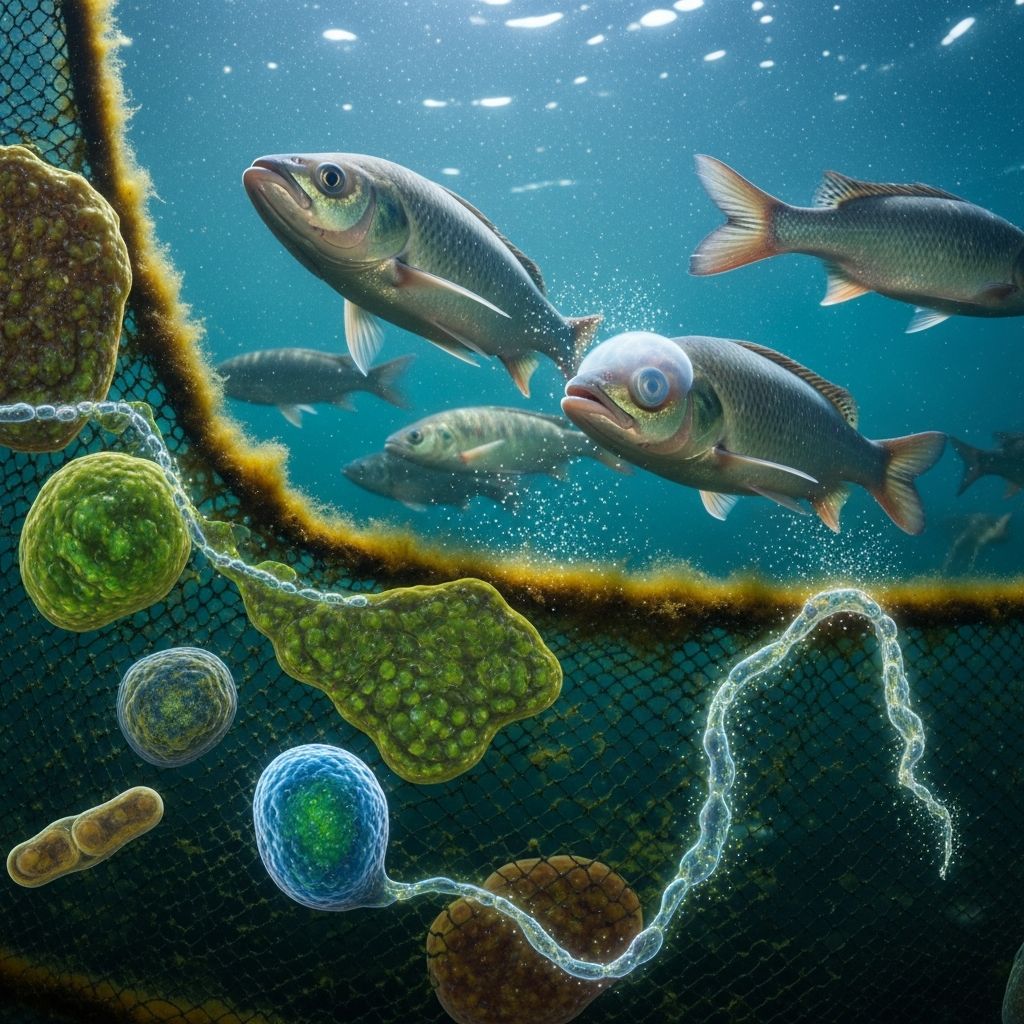
Bacterial infections pose significant risks to aquaculture operations worldwide, leading to substantial economic losses through high mortality rates in farmed fish and shellfish. These pathogens thrive in intensive farming environments, exacerbated by factors like poor water quality, overcrowding, and stress on aquatic species. Understanding their biology, transmission, and control is essential for sustainable production.
Prevalent Bacterial Pathogens in Farmed Species
Aquaculture faces a diverse array of bacterial threats, with Proteobacteria dominating, particularly Gammaproteobacteria species like Vibrio, which account for over half of documented pathogens. Databases catalog over 210 species, including emerging ones in genera such as Acinetobacter, Edwardsiella, and Pseudomonas.
Actinobacteria contribute pathogens like those in Mycobacteriaceae and Nocardiaceae, causing chronic infections. Bacteroidota genera, including Flavobacterium and Tenacibaculum, represent major concerns, comprising 87% of entries in specialized pathogen lists, with recent additions like Flavobacterium bernadetii and Tenacibaculum finnmarkense.
Vibriosis: A Global Concern
Vibriosis, caused by various Vibrio species, affects over 50 fish species in freshwater and marine systems, including eel, seabass, shrimp, and salmon. Vibrio anguillarum leads to hemorrhagic septicemia, with global distribution across cold, temperate, and tropical zones. Diagnostics rely on salt media like TCBS agar.
Vibrio harveyi induces luminescent vibriosis in shrimp larvae, grouper, and snapper, prevalent in warm waters. Eggs often get colonized pre-hatch, necessitating spawner removal and egg rinsing. Vibrio vulnificus targets eel in warm regions and carries zoonotic risks via biotypes 1 and 2.
Cold-water variants like Aliivibrio salmonicida (hitra disease) hit Atlantic salmon and trout since 1977 in Norway and beyond. Photobacterium damselae causes pasteurellosis in yellowtail, sea bass, and tuna. Vibrio species show higher abundance in active fish farms, posing environmental threats.
Aeromoniasis and Furunculosis
Aeromonas salmonicida subsp. salmonicida triggers classical furunculosis in salmonids and marine fish, with atypical forms causing carp erythrodermatitis. These occur in cold to temperate zones, identified by brown pigment on agar. Vaccines are available for management.
Aeromonas infections often follow nutritional imbalances or stressors like high ammonia and overcrowding, amplifying pathogenicity in juveniles.
Columnaris and Flavobacterial Diseases
Flavobacterium columnare causes columnaris disease, a devastating issue in freshwater fish globally. Related species like F. oreochromis and F. covae also emerge as threats. Symptoms include gill erosion and skin lesions, worsened by low oxygen and turbidity.
- Transmission: Primarily via water.
- Mortality: Up to 25% in outbreaks.
- Susceptible stages: Juveniles and larvae.
Mycobacteriosis and Nocardiosis
Mycobacterium marinum and M. fortuitum cause fish tuberculosis in tilapia, catfish, and cyprinids worldwide. Slow-growing on special media, diagnosed with Ziehl-Neelsen stain. Antibiotics fail to cure; zoonotic potential exists.
Nocardia species, including N. crassostreae in Pacific oysters and mussels, form typical colonies on selective media. Global in fish, regional in shellfish (USA, Japan, Netherlands). Incurable with antibiotics.
Clinical Manifestations and Diagnostics
Bacterial diseases manifest as septicemia, ulcers, fin rot, and internal hemorrhages. Vibriosis shows luminous glow in V. harveyi cases; furunculosis features boils. Gill diseases like bacterial gill disease (BGD) cause respiratory distress at temperatures up to 20°C.
Diagnostics standardize on culture media: TCBS for Vibrio, pigment checks for Aeromonas, ZN-stain for mycobacteria. Molecular tools and databases aid identification of novel pathogens.
| Disease | Key Signs | Diagnostic Tool |
|---|---|---|
| Vibriosis | Hemorrhages, luminescence | TCBS agar |
| Furunculosis | Skin boils, pigment | Brown agar colonies |
| Columnaris | Gill erosion, lesions | Selective media |
| Mycobacteriosis | Granulomas | ZN stain |
Epidemiology and Risk Factors
Diseases surge in high-intensity farms due to nutrient-rich waters favoring Vibrio and Photobacterium. Southeast Asia reports recurrent Vibrio in farms, linked to feed overload. Marine species face Aeromonas salmonicida, Pseudomonas anguilliseptica, Moritella viscosa, and Lactococcus garvieae.
Environmental stressors—overstocking, poor hygiene, temperature shifts—trigger outbreaks. Juveniles suffer highest mortalities, impacting trade and production.
Prevention and Management Strategies
Vaccines exist for vibriosis (V. anguillarum, A. salmonicida), hitra disease, and furunculosis. Hygiene prevents V. vulnificus at eel farms; egg rinsing curbs V. harveyi.
Water quality management—oxygen levels, ammonia control—reduces columnaris and BGD. Probiotics and immunostimulants show promise, though epidemiological data gaps hinder progress in many regions.
NOAA emphasizes healthy stocks resist infections better. Integrated approaches: biosecurity, monitoring, and early diagnostics sustain aquaculture.
Emerging Challenges and Future Directions
Databases track over 120 Proteobacteria pathogens, with new Flavobacterium and Chryseobacterium species. Antimicrobial resistance and climate-driven spread demand vaccine innovation and surveillance.
Global cooperation via FAO workshops addresses tropical threats. Research focuses on vaccines replacing antibiotics for sustainability.
Frequently Asked Questions (FAQs)
What causes most bacterial outbreaks in fish farms?
Stressors like overcrowding, poor water quality, and high nutrients promote pathogens like Vibrio.
Are aquaculture bacterial diseases zoonotic?
Some, like V. vulnificus and M. marinum, pose human health risks.
Can vaccines control vibriosis?
Yes, effective for species like V. anguillarum and A. salmonicida.
How to diagnose columnaris disease?
Use selective media for Flavobacterium columnare culture.
What prevents mycobacteriosis spread?
Biosecurity and culling, as antibiotics fail.
References
- Aquaculture bacterial pathogen database — PMC – NIH. 2023-08-21. https://pmc.ncbi.nlm.nih.gov/articles/PMC10448209/
- MAJOR BACTERIAL DISEASES AFFECTING AQUACULTURE — FAO. 2017. https://www.fao.org/fi/static-media/MeetingDocuments/WorkshopAMR/presentations/07_Haenen.pdf
- Bacterial diseases in marine fish species: current trends and future — PMC – NIH. 2023. https://pmc.ncbi.nlm.nih.gov/articles/PMC10518295/
- An overview on understanding the major bacterial fish diseases in — Frontiers. 2025. https://www.frontiersin.org/journals/aquaculture/articles/10.3389/faquc.2025.1515831/full
- Aquaculture Fish Health — NOAA Fisheries. 2023. https://www.fisheries.noaa.gov/national/aquaculture/aquaculture-fish-health
- Major bacterial diseases in aquaculture and their vaccine — CABI. 2012. https://www.cabidigitallibrary.org/doi/10.1079/PAVSNNR20127048
Similar Articles








Read full bio of medha deb


