

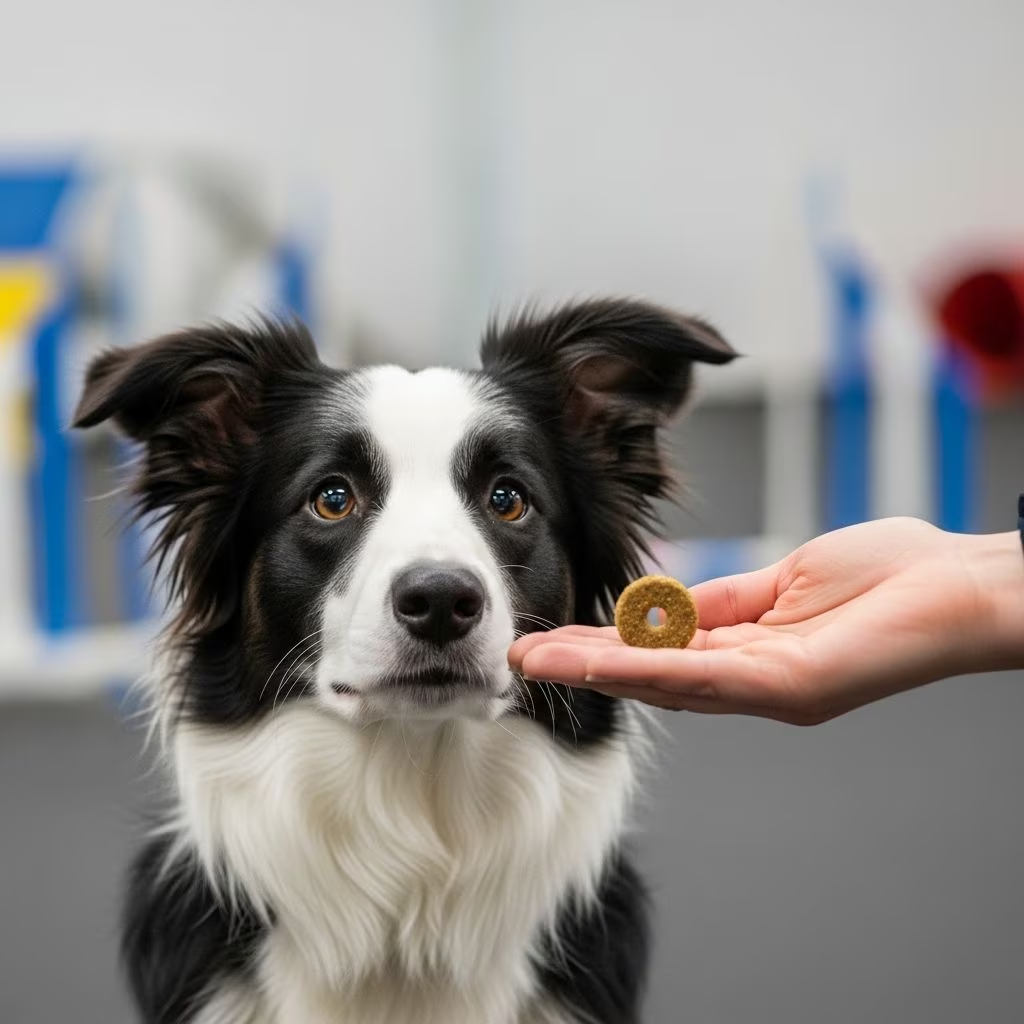
Poisoned cues happen when a dog associates a training command with both rewards and negative experiences, leading to confusion, hesitation, or avoidance. This undermines reliability and enthusiasm in behaviors like recall or sit, turning what should be a clear signal into an unreliable one.
Understanding the Basics of Cue Poisoning
In dog training, a cue serves as a clear signal for a specific action, such as sitting or coming when called. When introduced properly, dogs link the cue directly to positive outcomes like treats or play. However, poisoning occurs when the same cue pairs with unpleasant events, creating ambiguity. The dog no longer knows if following the cue brings joy or discomfort, resulting in suppressed responses.
This issue arises subtly. Trainers might use positive methods initially but switch to corrections like leash yanks or scolding once they think the dog ‘knows’ the behavior. Even mild force, such as pushing a dog’s rear for a sit, can taint the cue because dogs perceive it as aversive.
Common Ways Cues Get Poisoned
Several scenarios frequently lead to poisoned cues. Here’s a breakdown:
- Recall commands during fun interruptions: Calling a dog away from chasing a squirrel or playing with another dog often ends the enjoyment, associating ‘come’ with loss rather than gain.
- Mixing rewards and punishments: Starting with treats but adding corrections for errors poisons the cue, as the dog anticipates both possibilities.
- Physical manipulations: Forcing positions, like pressing down for a sit or pulling on a leash, links discomfort to the verbal cue.
- Inconsistent household use: Family members repeating cues without reinforcement or using them angrily dilutes their value.
- Environmental aversions: Training in stressful spots, like near loud noises, can indirectly poison cues tied to those settings.
Recall, or the ‘come’ command, tops the list of commonly poisoned cues because it’s invoked in high-distraction moments when dogs prefer other activities.
Spotting the Signs of a Poisoned Cue
Dogs communicate poisoned cues through body language and response changes. Watch for these indicators:
| Sign | Description | Implication |
|---|---|---|
| Slow or hesitant response | Dog pauses, sniffs ground, or looks away before complying | Anticipating negativity over reward |
| Avoidance behaviors | Turning head, lip licking, yawning, or freezing | Stress signals showing conflict |
| Opposite actions | Jumping instead of sitting or running away on recall | Cue no longer predicts desired behavior |
| Declining reliability | Behavior works in low distraction but fails elsewhere | Ambiguous association weakening cue |
| Stress manifestations | Whale eye, tucked tail, or shutdown | Emotional suppression from fear |
Early detection prevents escalation. If a once-eager dog now dodges your requests, the cue likely carries negative baggage.
Why Positive Reinforcement Prevents Poisoning
Positive reinforcement builds cues solely on rewards, eliminating ambiguity. Dogs learn that cues guarantee good things, fostering eager compliance without fear. Key principles include:
- Pair cues only with high-value reinforcers like food, toys, or praise.
- Avoid any aversives, even mild ones, during cue-associated moments.
- Ensure every cue instance ends positively, regardless of perfection.
Research from animal behavior supports this: Behaviors reinforced positively extinguish slower and generalize better than those mixed with punishment. The American Kennel Club emphasizes clear, consistent reinforcement to maintain cue integrity.
Step-by-Step Guide to Fixing Poisoned Cues
Recovering a poisoned cue requires patience and a clean slate. Follow these steps:
- Assess the damage: Test the cue in low-distraction settings. Note response quality without repeating or punishing.
- Choose a new cue: Switch words or signals to bypass old associations, like ‘here’ instead of ‘come’.
- Rebuild with positives: Lure or shape the behavior using rewards only. Start captures without the cue, then add it once fluent.
- Boost value: Use jackpots—extra rewards—for quick responses to rebuild enthusiasm.
- Generalize gradually: Practice in increasing distractions, always rewarding heavily.
- Monitor progress: Track response speed and stress; regress if signs reappear.
Retraining the same cue is possible but riskier, as residual negativity may linger. A fresh cue often yields faster results. Expect 2-4 weeks for solid recovery with daily sessions.
Preventing Poisoned Cues from the Start
Proactive habits safeguard training:
- Train in neutral environments first. Build strength before distractions.
- Never repeat cues. Wait calmly or use a leash to guide without verbal nagging.
- Family alignment: Educate household on consistent, positive use.
- Read body language: Stop if stress appears; end on a high note.
- Proof positively: Increase challenges with rewards, not corrections.
For recall, make it a party: Run away playfully, reward arrivals with games, and never call to end fun.
Real-World Examples and Case Studies
Consider a puppy trained to sit with treats, but later pushed into position during outings. The sit cue slowed, accompanied by avoidance. Switching to ‘park’ and retraining restored speed.
Another case: A service dog in training associated ‘forward’ with a scary vacuum nearby. Relocating sessions and pairing with toys fixed it, proving environmental poisons are fixable.
These illustrate that poisoning sneaks in via well-meaning actions, but positive resets work universally.
Advanced Strategies for Bulletproof Cues
Once basics are solid, layer in complexity:
- Variable reinforcement: Randomize rewards to mimic real life, enhancing persistence.
- Cue hierarchies: Teach emergency recalls separate from everyday ones.
- Play integration: Embed cues in games for joyful associations.
Track progress with a journal: Note sessions, responses, and reinforcer types for data-driven tweaks.
FAQs on Poisoned Cues
Q: Can all cues be poisoned?
A: Yes, any verbal, visual, or situational cue can if paired with negatives. Recall is most vulnerable due to its use.
Q: How long to fix a poisoned cue?
A: Varies by severity; mild cases take days, severe ones weeks with consistent positive work.
Q: Is physical prompting always bad?
A: In cue contexts, yes—it risks poisoning. Use luring or shaping instead.
Q: What if my dog ignores cues completely?
A: Prevent escalation by managing environment (leash, fences) while retraining.
Q: Do professional trainers poison cues?
A: Even experts can accidentally, often from rushing proofing. Slow, positive methods minimize risks.
Long-Term Benefits of Clean Cues
Maintaining unpoisoned cues yields a confident, responsive dog eager for interaction. Owners report fewer frustrations, stronger bonds, and safer off-leash freedom. Investing now prevents future retraining headaches.
References
- Beware of the Poisoned Dog Cue — Whole Dog Journal. 2023. https://www.whole-dog-journal.com/training/beware-of-the-poisoned-dog-cue/
- Linking Physical Skills to Poisoned Cues — The Moving Canine. 2022. https://themovingcanine.com/physical-skills/linking-physical-skills-to-poisoned-cues/
- Unintended Consequences: Understanding Poisoned Cues — Fenzi Dog Sports Academy. 2023. https://www.fenzidogsportsacademy.com/blog/poisoned-cues
- The Poisoned Cue — Dog Partners. 2021. https://www.dogpartners.ca/the_poisoned_cue
- Poisoned Cues in Dog Training: What They Are and What to Do — American Kennel Club (AKC). 2024. https://www.akc.org/expert-advice/training/poisoned-cues-what-they-are-and-what-to-do/
- A Few Thoughts About Poisoned Cues — Stale Cheerios. 2020. http://stalecheerios.com/training-concepts/thoughts-poisoned-cues/
- Come! One of the Most Poisoned Cues in Dog Training — Pawsitively Waggin Academy. 2023. https://www.pawsitivelywagginacademy.com/post/come-one-of-the-most-poisoned-cues-in-dog-training



