

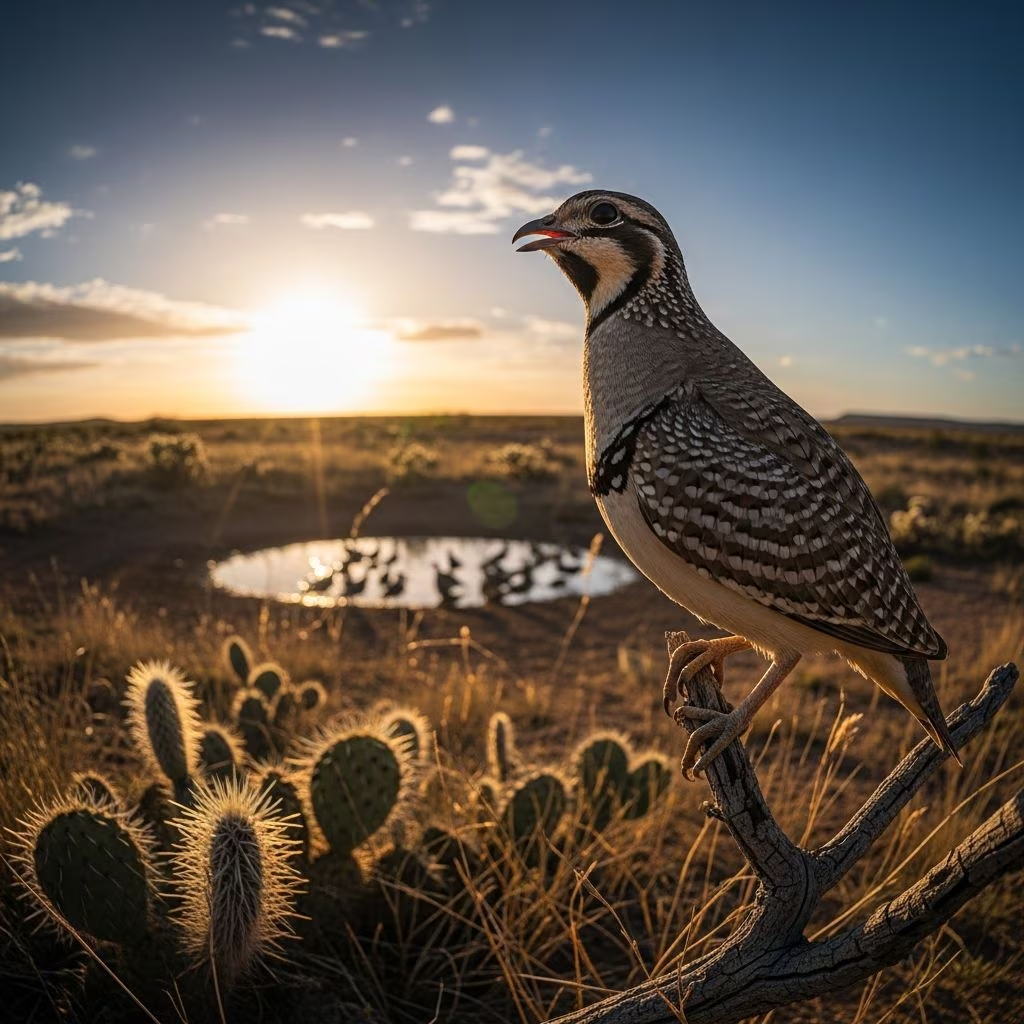
Arid-land birds face one of nature’s toughest challenges: thriving in environments where water is scarcer than rain. These resilient creatures have evolved a suite of behavioral, physiological, and anatomical adaptations to secure hydration, balancing the demands of high metabolism and intense heat. This article delves into their strategies, drawing from peer-reviewed research to reveal how they turn scarcity into survival.
Behavioral Tactics to Minimize Water Loss
Desert birds prioritize timing and microhabitat selection to evade peak heat. They restrict activity to cooler dawn and dusk periods, reducing panting and evaporation. For instance, species like zebra finches forage pre-emptively before midday highs, retreating to shaded spots during the hottest hours.
- Avoidance of Heat Peaks: By hunkering down in burrows or under vegetation when temperatures soar above 35°C, birds prevent excessive water loss through respiration.
- Strategic Watering Visits: Those near sources flock to oases, rivers, or artificial baths at dawn, concentrating activity where hydration is assured.
- Adjusted Foraging: Granivores shift to seeds with higher moisture content during droughts, optimizing intake without long exposures.
These behaviors not only conserve water but also maintain energy balance, as prolonged heat exposure hampers feeding efficiency.
Physiological Marvels: Kidneys and Metabolic Efficiency
Birds possess superior kidneys that produce highly concentrated urine, far exceeding mammalian capabilities. This allows arid species to extract maximal water from scant dietary sources. Small granivores like sparrows and finches derive nearly all hydration from the 5-10% moisture in seeds, supplemented by metabolic water from oxidation—about 0.95 ml per gram of fat metabolized.
| Adaptation | Benefit | Example Species |
|---|---|---|
| Hyper-efficient Kidneys | Urine concentration up to 1,200 mOsm/L | Desert sparrows |
| Metabolic Water Production | Meets 20-50% daily needs | Zebra finches |
| Reduced Gut Water Flux | Minimizes loss in digestion | Seed-eating finches |
Field studies confirm zebra finches’ water turnover rates (4.5 ml/day) align with predictions for desert birds, 50-100% below mesic counterparts, underscoring their frugality.
Dietary Innovations: Food as a Water Pipeline
Many arid birds bypass free-standing water by targeting hydrating foods. Insectivores snag juicy larvae, nectarivores tap floral sugars (80% water), and frugivores consume pulpy fruits. Even seed-eaters metabolize dry kernels efficiently, yielding enough water for lifelong hydration without drinking.
- Insect and Nectar Diets: Provide 70-90% water by mass, ideal for high-energy needs.
- Seed Specialists: Extract micro-moisture via specialized digestion, thriving in remote dunes.
- Opportunistic Shifts: During rains, pivot to germinating seeds bursting with hydration.
Evaporative Cooling: A High-Stakes Trade-Off
Heat dissipation demands water, creating a hydration-cooling dilemma. Drinking species excel here, ramping evaporative loss 12-fold via panting, tolerating 52°C+ versus 50°C for non-drinkers. This capacity stems from reliable water access, enabling aggressive cooling without dehydration risk.
Non-drinkers cap at 8-fold increases, prioritizing conservation. Zebra finches, for example, endure hyperthermia (body temps to 44°C) briefly, delaying evaporation until shade returns.
Extraordinary Transporters: The Sandgrouse Phenomenon
Male Namaqua sandgrouse epitomize dedication, commuting 30 km twice daily to waterholes. Their belly feathers, uniquely papillated and coiled, absorb 20-40 ml like sponges, retaining half during return flights. Chicks extract this by preening, vital as fledglings can’t fly for weeks.

SEM imaging reveals feather barbs with thousands of tiny hooks trapping water via capillary action, a 20-million-year evolutionary refinement.
Heatwave Resilience: Integrated Responses
During extremes (T_a >40°C), birds integrate tactics: hyperthermia, gular fluttering, wing-spreading, and reduced activity. Southern pied babblers lose mass above 35.5°C due to foraging cuts, but granivores like finches maintain balance via high digestibility and pre-dawn binges.
| Condition | Foraging Change | Water Turnover |
|---|---|---|
| Cool Days (<35°C) | Normal | Baseline |
| Heatwaves (>40°C) | 80% reduction midday | Increased drinking |
Comparative Physiology: Drinkers vs. Abstainers
Research on 12 Nama Karoo songbirds shows drinkers’ superior heat tolerance links to cooling scope. Metabolic rates rise less steeply, preserving energy. This co-evolution ties water access to thermal limits, shaping distributions.
Implications for Conservation in a Warming World
Climate change intensifies droughts, stressing even adapted species. Zebra finches showed breeding crashes after prolonged dry spells. Artificial water points aid, but habitat loss compounds risks. Understanding these strategies informs targeted interventions.
Frequently Asked Questions
How long can desert birds survive without drinking?
Seed-eaters like finches may never drink, relying on food moisture lifelong.
What enables sandgrouse to carry water in feathers?
Specialized belly barbs create capillary reservoirs, holding 25+ ml per bird.
Do all desert birds pant to cool off?
Yes, but drinkers pant more aggressively, tolerating higher temps.
How much water do small desert birds need daily?
Zebra finches: ~4.5 ml, mostly metabolic.
Can backyard water help desert birds?
Absolutely—baths attract concentrations during scarcity.
References
- Desert Birds: How Do Birds Drink Water? Part 1 — Birds.com. 2023. https://www.birds.com/blog/desert-birds-how-do-birds-drink-water-part-1/
- Drinking desert birds keep cool — Journal of Experimental Biology. 2020-08-26. https://journals.biologists.com/jeb/article/223/17/jeb214494/225906/Drinking-desert-birds-keep-cool
- The Field Metabolic Rate, Water Turnover, and Feeding and Drinking Behaviour of Zebra Finches During a Heatwave — PMC/NCBI. 2019-11-13. https://pmc.ncbi.nlm.nih.gov/articles/PMC6879461/
- Regularly drinking desert birds have greater evaporative cooling capacity — Functional Ecology. 2021. https://besjournals.onlinelibrary.wiley.com/doi/10.1111/1365-2435.13573
- Stuffing Water into Bird Feathers — APS Physics. 2023. https://link.aps.org/doi/10.1103/Physics.16.95
- Structure and mechanics of water-holding feathers of Namaqua sandgrouse — Royal Society Interface. 2023. https://royalsocietypublishing.org/rsif/article/20/201/20220878/90364/Structure-and-mechanics-of-water-holding-feathers



