

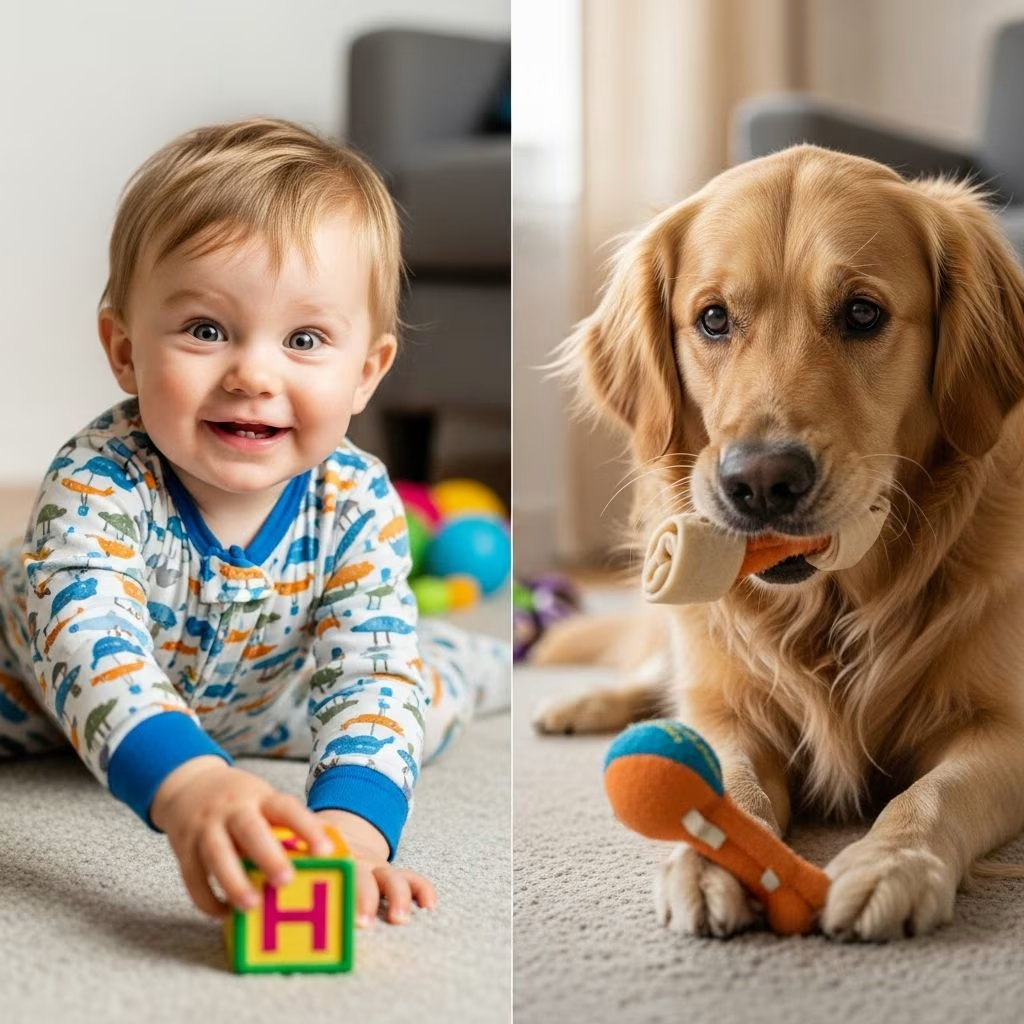
Past research indicates that dogs’ mental abilities and social intelligence align closely with those of human toddlers aged 2 to 2.5 years. Veterinary experts, such as Dr. Mondrian Contreras from Pumpkin Pet Insurance, use this analogy to help pet owners grasp their dogs’ behaviors, though they caution it’s an oversimplification. Dogs and toddlers share dependencies on caregivers, learning through trial and error, social cues, routines, positive reinforcement, repetition, and language signals. However, dogs possess superior senses like smell and hearing, enabling them to detect human fear via sweat or stress via breath changes—abilities beyond toddlers. This comparison highlights grains of truth but overlooks dogs’ capacity for self-control, household nuance understanding, and experiential consequences.
Do dogs really think like toddlers?
Determining how dogs think remains challenging without direct communication, but evidence suggests parallels and distinctions with toddler cognition. A 2017 University of Arizona study found dogs’ cooperative communication skills surpass chimpanzees and match 2-year-old children, particularly in following nonverbal cues like pointed fingers or gazes. Service dogs demonstrate advanced training and trust-building, indicating progression beyond toddler levels, as noted by Dr. Preston Turano of ASPCA Pet Health Insurance. Psychologist Stanley Coren estimates average dogs have a mental age of about 2.5 years in vocabulary (up to 165 words), counting small quantities, and emotional awareness, with exceptional cases like border collie Chaser understanding over 1,000 words.
Yet, stark differences exist: dogs lack abstract reasoning or recursive language comprehension that toddlers develop toward ages 7-10, treating words as signals rather than symbols. Toddlers and puppies both depend on caregivers, but dogs excel in sensory-based problem-solving and associative learning, such as linking a button push to treats after observation. Unlike toddlers preparing for complex philosophy, dogs focus on present-moment sensory input—eyes for body language, noses and ears for navigation—with heightened smell and hearing.
- Shared cognitive traits: Dependency on routines, positive reinforcement learning, social cue interpretation.
- Dog advantages: Acute smell/hearing for emotional detection, self-control via experience.
- Toddler edges: Emerging abstract thought, symbolic language.
Do dogs handle emotions like toddlers?
Dogs form profound emotional bonds often more complex than toddlers’, experiencing anxiety, depression, fear, excitement, and joy, which deepen over time with human-animal bonds. Toddlers’ underdeveloped emotional processing creates some similarity, as both show distress in separation, rely on caregivers for safety and affection, and respond to tone, expressions, and gestures. Parenting styles—permissive, authoritarian, or balanced—affect both: balanced approaches foster sociability and problem-solving in dogs and children.
Dogs express emotions via whines, barks, growls, ear positions, and tail tucks, providing clear signals. Studies confirm dogs feel human-like emotions including love, sadness, and jealousy. Three-year-olds with dogs show higher pro-social behavior, hinting at mutual emotional benefits. However, adult dogs’ emotional complexity exceeds toddlers’ due to lifelong bond maturation.
| Aspect | Dogs | Toddlers |
|---|---|---|
| Emotional Range | Anxiety, joy, complex bonds | Basic processing, developing complexity |
| Attachment Style | Secure base for exploration, separation distress | Same, caregiver-dependent |
| Expression | Vocalizations, body language | Crying, tantrums, words |
So how do dogs think?
Dogs perceive the world primarily through senses, prioritizing smell and hearing over vision, which aids body language reading and present-moment focus—a Zen-like state. They employ associative learning for anticipation: repeated experiences link actions to outcomes, like treats from button pushes, though frustration arises in novel puzzles. Dogs thrive on positive reinforcement and routines, akin to humans.
Three intelligence types define canine cognition: instinctive (breed-specific tasks), adaptive (environmental problem-solving), and working/obedience (trainability). Cooperative evolution with humans honed dogs’ social intelligence, potentially informing human evolution studies. While not toddlers, dogs mirror young children in key social and emotional domains, enriched by superior senses.
Frequently Asked Questions (FAQs)
Q: Do dogs have the same mental age as toddlers?
A: Average dogs match 2-2.5-year-old toddlers in vocabulary, counting, and social skills, per behavioral studies, but lack abstract reasoning.
Q: Can dogs smell human emotions like fear?
A: Yes, via sweat and breath changes, surpassing human and toddler sensory capabilities.
Q: Are dogs’ emotional bonds stronger than toddlers’?
A: Often more complex due to lifelong development, including advanced joy, anxiety, and attachment.
Q: How do dogs learn differently from toddlers?
A: Through sensory association and present-focus, not symbolic language or future abstraction.
Q: Do parenting styles affect dogs like children?
A: Yes, balanced affection and limits improve sociability and problem-solving in both.
References
- Are Dogs Really Just Permanent Toddlers? — Kinship. 2023. https://www.kinship.com/dog-behavior/are-dogs-like-toddlers
- Dogs May Have Social Skills Similar to Toddlers, Study Shows — American Kennel Club (AKC). 2019-10-24. https://www.akc.org/expert-advice/news/dogs-social-skills-study-shows/
- Dog Versus Baby Intelligence: A Comparison — Evolution News (Science and Culture). 2025-02. https://scienceandculture.com/2025/02/dog-versus-baby-intelligence-a-comparison/
- Are Dogs the New Kids? Science Says… Sort Of — National Canine Research Council. N/A. https://nationalcanineresearchcouncil.com/are-dogs-the-new-kids-science-says-sort-of/
- Dogs’ Intelligence on Par with 2-Year-Old Humans — American Psychological Association (APA). 2009-08. https://www.apa.org/news/press/releases/2009/08/dogs-think



