

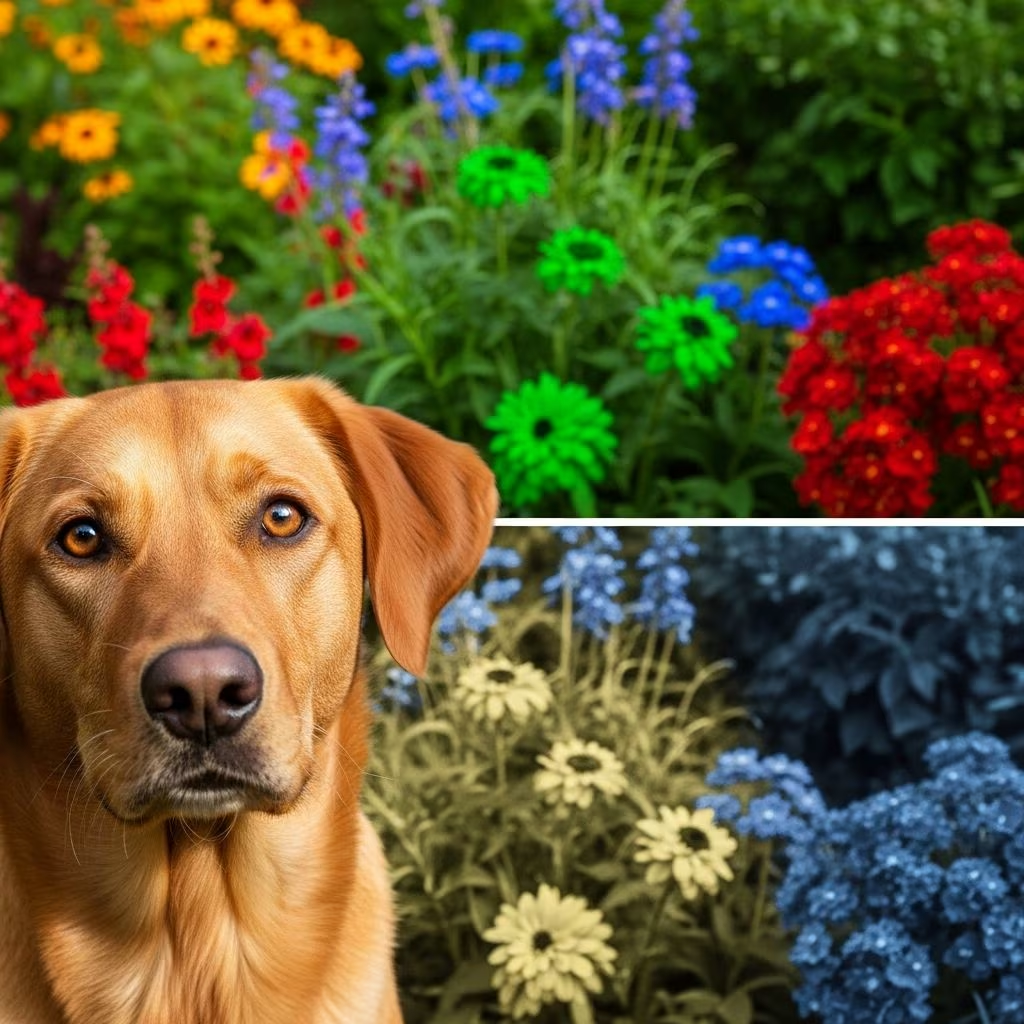
The common belief that dogs see the world in black and white is a myth. Dogs possess **dichromatic color vision**, meaning they have two types of cone cells in their retinas sensitive to blue and yellow wavelengths, unlike humans’ three cones for red, green, and blue. This vision resembles human red-green color blindness, where reds and greens appear as shades of yellow or gray.
How Dog Vision Differs from Human Vision
Dogs’ eyes contain two cone pigments: one peaking at 429 nm (blue-violet) and another at 555 nm (yellow-green). This setup limits their color spectrum compared to humans’ trichromatic vision spanning red (564 nm), green (534 nm), and blue (420 nm). Dogs perceive the world with less color variety but enhanced motion detection and low-light sensitivity due to more rod cells.
Human vision excels in detail and color richness under bright light. Dogs, however, have visual acuity 4-8 times poorer, prioritizing brightness discrimination over fine details. Their brightness sensitivity is about half as precise as humans’, yet color cues often override brightness in discrimination tasks.
What Colors Can Dogs See?
Dogs distinguish **blues and yellows** most vividly. The visible spectrum for dogs translates as:
- Red: Grayish-brown or dark yellow
- Orange: Dark yellow
- Yellow: Light yellow
- Green: Grayish-yellow
- Blue: Light or dark blue
- Violet: Blue
This palette arises from their two cones combining signals into yellow-blue variations. Studies confirm dogs cannot differentiate reds from greens, merging them into yellow-gray hues.
| Color | Human Perception | Dog Perception |
|---|---|---|
| Red | Bright red | Grayish-brown/dark yellow |
| Green | Vivid green | Grayish-yellow |
| Blue | Deep blue | Dark blue |
| Yellow | Bright yellow | Light yellow |
Table: Comparative color perception. Data from spectral sensitivity studies.
The Science Behind Dog Color Vision
Neurobiological research identifies two cone classes in canine retinas, enabling dichromatic vision akin to human deuteranopia (red-green blindness). Visual-evoked potentials and immunohistochemistry confirm sensitivities at 555 nm and 429 nm.
Behavioral experiments validate this. In a modified Ishihara test (used for human color blindness), dogs showed longer looking times and alerting responses to red-green cat stimuli indistinguishable to deuteranopes, but not to achromatic versions. This indicates color reliance over brightness.
Another study trained eight mixed-breed dogs to associate food with colored papers (dark/light yellow vs. blue). In tests pitting color against brightness, dogs chose correctly by color 70-100% of the time, proving active color use.
Historical Myths and Modern Discoveries
The ‘dogs are color blind’ myth stemmed from early assumptions of mammalian monochrome vision. Pioneering work by Dr. Jay Neitz revealed dogs’ blue-yellow capabilities, influencing training and toy design. His research showed absence of red-sensitive cones, confirming limited but functional color sight.
Peer-reviewed studies since have used associative learning with food rewards. Dogs discriminate hues better than brightness alone, as in Kasparson et al.’s findings where color proved more informative.
How Dogs Use Color in Everyday Life
Despite limitations, dogs leverage color for object recognition, navigation, and play. They excel at spotting blue toys against green grass, where humans might struggle. Training benefits: Use blue/yellow cues over red/green for commands or agility courses.
In hunting or herding, motion and brightness dominate, but color aids in distinguishing prey or flock from terrain. Owners note dogs ignoring red toys but chasing blue balls avidly, aligning with cone sensitivities.
Canine Vision Strengths Beyond Color
- Night Vision: More rods provide superior low-light performance.
- Motion Detection: Higher flicker fusion rate spots fast movements.
- Field of View: Wider peripheral vision (240° vs. humans’ 180°).
- Brightness Discrimination: Detects subtle luminance changes, though less precise than color.
Toy and Training Tips for Dog Vision
Optimize playthings with high-contrast blues, yellows, and whites. Avoid reds/greens that blend into backgrounds. For training:
- Use blue flags for ‘sit’ in grassy fields.
- Yellow tennis balls stand out vividly.
- Fluorescent toys enhance visibility at dusk.
Trainers now incorporate color science, shifting from brightness-only methods.
Frequently Asked Questions (FAQs)
Are dogs completely color blind?
No, dogs have dichromatic vision, seeing blues and yellows but not reds/greens distinctly.
What do reds and greens look like to dogs?
Reds appear as dark yellow/grayish-brown; greens as grayish-yellow, often indistinguishable.
Can all dog breeds see color the same way?
Yes, all dogs share similar cone types; breed differences affect acuity, not color palette.
Do dogs see better at night than humans?
Yes, due to more rod cells and a reflective tapetum lucidum layer.
Should I buy colorful toys for my dog?
Choose blues, yellows, and high-contrast patterns for best visibility.
Implications for Dog Owners
Understanding canine vision fosters empathy. A ‘dull’ world to us bursts with detectable blues amid yellow-grays for dogs. Adjust environments: blue bowls prevent food guarding mishaps; yellow leashes aid recall. Health-wise, vision changes signal issues—consult vets for sudden blindness.
Research evolves; while foundational studies date back, recent behavioral confirmations hold. Future tech like dog-vision cameras simulate their view, aiding design.
References
- Are dogs red–green colour blind? — Proc Biol Sci / PMC. 2017-11-08. https://pmc.ncbi.nlm.nih.gov/articles/PMC5717654/
- New Study Shows That Dogs Use Color Vision After All — Smithsonian Magazine. 2013-10-23. https://www.smithsonianmag.com/science-nature/new-study-shows-that-dogs-use-color-vision-after-all-13168563/
- Dr. Jay Neitz featured in article on canine eyesight — UW Medicine Ophthalmology. 2023. https://ophthalmology.washington.edu/news/dr-jay-neitz-featured-in-article-on-canine-eyesight
- Dogs Are Not Actually Fully Colorblind — Psychology Today. 2022-05-01. https://www.psychologytoday.com/us/blog/canine-corner/202205/dogs-are-not-actually-fully-colorblind



