

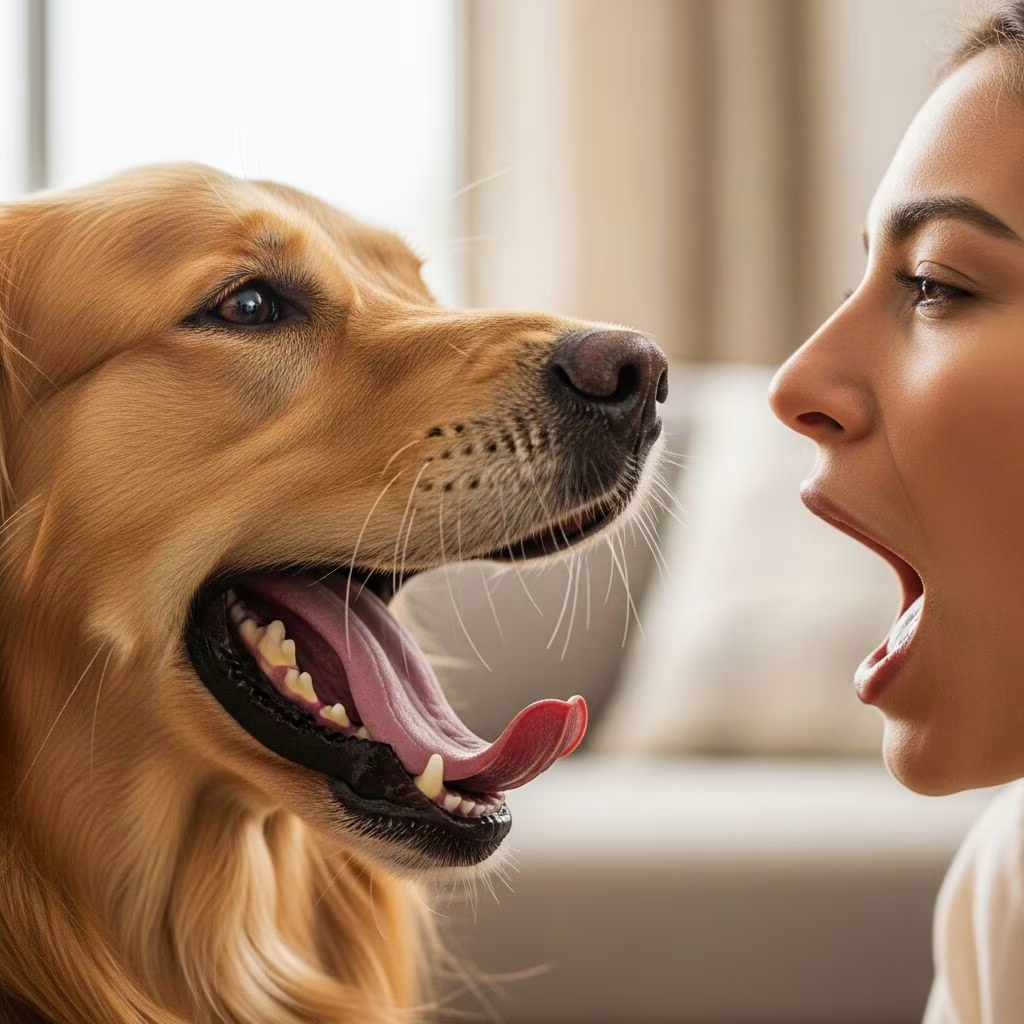
Are Dog Yawns Contagious? Understanding the Phenomenon
If you’ve ever noticed your dog yawning shortly after you yawn, you’re not imagining things. Contagious yawning in dogs is a real phenomenon that has captured the attention of scientists and dog lovers alike. Research has demonstrated that dogs do indeed catch yawns from humans, and this behavior offers fascinating insights into the emotional lives of our canine companions.
Contagious yawning refers to the tendency to yawn after seeing, hearing, or thinking about another individual yawning. While this behavior is well-documented in humans, scientists have more recently discovered that dogs share this capacity with us, suggesting deeper connections between our species than previously understood.
The Science Behind Contagious Yawning in Dogs
Early research on contagious yawning in dogs provided compelling evidence for this behavior. A landmark study conducted in 2008 by researchers at the University of London demonstrated that dogs could indeed catch yawns from humans, with approximately 72% of the subjects yawning after observing a human model yawn. This groundbreaking finding opened new avenues for understanding dog behavior and cognition.
Subsequent research has expanded our understanding of this phenomenon. Scientists have worked to determine not only whether dogs yawn contagiously, but also to understand the underlying mechanisms driving this behavior. Multiple studies have now confirmed that contagious yawning is not a random occurrence but rather a structured response influenced by several factors.
Is Contagious Yawning Related to Empathy?
One of the most intriguing questions surrounding contagious yawning in dogs is whether it indicates empathy. The relationship between contagious yawning and empathy has become central to understanding this behavior. Evolutionary biologists have long suggested that humans yawn contagiously because of our capacity for empathy—our ability to understand and share the emotions of others.
Researchers from the University of Tokyo conducted a comprehensive study involving 25 dogs and their owners to investigate this connection. The study found that dogs yawned significantly more frequently when observing their owners yawn compared to when watching strangers yawn. This familiarity bias suggests an emotional component to the behavior, supporting the empathy hypothesis.
What made this research particularly compelling was the inclusion of physiological measurements. The researchers monitored the dogs’ heart rates throughout the experiment using telemetric measures. The findings showed that subjects’ heart rates did not differ significantly between conditions, effectively ruling out the possibility that the yawning was merely a stress response or sign of anxiety.
Key Findings About Dog Yawn Contagion
Research has revealed several important patterns regarding contagious yawning in dogs:
- Developmental progression: Dogs show a developmental increase in susceptibility to yawn contagion. Studies of puppies aged 4 to 14 months revealed that only dogs above 7 months of age consistently demonstrated contagious yawning, suggesting this ability develops over time.
- Familiarity matters: Dogs yawn more frequently when the yawning model is someone familiar to them, such as their owner, compared to unfamiliar people. This pattern mirrors empathic responses, where emotional closeness influences behavioral responses.
- Visual perception is important: The perception and recognition of the yawning behavior appears to be crucial. The eye region of yawning individuals may be particularly potent in triggering yawn contagion, as dogs need to recognize and process the behavioral cue.
- Not stress-related: Multiple studies have demonstrated that contagious yawning in dogs is not driven by stress or anxiety, distinguishing it from yawning that occurs in response to actual stressful situations.
Conflicting Research and Ongoing Debates
While many studies support the empathy-linked explanation for contagious yawning in dogs, the research landscape is not entirely uniform. Some studies have produced contradictory findings regarding the role of emotional closeness in modulating contagious yawning.
One notable study of puppies aged 4 to 14 months found that while dogs demonstrated contagious yawning, emotional closeness with the yawning model did not significantly affect the strength of contagion. This finding raised questions about whether the previous evidence of emotionally modulated auditory contagious yawning in dogs was reliable.
Researchers have attributed these discrepancies to differences in study methodology. Some investigations used video presentations of yawning, while others used live demonstrations. Some studies examined responses to human yawning, while others included dog-to-dog yawn contagion. These methodological variations may explain why conclusions differ across studies.
Despite these inconsistencies, the weight of evidence suggests that contagious yawning is indeed present in dogs and is likely influenced by social and emotional factors, though the precise mechanisms remain an area of active research.
What Contagious Yawning Reveals About Canine Empathy
Contagious yawning may indicate rudimentary forms of empathy in domesticated dogs. The fact that this behavior develops over time, increases with familiarity, and occurs without stress suggests it operates through empathic mechanisms similar to those in humans.
The connection to empathy is particularly significant because it suggests dogs possess cognitive and emotional capabilities more sophisticated than once believed. Understanding these abilities has broader implications for how we interact with dogs and recognize their emotional sophistication.
Research on contagious yawning may also help us better understand how different dog breeds process human social cues and their suitability for various roles in human society, from service dogs to therapy animals. Dogs with stronger empathic responses may be better suited for roles requiring attunement to human emotional states.
How Contagious Yawning Works in Dogs
The mechanism underlying contagious yawning in dogs appears to involve several components working in concert. Dogs must first perceive and recognize the yawning behavior in another individual. This visual recognition triggers a response through pathways associated with empathy and emotional understanding.
The involvement of emotional bonds suggests that the dog’s brain processes the identity and significance of the yawning individual, with stronger bonds potentially enhancing the likelihood of contagion. This represents a form of social cognition that goes beyond simple mimicry.
The developmental pattern—with the ability to yawn contagiously emerging around 7 months of age in puppies—suggests this capacity depends on neurodevelopmental maturation. The timing coincides with when puppies develop increased capacity for recognizing and responding to emotional cues from others.
Comparing Dog and Human Contagious Yawning
The parallels between contagious yawning in dogs and humans are striking. Both species show developmental increases in susceptibility to contagion, with humans typically displaying a substantial increase around age four. Both are influenced by emotional closeness and social bonds. And in both cases, the phenomenon appears linked to empathic capacities rather than stress responses.
These similarities suggest that contagious yawning relies on developmental processes shared across species, pointing to common evolutionary origins for empathic abilities. This cross-species consistency strengthens the argument that yawn contagion reflects genuine empathic capacity rather than a learned behavior or simple mimicry.
Why Your Dog Yawns When You Yawn
When your dog yawns after you yawn, it likely reflects their attunement to your emotional state and their bond with you. As the dog observes your yawn, they process this social cue through their empathic systems, resulting in a yawn response.
This behavior is more likely to occur with dogs who have strong emotional connections to you and who have developed the neurological capacity to recognize and respond to social cues. Young puppies may not yet show this behavior, while adult dogs with secure attachments are more likely to demonstrate it.
Interestingly, observant dog owners often notice this pattern and interpret it as a sign of their dog’s attunement and affection—an interpretation that scientific evidence increasingly supports.
Frequently Asked Questions About Contagious Yawning in Dogs
Q: Can all dogs catch yawns from humans?
A: Not necessarily. Dogs below approximately 7 months of age have not yet developed the capacity for contagious yawning. Additionally, individual differences in empathic sensitivity and attachment styles may influence susceptibility.
Q: Is contagious yawning a sign of anxiety in dogs?
A: No. Research utilizing physiological monitoring has ruled out anxiety as the mechanism. Dogs’ heart rates remain unchanged during contagious yawning episodes, distinguishing this behavior from stress-related yawning.
Q: Do dogs yawn contagiously from other dogs?
A: While most research has focused on dog-human yawn contagion, some evidence suggests that dog-to-dog contagious yawning may also occur, though this area requires further investigation.
Q: Does contagious yawning mean my dog loves me?
A: Contagious yawning is more likely to occur between dogs and their familiar caregivers, suggesting it reflects emotional bonds and attunement. While not a definitive measure of love, it indicates your dog is attuned to you emotionally.
Q: Can dog yawn contagion be trained or taught?
A: Contagious yawning appears to develop naturally as part of canine cognitive development rather than through training. However, building strong emotional bonds with your dog may enhance their responsiveness to your behavioral cues.
Q: Why don’t some studies agree on contagious yawning in dogs?
A: Research discrepancies often stem from differences in methodology, such as using video versus live demonstrations, examining different age groups, or testing dog-to-human versus dog-to-dog contagion. These methodological variations can produce different findings.
The Significance of Contagious Yawning for Understanding Dogs
Contagious yawning in dogs holds significance far beyond its curiosity value. It provides a window into how dogs process social information, recognize emotional states, and maintain social bonds. The behavior suggests that dogs possess sophisticated social cognition that allows them to recognize and respond empathically to others’ emotional expressions.
Understanding contagious yawning may help breeders and trainers identify dogs with strong empathic capacities, potentially improving selection for roles such as therapy dogs, service animals, or emotional support companions. It also contributes to our broader understanding of the human-dog relationship and why these animals have become such integral parts of human society.
References
- Contagious yawning in domestic dog puppies (Canis lupus familiaris) — National Center for Biotechnology Information (PubMed). 2012-09-21. https://pubmed.ncbi.nlm.nih.gov/23076724/
- Familiarity Bias and Physiological Responses in Contagious Yawning — PLOS ONE. 2013-08-15. https://journals.plos.org/plosone/article?id=10.1371/journal.pone.0071365
- Yawn contagion and empathy in dogs — The University of Tokyo. 2012. https://www.u-tokyo.ac.jp/focus/en/articles/a_00186.html
- Yawning Is Contagious Between Dogs and Humans — Psychology Today. 2023-11-15. https://www.psychologytoday.com/us/blog/gone-to-the-dogs/202311/yawning-is-contagious-between-dogs-and-humans
- Do Dogs Yawn Because Their Owners Do? — American Kennel Club. https://www.akc.org/expert-advice/lifestyle/do-dogs-yawn-because-owners-do/



