

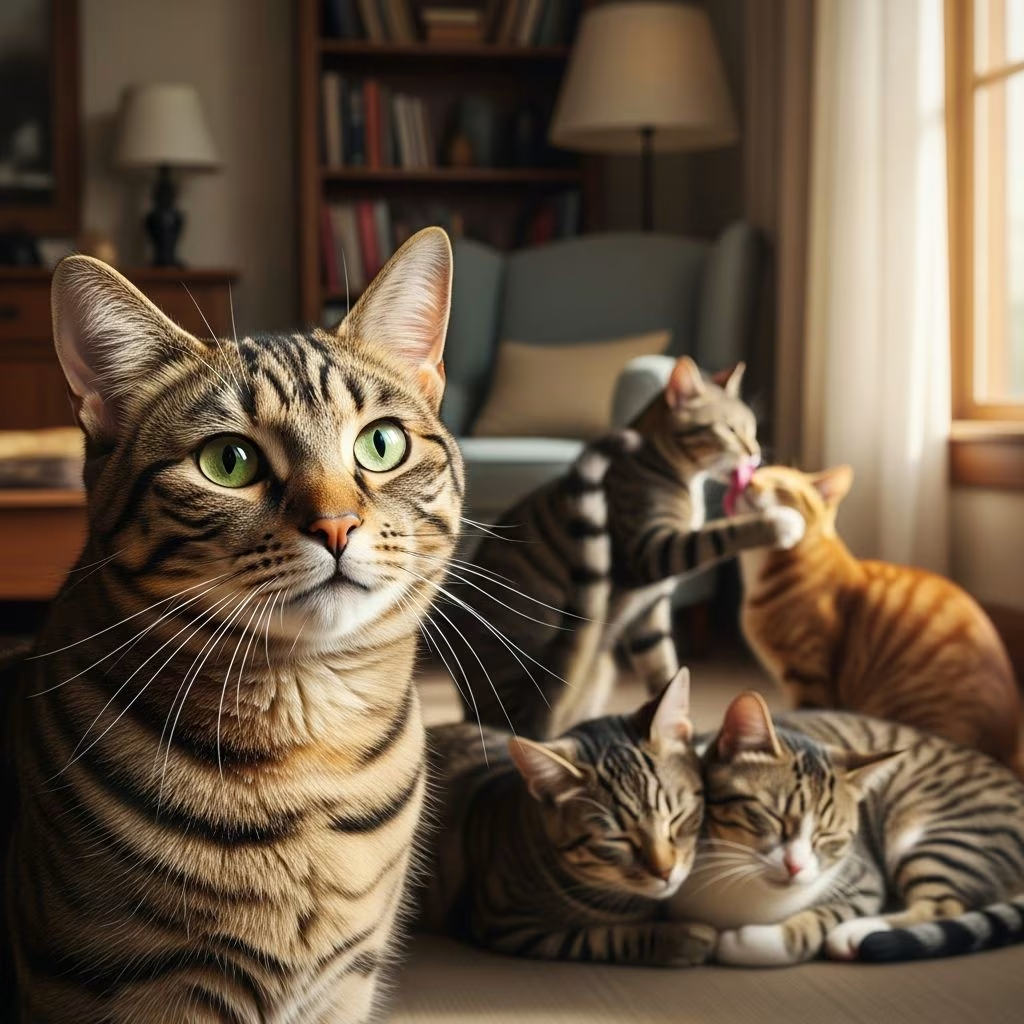
Cats exhibit a flexible form of sociability, forming groups in feral settings primarily around related females and their offspring, while maintaining solitary hunting instincts. This duality allows them to thrive both independently and in selective social contexts, particularly with humans who respect their boundaries.
The Roots of Feline Social Organization
In wild or feral environments, cats do not form rigid packs like wolves but instead create loose colonies centered on resource availability. These groups typically include multiple queens—adult females—and their kittens, with a small number of males visiting for mating purposes. The males maintain larger territories that overlap several such colonies, reflecting their solitary nature outside breeding seasons. Food scarcity or abundance directly influences group density; plentiful resources encourage closer proximity, while sparse conditions promote dispersal.
Cats manage relationships within these groups through a repertoire of behaviors. Affiliative actions, such as allorubbing (rubbing against each other), mutual grooming, and nose-to-nose greetings, signal trust and familiarity. Conversely, antagonistic displays like hissing, swatting, or outright fights enforce personal space and hierarchy when tensions arise. Cats with strong bonds position themselves closer during rest periods, yet they spend the majority of their time apart, underscoring their preference for independence.
Critical Windows for Social Development
The period between 2 and 7 weeks of age marks the prime socialization phase for kittens, when they are most receptive to new stimuli. During this sensitive window, exposure to diverse experiences—other cats, humans, sounds, smells, and textures—builds confidence and reduces future fear responses. Kittens handled gently by humans in this stage often develop into more outgoing adults.
Social maturity arrives around 7 to 12 months, coinciding with sexual maturity at 6 to 12 months. Young cats may remain with their natal group up to 12-18 months, solidifying bonds and learning group norms to avoid conflicts. Missing this early socialization can lead to wariness; however, well-socialized cats can rebound from negative encounters with relative ease, requiring only a few positive interactions to trust new people.
How Cats Bond with Humans
Domestic cats mirror their feral social strategies in human households, initiating contact on their terms while responding to owner cues. Studies of cat-owner dyads reveal symmetrical compliance: when one partner seeks interaction, the other often reciprocates, leading to balanced relationships. Cats do not inherently favor one human gender or age group but adjust behaviors based on how people approach them—women and girls, who crouch to cat level and speak softly, elicit more positive responses than abrupt advances by children or stationary men.
Interaction patterns vary by household. In high-interactivity homes, cats vocalize, rub, and approach frequently; in low ones, they adapt by reducing initiations while remaining content. Cats even attune to owner emotions, increasing affectionate behaviors like rubbing during human depressive states, potentially alleviating negative moods comparably to human companions.
Factors Shaping Cat-Human Dynamics
Several variables influence these bonds. Owner personality traits, such as high openness, correlate with calmer, less anxious cats. Cat age, sex, and cohabitation duration also play roles in temporal interaction patterns, with adults showing more reciprocity than juveniles. Well-socialized cats prove resilient, enduring multiple poor experiences before shying away, but thriving quickly under kind new guardians.
Cats demonstrate social cognition by recognizing their names and forming secure attachments to owners. They distinguish owner emotions via posture, voice, and even cross-modal cues like matching facial expressions to vocalizations, especially for intense feelings. This suggests cats hold mental models of their social partners’ states, enhancing mutual understanding.
Solitary Hunters in Social Skins
Despite social capabilities, cats remain obligate solitary hunters by evolution. They hunt alone but tolerate groups where benefits outweigh costs, such as shared kitten-rearing or defense. In homes, this translates to needing personal space alongside companionship. Environmental enrichment—separate litter boxes, scratching posts, high perches, and play outlets—prevents stress and fosters positive interactions.
| Aspect | Feral Cats | Domestic Cats |
|---|---|---|
| Group Composition | Queens + kittens, visiting males | Selective bonds with family/humans |
| Interaction Style | Affiliative & antagonistic as needed | Initiates on terms, reciprocal compliance |
| Space Preference | Mostly solitary, close when bonded | Needs safe retreats + play opportunities |
Enhancing Your Cat’s Social World
- Respect signals: Allow escapes from unwanted petting to build trust.
- Positive reinforcement: Use treats and play during calm approaches.
- Multi-cat homes: Introduce slowly with scent swapping to mimic natural affiliation.
- Sensitive period handling: For kittens, gentle daily human contact from weeks 2-7.
- Emotional attunement: Speak softly and match energy levels for better meshing.
Challenges in Multi-Cat Households
Introducing cats requires patience, as established hierarchies can spark antagonism. Provide ample resources to minimize competition—aim for n+1 of each essential (litter boxes, bowls) where n is cat number. Monitor for stress signs like over-grooming or hiding, intervening with separation if needed.
Cats’ Emotional Intelligence
Emerging research highlights cats’ sensitivity to human cues. They vocalize more and rub affectionately when owners are down, suggesting empathy-like responses. In experiments, cats match emotional voices to faces, indicating sophisticated partner modeling that strengthens bonds over time.
Common Misconceptions About Cat Sociability
Many view cats as aloof compared to dogs, yet this stems from anthropomorphism. Cats’ subtlety—slow blinks, tail flicks, purring—signals affection differently. Their independence reflects evolutionary adaptation, not disinterest.
FAQs
Can cats form strong bonds like dogs?
Yes, cats attach securely to owners, recognizing names and emotions, though they express it through subtle, initiated contacts.
What age is best for socializing kittens?
2-7 weeks; expose to varied stimuli gently for optimal outcomes.
Why do some cats avoid people?
Poor early socialization or negative experiences; well-socialized ones recover with positives.
Do cats prefer certain humans?
They respond to behaviors—gentle, low approaches from anyone yield positives.
How to tell if my cat likes social time?
Seeks proximity, rubs, slow blinks, purrs during interactions.
Optimizing Home Environments for Social Cats
Core needs include vertical space for oversight, scent-rich areas, and predictable routines. Interactive toys mimic hunting, while pheromone diffusers reduce anxiety. Consistent, positive human interactions during peak activity (dawn/dusk) enhance bonds.
References
- Social Behavior of Cats — Merck Veterinary Manual. 2023. https://www.merckvetmanual.com/behavior/behavior-of-cats/social-behavior-of-cats
- The Mechanics of Social Interactions Between Cats and Their Owners — PMC (Vitale et al.). 2021-04-21. https://pmc.ncbi.nlm.nih.gov/articles/PMC8044293/
- Unanswered Questions and Hypotheses about Domestic Cat Sociality — PMC (Turner). 2021-10-13. https://pmc.ncbi.nlm.nih.gov/articles/PMC8532687/
- Demystifying Feline Behavior — Penn Today, University of Pennsylvania. 2023. https://penntoday.upenn.edu/news/demystifying-feline-behavior
- What’s Going On Inside Your Cat’s Head? — American Psychological Association. 2023. https://www.apa.org/news/podcasts/speaking-of-psychology/cat-human-bond



