

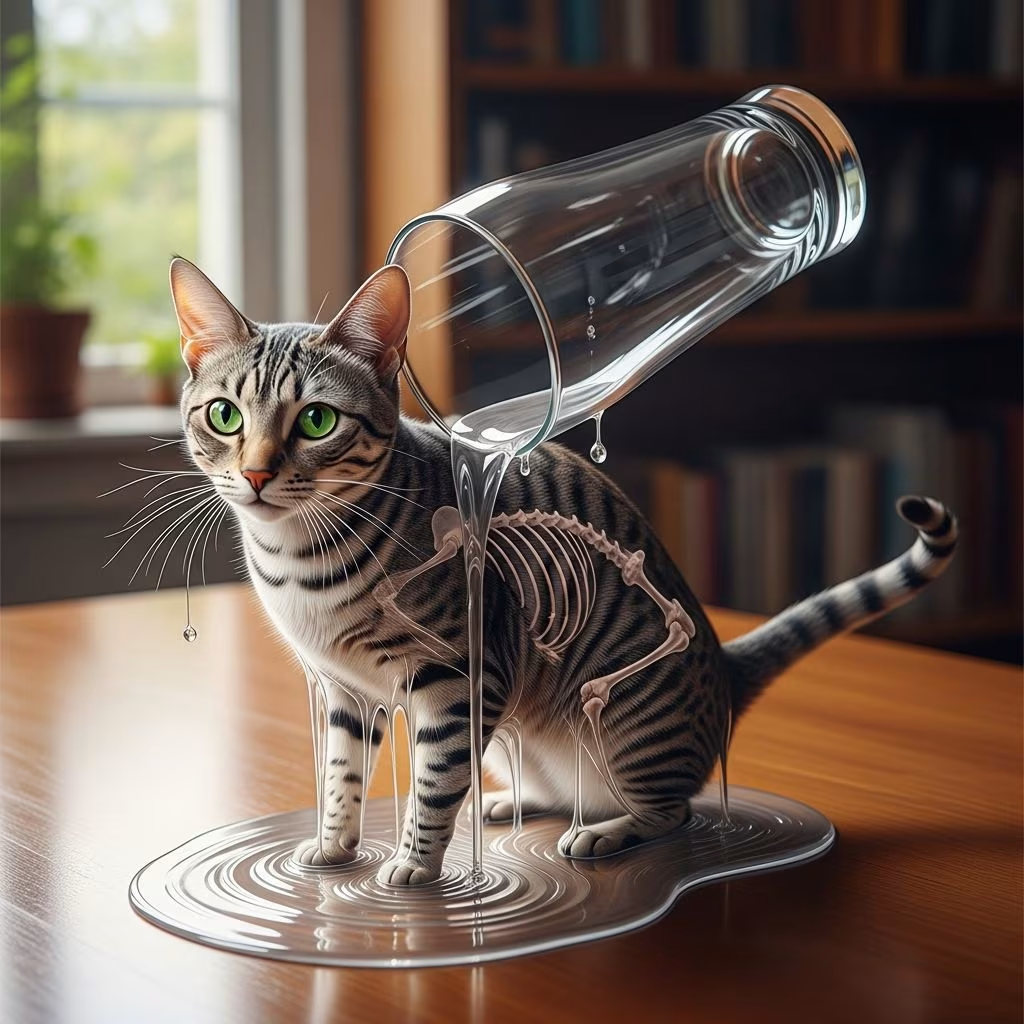
Cats have long captivated us with their seemingly supernatural ability to squeeze through impossibly small gaps, curl into tiny boxes, and flow like liquid into any available space. This phenomenon, popularized by viral videos and memes, prompted scientists to investigate: are cats actually liquid? While not literally fluid, cats exhibit remarkable fluid-like properties due to their unique anatomy and behaviour. This article explores the origins of the idea, key scientific studies, anatomical explanations, and what these observations reveal about feline intelligence.
Origins of the ‘Cats Are Liquid’ Meme
The notion that cats are liquid stems from everyday observations turned internet sensation. Photos of cats defying gravity by fitting into jars, suitcases, and crevices exploded online, with sites like Bored Panda compiling galleries that went viral. These images showcase cats flattening their bodies, elongating their torsos, and conforming perfectly to containers—behaviours reminiscent of poured liquids taking the shape of their vessels.
The meme gained scientific traction in 2014 when French physicist Marc-Antoine Fardin published ‘On the Rheology of Cats‘, blending humour with physics. Rheology, the study of matter flow and deformation, provided a framework to analyse feline antics. Fardin’s work, inspired by those viral photos, applied fluid dynamics equations to cats squeezing under furniture or loafing in boxes, concluding they behave as non-Newtonian fluids—solid most times but liquid when needed.
The Ig Nobel Prize-Winning Study
Fardin’s paper earned him the 2017 Ig Nobel Prize in Physics, awarded for achievements that ‘make people laugh, then think’. The Ig Nobel celebrates quirky science, and Fardin’s analysis fitted perfectly. He overlaid rheological calculations on cat photos: for instance, a cat in a jar showed surface tension-like spreading, while a ‘cat loaf’ demonstrated viscosity.
- Key Findings: Cats fill containers completely, altering shape without fracturing—hallmarks of liquidity.
- Fluid Classification: Cats as ‘complex fluids’ that flow under pressure but retain cohesion.
- Implications: This playful study popularized rheology in pop culture, leading to TEDx talks and widespread discussion.
Though tongue-in-cheek, the research highlighted real physics: cats’ density (about 1 g/cm³, similar to water) and flexibility allow liquid-mimicry.
Péter Pongrácz’s Groundbreaking Home Experiments
Building on the meme, biologist Péter Pongrácz from Eötvös Loránd University tested the hypothesis empirically. His 2024 iScience paper, ‘Cats are (almost) liquid!—Cats selectively rely on body size awareness when negotiating short openings‘, involved at-home trials with 38 cats in Budapest.
Methodology: Researchers created portable setups with cardboard panels on doorframes. Two configurations:
- Fixed height, decreasing width holes.
- Fixed width, decreasing height holes.
Cats moved from experimenter to owner through holes, filmed for analysis. Unlike lab-stressed dogs, home settings minimized feline anxiety.
Key Results
| Hole Type | Cats Hesitating | Behaviour |
|---|---|---|
| Narrowing Width (Tall Holes) | 8/30 cats | Trial-and-error: flowed through even half-body-width gaps without pause. |
| Shortening Height (Wide Holes) | 22/30 cats | Hesitated, slowed before shortest; aware of vertical limits. |
Cats acted liquid horizontally—squeezing effortlessly—but solid vertically, suggesting body-size representation. This mirrors Pongrácz’s 2019 dog study in Animal Cognition, where canines hesitated at small openings.
Wild implications: Hesitating at low holes preserves visibility against predators, even in safe homes.
The Anatomy Behind Feline Fluidity
Cats’ liquid-like feats stem from skeletal and muscular adaptations honed by evolution as agile hunters.
- Free-Floating Collarbones (Clavicles): Unlike fixed human collarbones, cats’ tiny clavicles float, allowing extreme shoulder compression. If head fits, body follows.
- Flexible Spine: 30 vertebrae (vs. humans’ 24) with hyper-elastic discs enable 1.5x body-length stretching.
- Compliant Ribcage: Eleven pairs of ribs spread sideways, reducing torso width by 50%.
- Soft Abdomen: Loose skin and minimal fat allow flattening.
Combined, these permit passage through gaps 70-80% of shoulder width. No true liquids, but superior to dogs (fixed clavicles limit them).
Are Cats Literally Liquid?
No—cats are mammals with solid skeletons, organs, and cells. They don’t flow involuntarily or evaporate. The ‘liquid’ label is metaphorical for behaviours mimicking fluids:
- Conform to Containers: Fill boxes, sinks, glasses completely.
- Impenetrable Gaps: Squeeze under doors (head-first strategy).
- Selective Solidity: Pongrácz shows context-awareness, not mindless flow.
Critics note: True liquids lack self-preservation; cats hesitate strategically. Still, their biology blurs solid-liquid lines uniquely.
Real-World Implications for Cat Owners
Understanding ‘liquid cats’ aids safety:
- Escape Risks: Tiny gaps = potential runaways; block with lattice.
- Enrichment: Boxes, tunnels exploit instincts for mental health.
- Health Checks: Excessive squeezing may signal stress or pain.
- Training: Use body awareness in agility or recall.
Vets confirm: Flexibility decreases with age/obesity; maintain via diet/exercise.
Comparisons: Cats vs. Other Animals
| Animal | Flexibility Level | Key Adaptation | Liquid-Like? |
|---|---|---|---|
| Cat | High | Floating clavicle, flexible spine | Yes (horizontal) |
| Dog | Medium | Fixed clavicle | No |
| Ferret | High | Long spine, narrow build | Yes |
| Snake | Extreme | No limbs, hydrostatic skeleton | Truly fluid |
Cats excel among pets; Pongrácz’s tests show superior horizontal confidence.
Frequently Asked Questions (FAQs)
Q: Can all cats squeeze like liquids?
A: Most can, thanks to shared anatomy, but breed (e.g., Persians less flexible), age, and weight affect ability.
Q: Why do cats enter tiny boxes?
A: Security instinct—enclosed spaces feel safe; they conform to fill completely.
Q: Is the rheology study serious science?
A: Playful yet rigorous; Ig Nobel highlights accessible physics.
Q: Do cats know their body size?
A: Yes, Pongrácz’s study shows selective awareness, especially vertically.
Q: How small a gap can cats fit through?
A: Typically shoulder-width minimum; experiments showed half-body-width horizontally.
Conclusion: Cats Are Master Shape-Shifters
From memes to peer-reviewed papers, ‘cats are liquid’ reveals profound biology and cognition. Fardin’s rheology and Pongrácz’s ethology prove felines aren’t fluids but evolution’s fluid mimics—flexible, aware, and endlessly fascinating. Next time your cat oozes under a door, appreciate the science behind the squeeze.
References
- At-home experiments shed light on cats’ liquid behavior — Science News. 2024-09-17. https://www.sciencenews.org/article/home-experiments-cats-liquid-behavior
- Are Cats Liquid? Exploring Their Flexibility — Cascade Kennels. 2024. https://www.cascadekennels.com/are-cats-liquid-exploring-their-flexibility/
- Settling the Age-Old Question Once and for All: Are Cats Liquid? — Animalia.pet. 2024. https://animalia.pet/knowledge/are-cats-liquid/
- Cats May Be Aware of Their Body Size, Suggests Study — Smithsonian Magazine. 2024. https://www.smithsonianmag.com/smart-news/cats-may-be-aware-of-their-body-size-suggests-study-of-their-famously-liquid-behavior-180985282/
- The Ig Nobel Prize: Why are Cats Liquid? — Stem Fellowship. 2024. https://live.stemfellowship.org/the-ig-nobel-prize-why-are-cats-liquid/



