

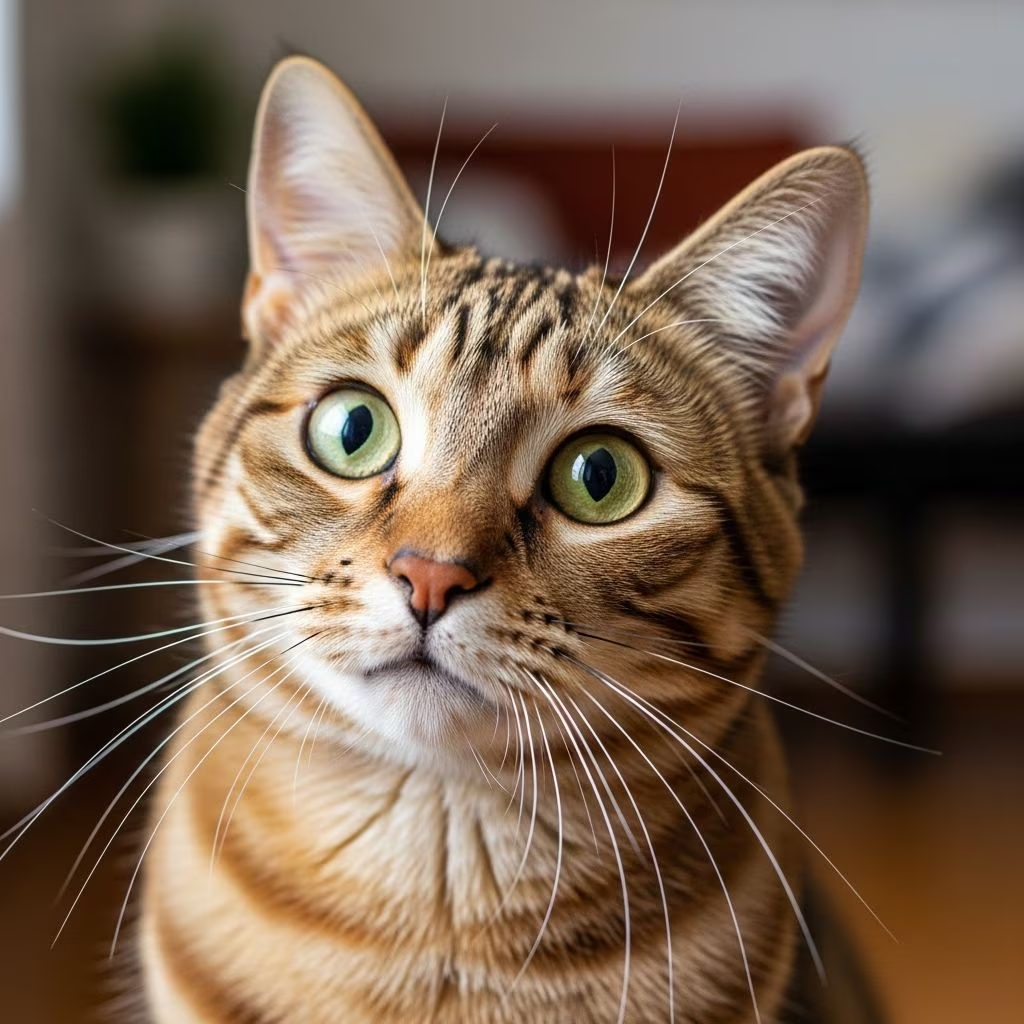
Cats are often stereotyped as aloof and independent, yet their penchant for investigating every nook, batting at moving objects, and squeezing into tight spaces suggests a deep-seated curiosity. But are cats truly curious, or is this behaviour driven by something more primal? This article delves into the science of feline curiosity, drawing from studies on cat behaviour, instincts, and personality traits to provide a comprehensive understanding.
Why Are Cats So Curious?
Curiosity in cats stems primarily from their evolutionary roots as both predators and prey. As mesopredators, cats must constantly scan their environment for opportunities to hunt or threats to evade, making vigilance and exploration essential survival tools. Mikel Delgado, Ph.D., explains that this dual role demands constant awareness: cats cannot miss a meal but must remain cautious of dangers.
Modern domestic cats retain these instincts, manifesting as playful investigation. For instance, knocking objects off counters or pawing at unfamiliar items isn’t mischief but a way to test their world. Research links this to intelligence: lively minds are inherently curious, and cats’ smarts drive them to learn through trial and error. A study highlighted how curiosity leads cats into predicaments like getting stuck in trash cans, underscoring its role in cognitive development.
Owners’ emotions also play a part. A 2015 study showed cats mirror human feelings: enthusiasm sparks their curiosity, while negativity breeds caution. Cats looked to owners 79% of the time post-stimulus, adopting similar emotional responses. This emotional transmission highlights the social bond influencing feline exploration.
The Science Behind Cat Curiosity
Scientific studies reveal nuanced views on cat curiosity. While popularly assumed boundless, a University of Sussex experiment with 18 cats challenged this. Cats preferred toys in expected boxes over surprising switches and engaged more with familiar people, suggesting they prioritise routine and safety over novelty. Unlike dogs or children thrilled by peek-a-boo, cats avoid uncertainty to maintain control.
Contrasting this, other research affirms curiosity’s presence. Domestic cats recognised owners’ names via images and voices, showing surprise at mismatches, indicating associative learning and interest in social cues. Personality clusters from a study of 55 cats identified ‘active, playful, curious, and easygoing’ traits linked to more affiliative behaviours.
Over 4,300 cats across 26 breeds revealed seven behavioural traits, including curiosity as a distinct factor, varying by individual. Kittens exhibit peak curiosity during their 2-9 week sensitive period, approaching novel stimuli cautiously to form safety associations. Adults retain this but grow warier, though bold cats actively explore new spaces for resources.
How Cats Show Their Curiosity
- Investigative Play: Batting, stalking, and pouncing mimic hunting, driven by prey drive even post-meal.
- Exploration of Spaces: Squeezing into boxes or cabinets tests hiding spots and safety.
- Sensory Testing: Sniffing, touching, and tasting new objects gathers data.
- Counter Surfing: Not just hunger; it’s foraging instinct in familiar territories.
- Social Mirroring: Responding to owner emotions with matching curiosity or caution.
These behaviours peak in youth but persist lifelong, aiding alertness. Curiosity evolved to keep wild cats safe, prompting bold exploration or strategic hiding. In homes, it fosters bonding, as researcher R.A. Butler noted: beyond basic needs, curiosity fulfils social drives in civilised settings.
Cat Personality Traits and Curiosity
Cats aren’t uniform; curiosity varies by personality. Stella and Croney’s study clustered cats into shy-calm (hiding more, slower to approach) versus active-curious (playful, vocal, affiliative). Owners’ descriptions align: curious cats perch higher, interact more.
A large-scale analysis of 4,300 cats pinpointed seven traits: curiosity among them, influenced by breed, age, and environment. Natural history matters too: understanding cats’ solitary origins, crepuscular patterns, and predatory behaviours predicts curious expressions. Observing without bias—’with senses, not stories’—reveals individual motivations.
| Personality Cluster | Curiosity Level | Behaviours |
|---|---|---|
| Shy, Calm, Timid | Low | Hides, slow approach, less play |
| Active, Playful, Curious | High | Affiliative, vocal, explores |
This table summarises coping styles under stress, showing how curiosity correlates with boldness.
Are All Cats Equally Curious?
No—age, socialisation, and experience modulate curiosity. Kittens learn rapidly, forming lifelong views; post-sensitive period, they’re cautious but not incurious. Neko Cafe cats recognised names calmly, unlike surprised home cats, suggesting environment tempers expression.
Feral roots emphasise caution: curiosity serves survival, not thrill-seeking. Vitale Shreve et al. found cats prefer specific social stimuli, choosing favourites in food, toys, scents, and interactions. Hunger isn’t always the driver; even sated cats forage curiously.
Nurturing Your Cat’s Curiosity Safely
Channel curiosity constructively:
- Provide enrichment: puzzle feeders, scratching posts, window perches.
- Rotate toys to mimic novelty without shock.
- Secure hazards: close cabinets, hide cords.
- Socialise early for confident explorers.
- Observe contexts: curiosity spikes in safe, routine settings.
Excessive curiosity may signal needs like enrichment or health issues—consult vets for sudden changes.
Curiosity Killed the Cat? Debunking Myths
The proverb warns of peril, yet curiosity educates. Studies show it’s adaptive: smart cats learn via exploration. Sussex findings clarify cats are selectively curious, preferring predictability. Owners foster it through positive emotions.
Frequently Asked Questions (FAQs)
Are cats naturally curious?
Yes, driven by predator-prey instincts and intelligence, though selectively.
Why do cats knock things over?
To investigate stability, movement, or sounds—testing their environment.
Do cats lose curiosity with age?
They become warier but retain inquisitiveness, especially bold individuals.
Can owners influence cat curiosity?
Absolutely—positive emotions boost it, negativity reduces exploration.
Is low curiosity a concern?
May indicate shyness or health issues; enrich environment and vet check.
Why do cats prefer boxes?
Boxes offer safe hiding, satisfying exploratory and secure instincts.
References
- Cats and science: three studies to explain their behaviour — Oasy. 2023. https://www.oasy.com/en/pet-news/useful-tips/studies-to-understand-cats-behaviour
- 8 Reasons Cats Are Curious & How They Show It — Rover.com. 2023. https://www.rover.com/blog/why-are-cats-so-curious/
- Wait! Cats AREN’T Curious? Here’s the Truth — Sparklecat.com. 2023. https://www.sparklecat.com/special/wait-cats-arent-curious-heres-the-truth
- Common misconceptions about the social behavior of domestic cats — PMC (Peer-reviewed). 2024-01-15. https://pmc.ncbi.nlm.nih.gov/articles/PMC10841747/
- Curiosity Educated the Cat: Applying Lessons Across Species — Pet Harmony Training. 2023. https://petharmonytraining.com/curiosity-educated-the-cat-applying-lessons-across-species/
- Curious cat? Scientists identify 7 feline behavioral personality traits — The Jerusalem Post. 2023. https://www.jpost.com/health-and-wellness/curious-cat-scientists-identify-7-feline-behavioral-personality-traits-678985



