Aquatic Turtle Housing: Complete Setup Guide
Learn how to create the perfect aquatic turtle habitat with proper tank size, filtration, and environmental conditions.
Aquatic Turtle Housing: Creating the Ideal Environment for Your Pet
Aquatic turtles are fascinating and long-lived reptile companions that can provide decades of enjoyment when properly cared for. One of the most critical aspects of turtle ownership is providing an appropriate housing environment. The quality of your turtle’s habitat directly impacts their health, longevity, and overall well-being. Understanding the specific requirements for aquatic turtle housing will help you create an environment where your turtle can thrive.
Tank Size and Dimensions
Selecting the correct tank size is fundamental to your aquatic turtle’s health and happiness. Many new turtle owners underestimate the space requirements these animals need. As a general rule, aquatic turtles require approximately 10 gallons of water per inch of shell length. This means a 5-inch turtle needs a minimum 40-gallon tank, while larger specimens require even more space.
For water depth, maintain at least one and a half to two times the turtle’s carapace length. For example, a 4-inch turtle should have water that is 6 to 8 inches deep. The tank itself should be at least four to five times longer and three to four times wider than the turtle to allow for adequate swimming and turning space.
Adult turtles typically require 90 to 120-gallon tanks to ensure they have sufficient swimming space and room to engage in natural behaviors. If housing multiple turtles together, increase the recommended tank size by 25% for each additional turtle. Always plan for growth, as many turtle species continue to increase in size throughout their lives.
Escape Prevention and Safety
Aquatic turtles are surprisingly good climbers and escape artists. Your enclosure must be 100% escape-proof with a secure, screened lid to prevent your turtle from escaping. A lost turtle in your home poses serious safety risks to the animal and makes recovery extremely difficult.
Additionally, turtles must be completely protected from children and other household pets. Consider housing your turtle in a dedicated room with no access by other animals, or ensure your tank has a secure, locking screen lid. This protects both your turtle and your other pets from potential harm.
Water Quality and Filtration
Maintaining clean water is essential for preventing respiratory infections and bacterial diseases in aquatic turtles. Proper filtration is critical to keeping water conditions optimal without requiring constant water changes.
Your filter should be rated for at least twice the number of gallons in your tank. For example, a 40-gallon tank should have a filter rated for at least 80 gallons. If you’re housing baby turtles, ensure the filter has a screen or protection on the intake so hatchlings cannot be sucked into it.
Monitor water quality regularly and perform partial water changes as needed. Keep the tank as full as possible once turtles are beyond the hatchling stage, as this maximizes swimming space and helps maintain water chemistry. Use turtle-safe water that has been treated to remove harmful chemicals.
Temperature and Heating Requirements
Aquatic and semi-aquatic turtles require specific temperature ranges to maintain proper metabolism and health. Generally, maintain these temperature ranges:
| Temperature Zone | Target Range | Purpose |
|---|---|---|
| Water Temperature | 72-82°F (depending on species) | Maintains metabolic function |
| Basking Area | 85-95°F | Thermoregulation and UVB absorption |
| Air Temperature | 75-85°F | Overall ambient conditions |
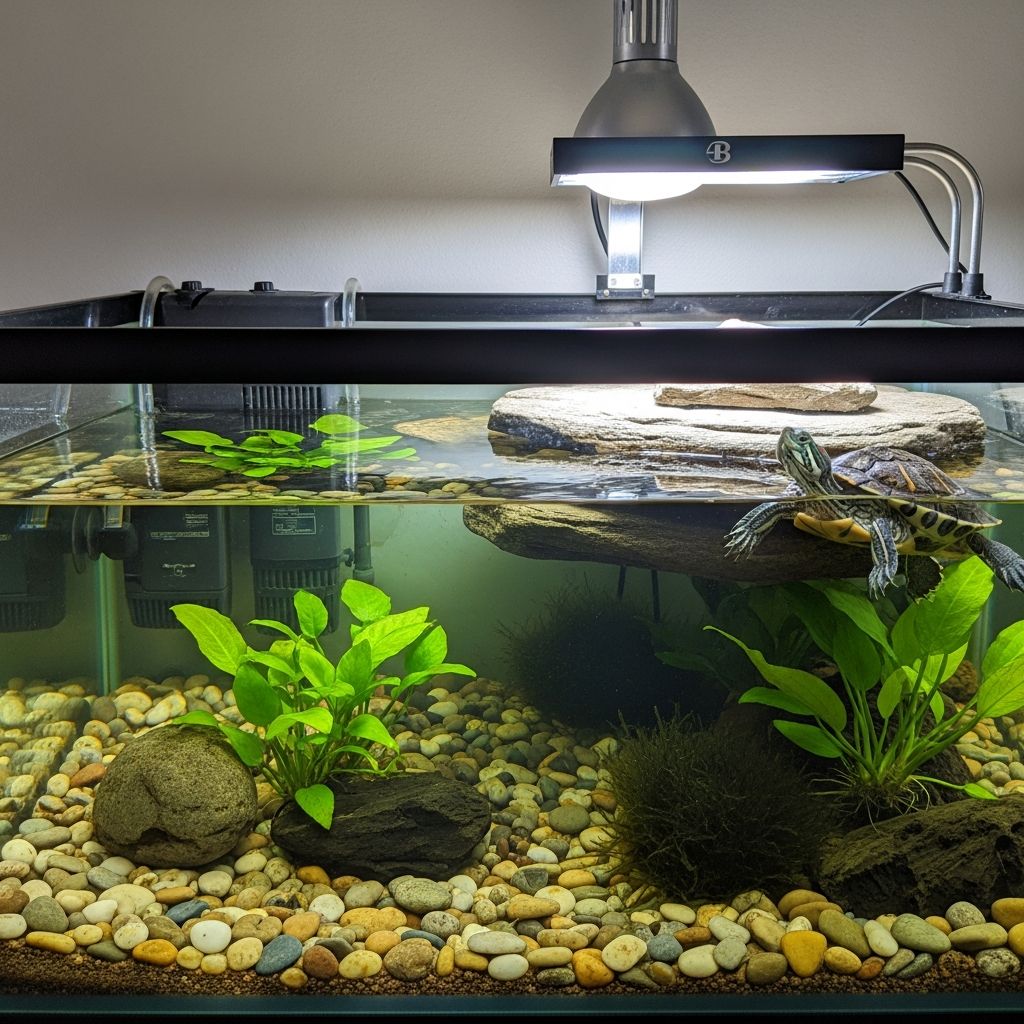
Use a submersible aquarium heater to maintain proper water temperature consistently. Place your basking lamp to create a temperature gradient, allowing your turtle to move between warmer and cooler areas as needed. Install thermometers in both the basking area and the water to monitor temperatures accurately.
Position the tank away from windows and direct sunlight, which can cause harmful temperature fluctuations and excessive algae growth. Provide shade over at least one-third of the tank to give your turtle a cooler refuge when needed.
Basking Areas and Platforms
Dry basking areas are absolutely essential for aquatic turtles. Basking allows turtles to regulate their body temperature and absorb UVB rays necessary for calcium metabolism and shell health. Create easily accessible basking platforms using sturdy materials like slate, rocks, or floating wood that can safely support your turtle’s weight.
Ensure any rocks used in the habitat are larger than your turtle’s head to prevent accidental ingestion that could cause gastrointestinal obstruction. The basking area should be positioned so your turtle can climb onto it without difficulty and dry off completely. For female turtles, provide an additional nesting area with appropriate substrate material.
Maintain the basking area’s temperature at 85-90°F using an appropriate heat lamp positioned 18 inches from the basking surface. The basking spot should receive UVB lighting to promote proper calcium metabolism and shell development.
Lighting and UVB Requirements
Proper lighting is crucial for your turtle’s health. Aquatic turtles require UVB lighting to synthesize vitamin D3, which facilitates calcium absorption necessary for strong shells and bones. Position UVB lights within 18 inches of your turtle’s basking area and replace them every 6 to 12 months as their effectiveness diminishes over time.
Provide a light cycle that mimics natural day-night patterns, typically 12 hours of light and 12 hours of darkness. This helps regulate your turtle’s circadian rhythms and overall health.
Substrate Considerations
Using substrate in an aquatic turtle tank is optional but requires careful consideration if you choose to include it. Never use small pebbles or gravel that could fit in your turtle’s mouth, as these can cause serious intestinal blockages. Absolutely avoid substrates smaller than your turtle’s head size.
Acceptable substrate options include thoroughly rinsed sand or large rocks and slate pieces that are too big for your turtle to ingest. Keep substrate minimal as it can harbor harmful bacteria and complicate water quality management. Many experienced keepers prefer minimal or no substrate to reduce bacterial growth and simplify tank maintenance.
Tank Decor and Enrichment
While turtles may seem simple, they benefit from environmental enrichment and hiding spots. Include turtle-friendly decorations such as PVC pipes and commercial turtle hides to provide security and mental stimulation. Rearrange decorations occasionally to create novel environments and encourage natural behaviors.
Offer enrichment through varied feeding methods, such as live prey or turtle sticks, to keep your turtle engaged and active. However, ensure all decorations are secure and cannot topple over, potentially injuring your turtle or disrupting the tank environment.
Tank Placement and Support
Position your turtle tank on a sturdy, level surface capable of supporting the considerable weight of a filled aquarium. A large tank can weigh hundreds of pounds when filled with water, so proper support is essential. A sturdy table or cabinet rated for the weight is ideal.
Avoid placing the tank near windows or in direct sunlight, as this can cause temperature fluctuations, excessive algae growth, and stress to your turtle. Ensure the area provides adequate space for maintenance access and allows you to safely approach the tank for feeding and cleaning.
Additional Equipment and Supplies
Beyond the basic tank setup, several essential items complete your aquatic turtle’s housing:
Thermometers: Install both submersible aquarium thermometers and air thermometers to monitor temperature zones accurately.
Aquarium Heater: A submersible heater maintains consistent water temperature, especially important in cooler climates.
Heat and Light Fixtures: Thermostat-controlled heat lamps maintain proper basking temperatures and prevent overheating.
UVB Lighting: Proper UV lighting is non-negotiable for bone and shell health.
Tank Cover: A secure screen or glass cover prevents escapes and protects your turtle from household hazards.
Water Testing Kit: Regular water quality testing ensures optimal conditions for your turtle’s health.
Drain Considerations
If your tank setup includes a drain system, ensure it functions properly to prevent water overflow during rain or unexpected flooding. This is particularly important for outdoor or semi-outdoor tank setups. A properly functioning drain protects both your turtle’s habitat and your home.
Long-Term Habitat Expansion
As your turtle grows, be prepared to upgrade and expand the habitat accordingly. Young turtles housed in smaller temporary setups must be transitioned to appropriately sized adult enclosures as they approach adult size. Failure to provide adequate space as your turtle matures can lead to stunted growth, shell deformities, and health problems.
Plan your turtle housing with growth in mind. Starting with at least a 40-gallon tank even for smaller juveniles allows for easier transitions to adult-sized enclosures.
Frequently Asked Questions
Q: How many gallons does an aquatic turtle need?
A: As a general rule, provide 10 gallons of water per inch of shell length, with a minimum of 40 gallons recommended for most adult turtles. Larger turtles may require 90-120 gallon tanks.
Q: What water depth is appropriate for aquatic turtles?
A: Water depth should be at least one and a half to two times the turtle’s carapace length. This typically means 6-8 inches for smaller turtles and deeper for larger specimens.
Q: Can I keep multiple turtles in one tank?
A: Yes, but increase the recommended tank size by 25% for each additional turtle. Ensure adequate space, basking areas, and resources to prevent aggression and stress.
Q: What substrate is safe for aquatic turtles?
A: Avoid small pebbles or any substrate smaller than your turtle’s head. Use thoroughly rinsed sand or large rocks, or keep the tank substrate-free to reduce bacterial growth.
Q: How often should I change the water?
A: With proper filtration rated for twice your tank’s volume, you can minimize water changes and monitor quality regularly. Perform partial water changes as needed based on water quality test results.
Q: What temperature should the basking area be?
A: Maintain basking areas at 85-95°F, with water at 72-82°F and air temperature at 75-85°F depending on your turtle species.
Q: How do I prevent my turtle from escaping?
A: Use a 100% escape-proof enclosure with a secure, locking screen lid. Turtles are good climbers, so standard aquarium covers may not be sufficient.
Q: Is UVB lighting necessary for aquatic turtles?
A: Yes, UVB lighting is essential for calcium metabolism and shell health. Position lights within 18 inches of the basking area and replace them every 6-12 months.
Q: What should I use for a basking platform?
A: Use sturdy materials like slate, rocks, or floating wood that can safely support your turtle’s weight and dry off completely.
References
- Aquatic Turtle Care Recommendations — MedVet. 2025. https://www.medvet.com/aquatic-turtle-care-recommendations/
- Aquatic Turtle Habitat Guidelines — Central Mississippi Turtle Rescue. 2025. https://www.centralmsturtlerescue.com/-aquatic-turtle-habitat-guidelines.html
- Setting Up an Aquatic Turtle Habitat — Zilla Reptiles. 2025. https://www.zillarules.com/articles/setting-up-an-aquatic-turtle-habitat
- Aquatic Turtle Care Sheet — PetMD. 2025. https://www.petmd.com/reptile/aquatic-turtle-care-sheet
- Aquatic Turtle Tank Setup 101: A Beginner’s Guide — Chewy. 2025. https://www.chewy.com/education/reptile-and-amphibian/turtle-and-tortoise/turtles-tank-setup
- Aquatic Turtle Husbandry Sheet — Animal Hospital of Verona. 2025. https://animalhospitalverona.com/uploads/SiteAssets/120/files/resources/Aquatic_Turtle_Husbandry_Sheet_AHOV.pdf
Similar Articles






Read full bio of Sneha Tete