
Aquarium Fish Taxonomy: A Practical Guide For Hobbyists
Explore the hierarchical classification of popular aquarium fish, from major classes to specific families, to better understand their biology and care needs.
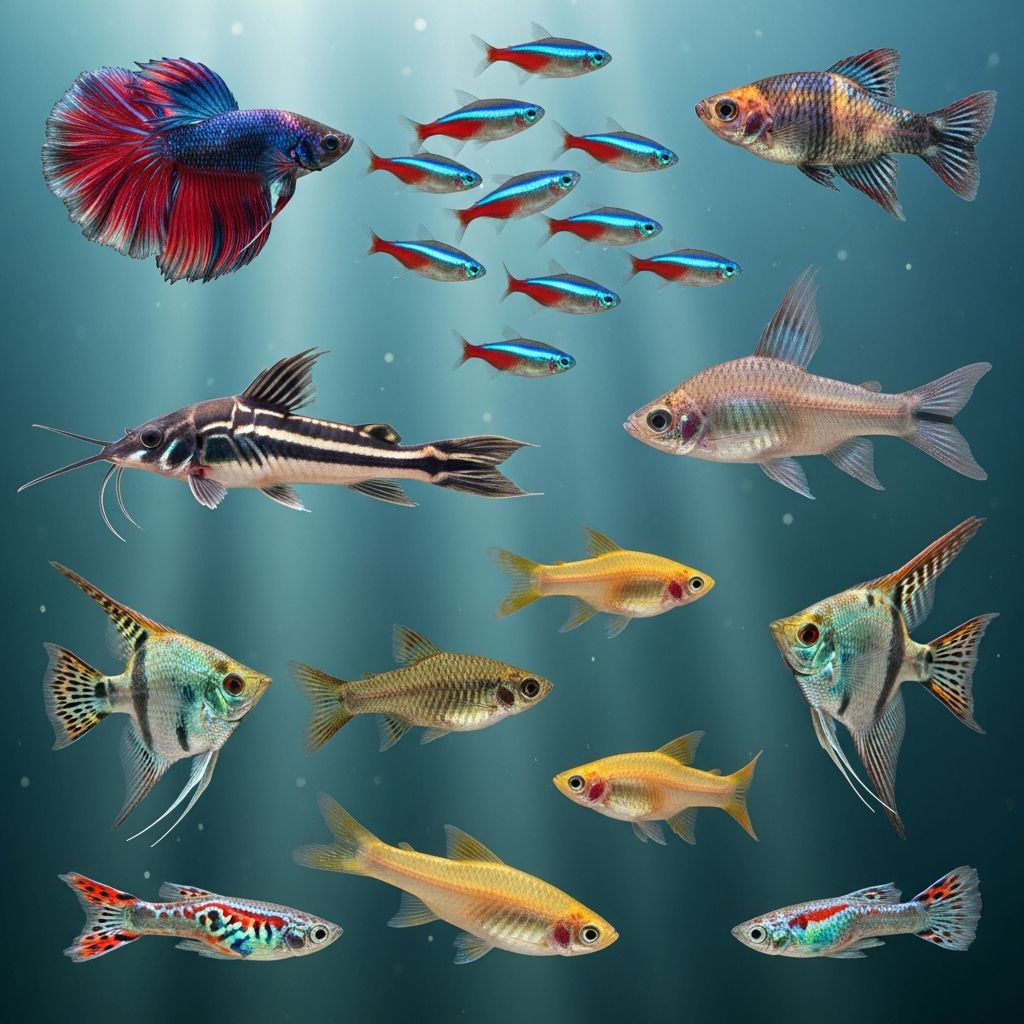
Fish taxonomy organizes the vast diversity of aquarium species into a structured hierarchy, aiding hobbyists in understanding their biological relationships, care requirements, and compatibility. This system divides fish primarily into cartilaginous and bony groups, with bony fish dominating the aquarium trade through subcohorts like Ostariophysi and Neoteleostei.
Fundamentals of Fish Classification
The taxonomic framework begins with broad categories such as kingdom, phylum, class, order, family, genus, and species. For aquarium enthusiasts, this hierarchy is crucial for identifying species like the neon tetra, classified as Paracheirodon innesi under Kingdom Animalia, Phylum Chordata, Class Actinopterygii, Order Characiformes, Family Characidae.
Bony fish, or Osteichthyes, represent the majority of aquarium species, split into ray-finned (Actinopterygii) and lobe-finned (Sarcopterygii) types. Ray-finned fish, including most pet fish, feature fins supported by bony rays and dominate freshwater and marine setups.
| Taxonomic Rank | Example: Neon Tetra | Description |
|---|---|---|
| Kingdom | Animalia | All animals with multicellular, heterotrophic structure. |
| Phylum | Chordata | Possess a notochord at some life stage. |
| Class | Actinopterygii | Ray-finned bony fish. |
| Order | Characiformes | Tetra-like fish with adipose fin. |
| Family | Characidae | Characins including tetras. |
| Genus | Paracheirodon | Small, colorful tetras. |
| Species | innesi | Neon tetra specifically. |
This table illustrates the binomial nomenclature, where the genus and species form the scientific name, ensuring precise identification across global aquarists.
Cartilaginous vs. Bony Fish in Aquariums
Cartilaginous fish (Chondrichthyes), such as sharks and rays, have skeletons of cartilage rather than bone. While less common in home aquariums due to size and aggression, species like the bamboo shark appear in advanced setups. They lack swim bladders, relying on constant motion for buoyancy.
Bony fish, conversely, possess ossified skeletons and swim bladders for neutral buoyancy. Aquarium favorites fall here, offering diverse shapes, colors, and behaviors suited to various tank sizes.
Key Subcohorts: Ostariophysi and Neoteleostei
Ostariophysi forms a basal group of bony fish with specialized traits like the Weberian apparatus for enhanced hearing and alarm substances (schreckstoff) released from skin club cells upon injury, triggering escape responses in conspecifics. This subcohort includes resilient species ideal for beginners.
Cyprinidae: The Largest Freshwater Family
Cyprinidae, with over 3,000 species, is the most speciose freshwater family, spanning Asia, Europe, and North America. Popular aquarium members include goldfish (Carassius auratus), koi, barbs (Puntigrus spp.), danios (Danio spp.), and rasboras (Borasara spp.). These omnivores thrive in planted tanks but require cool water for goldfish varieties. They lack stomachs, relying on intestinal digestion, and feature pharyngeal teeth.
- Goldfish and Koi: Coldwater species needing spacious ponds or large tanks; prone to swim bladder issues from overfeeding.
- Barbs and Danios: Active schooling fish; prefer groups of 6+ for natural behavior.
- Rasboras: Peaceful nano-fish for community tanks.
Characiformes: Vibrant Tetras and Allies
The order Characiformes encompasses tetras, pencils, and hatchetfish, distinguished by an adipose fin and fatty stomach. Unlike cyprinids, they possess a true stomach and pyloric caeca for digestion. Neon and cardinal tetras (Paracheirodon spp.) light up tanks with iridescent stripes, demanding soft, acidic water mimicking Amazonian habitats.
Other notables include rummy-nose tetras (Hemigrammus rhodostomus) and silver dollars (Metynnis spp.), which are herbivorous and need vegetable matter in diets.
Loricariidae and Callichthyidae: Armored Bottom Dwellers
Loricariidae (plecos) feature sucker mouths and bony plates for algae scraping. Common pleco (Hypostomus plecostomus) grows large, while smaller bristlenose plecos suit home aquariums. They absorb oxygen through intestines in low-oxygen waters.
Callichthyidae, or Corydoras catfish, burrow in substrates and gulp air, adding lively scavenging to tanks. Species like Sterbai corys (Corydoras sterbai) display spotted elegance.
Neoteleostei: Advanced Bony Fish Groups
Neoteleostei includes more derived fish with refined adaptations. Cichlidae stands out with over 1,700 species across 10+ subfamilies, grouped by geography: African (Rift Lake endemics), Central/South American.
Cichlidae: Diverse and Intelligent Predators
African cichlids from Lakes Malawi, Tanganyika, and Victoria evolved rock-dwelling (mbuna) or open-water (utaka) forms, requiring alkaline, hard water and rocky setups. Malawi mbuna like electric yellow labs (Labidochromis caeruleus) dazzle with colors but demand species-specific tanks to curb aggression.
South American cichlids, such as angelfish (Pterophyllum scalare) and discus (Symphysodon spp.), prefer warmer, softer waters and form pair bonds, showcasing parental care.
- Lake Malawi: Mbuna (rock-huggers), Peacock cichlids (haplochromines).
- Lake Tanganyika: Shell-dwellers, Frontosa (Cyphotilapia frontosa).
- American Cichlids: Oscars (Astronotus ocellatus), Convicts (Amatitlania nigrofasciata).
Poeciliidae: Livebearers and Guppies
Poeciliidae deliver live young via placentation, including guppies (Poecilia reticulata), mollies (Poecilia sphenops), and swordtails (Xiphophorus hellerii). Hardy and prolific, they tolerate brackish water and breed readily in community tanks.
Osphronemidae: Labyrinth Bubble-Nest Builders
This family features anabantoids like bettas (Betta splendens), gouramis (Trichopodus spp.), and paradise fish. A labyrinth organ allows air breathing, suiting low-oxygen setups. Bettas display aggressive fin displays, best housed solo.
Evolutionary Insights and Aquarium Implications
Fish taxonomy reveals evolutionary paths: jawless Agnatha ancestors led to Chondrichthyes and Osteichthyes. Paraphyletic groups like traditional Pisces highlight modern cladistics favoring monophyletic clades.
For aquarists, matching taxonomy to care prevents mismatches—e.g., Ostariophysi alarm systems mean avoiding fin-nippers with club-cell species. Disease tables link orders to vulnerabilities: ich in characins, velvet in cichlids.
| Group | Water Parameters | Behavior | Diet |
|---|---|---|---|
| Cyprinidae | pH 6.5-7.5, 20-26°C | Schooling | Omnivore |
| Characiformes | pH 5.5-7.0, 24-28°C | Schooling | Carnivore/Omni |
| Cichlidae (African) | pH 7.5-8.5, 24-30°C | Territorial | Omnivore/Algae |
| Poeciliidae | pH 7.0-8.0, 24-28°C | Peaceful | Omnivore |
Common Misconceptions in Fish Taxonomy
“Sharks” like rainbow shark (Epalzeorhynchos frenatus) are cyprinids, not true sharks. Cichlids span continents, not just Africa. Understanding these clarifies stocking.
FAQs
What is the largest family of aquarium fish?
Cyprinidae, with species like goldfish and barbs.
Why do tetras school tightly?
Schreckstoff alarm from Ostariophysi lineage prompts flight.
Can I mix African and South American cichlids?
No; differing pH and aggression levels cause stress.
What makes livebearers unique?
Poeciliidae give birth to live fry, unlike egg-scatterers.
Do all fish need a heater?
Tropical groups like Neoteleostei yes; cyprinids vary.
References
- Fish species (how we divide fish) — Aqua-Fish.Net. 2023. https://en.aqua-fish.net/articles/fish-species-how-we-divide-fish
- Taxonomy of fish — Wikipedia. 2024-02-20. https://en.wikipedia.org/wiki/Taxonomy_of_fish
- Fish Taxonomy – Exotic and Laboratory Animals — MSD Veterinary Manual. 2025. https://www.msdvetmanual.com/exotic-and-laboratory-animals/aquarium-fish/fish-taxonomy
Similar Articles








Read full bio of medha deb


