
Aquaculture Disease Challenges: Biosecurity Tips 2025
Exploring infectious threats in fish farming, from bacterial outbreaks to prevention tactics for sustainable production.
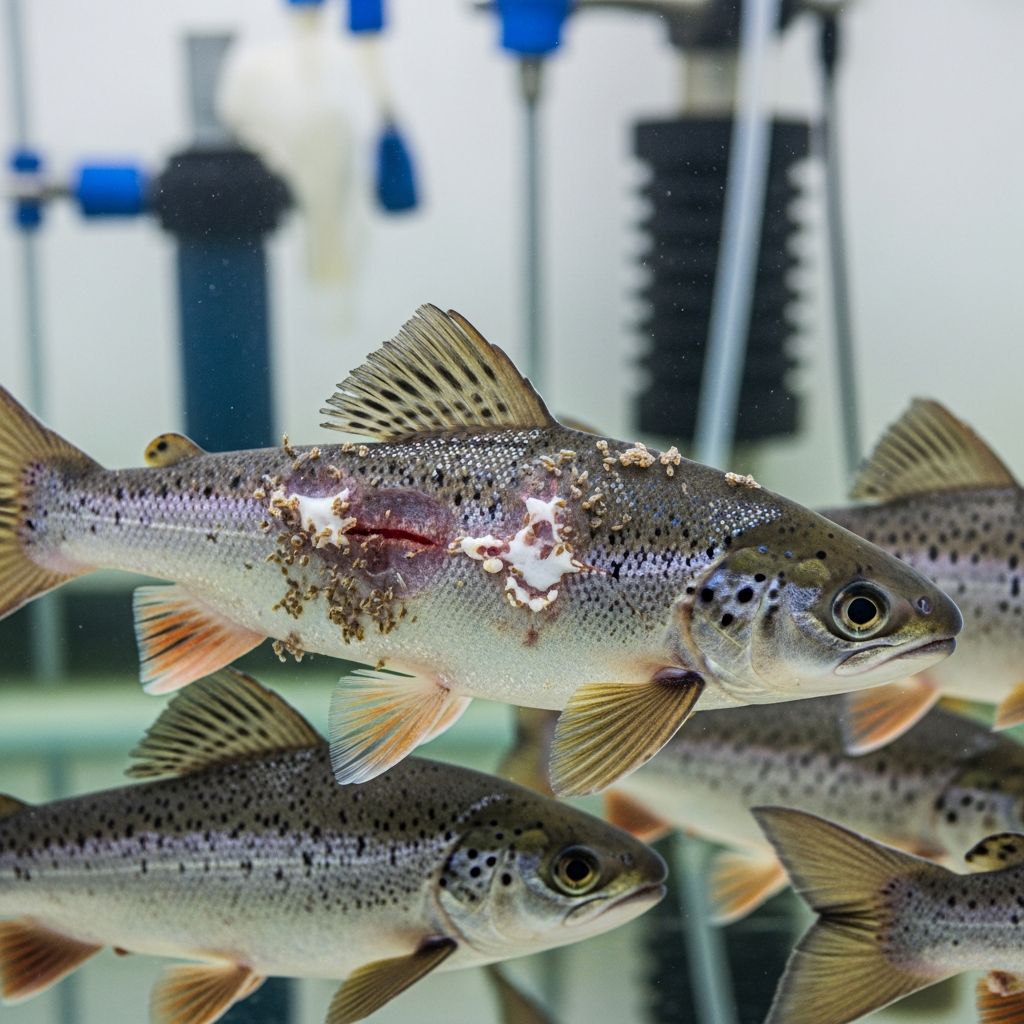
Aquaculture faces significant hurdles from infectious diseases that threaten fish populations and economic viability. These illnesses, driven by bacteria, viruses, parasites, and fungi, thrive in high-density farming environments, leading to high mortality and production losses.
Why Infections Dominate Aquaculture Losses
In fish farming, infectious agents cause up to 60% of all production setbacks, making disease control central to industry growth. High stocking densities amplify pathogen spread, while stressed fish from poor water quality or overcrowding lose immune defenses.
Pathogens exploit the host-pathogen-environment triangle: vulnerable fish meet aggressive microbes in suboptimal conditions, sparking outbreaks. Primary infections arise internally from carriers, while secondary ones enter via contaminated water, feed, or gear.
Bacterial Pathogens: Primary Culprits
Bacteria top the list of aquaculture threats, with species like Aeromonas, Flavobacterium, and Edwardsiella causing widespread havoc. These opportunists strike when fish immunity wanes due to intensive rearing.
Aeromonas Septicemia and Hemorrhages
Aeromonas spp., including A. salmonicida, trigger hemorrhagic septicemia, marked by skin ulcers, bleeding, and rapid death. Common in freshwater and marine settings, they hit carp and salmonids hardest, peaking at warm temperatures above 27°C.
Symptoms include red streaks on fins, body discoloration, and gill damage. Outbreaks ravage fingerlings, with mortality soaring in summer months.
Gill and Columnaris Diseases
Bacterial gill disease (BGD), caused by Flavobacterium branchiophilum, swells primary lamellae, traps mucus, and impairs breathing. It strikes young salmonids in hatcheries, worsened by low oxygen, high ammonia, or crowding.
Columnaris, from F. columnare, forms yellow patches on gills and skin, leading to necrosis. A global killer in freshwater fish, it ignores temperature shifts and spreads via water.
| Disease | Causative Agent | Main Hosts | Key Symptoms | Mortality Risk |
|---|---|---|---|---|
| Aeromonas Septicemia | Aeromonas spp. | Grass carp, salmon | Ulcers, hemorrhages | High in fingerlings |
| Bacterial Gill Disease | F. branchiophilum | Salmonids | Gill swelling, necrosis | Up to 25% |
| Columnaris | F. columnare | Freshwater fish | Yellow lesions | Severe outbreaks |
| Edwardsiellosis | Edwardsiella ictaluri | Catfish | Internal lesions | Catastrophic |
Other Bacterial Threats
Streptococcosis and vibriosis add to the burden, causing meningitis-like symptoms or gut inflammation. Enteritis plagues carp, with 50-90% mortality in young stock, often alongside gill rot.
Erythroderma, a skin infection, enters via wounds from handling or frostbite, persisting year-round.
Viral and Parasitic Invaders
Viruses like those behind hemorrhagic septicemia hit grass carp fingerlings from June to September, causing mass die-offs at peak summer heat.
Parasites, including Cryptobia branchialis and trichodinids, attach to gills or skin. Cryptobia plagues pond fish nationwide, peaking July-September with acute mortality in summer fingerlings.
Invasive parasites spread via infested fish, feed, or silt, contaminating entire systems.
Transmission Pathways in Farms
Diseases spread horizontally through water or vertically from parents to offspring. Carriers shed pathogens asymptomatically until stress triggers outbreaks.
- Waterborne: Primary route in ponds, amplified by high densities.
- Feed and Gear: Contaminated inputs introduce secondary infections.
- Stocking Stress: Injuries during transport invite bacteria.
Biosecurity: Frontline Defense
Biosecurity minimizes risks through exclusion, management, and eradication. NOAA emphasizes density control and health checks to curb farm outbreaks.
Key practices include quarantining new stock, disinfecting equipment, and monitoring water quality. Opportunistic pathogens like Vibrio strike stressed fish, so optimal conditions are vital.
- Site selection away from wild disease sources.
- UV filtration and probiotics to reduce pathogen loads.
- Regular health surveillance via necropsies.
Environmental Triggers and Management
High temperatures (28-35°C) fuel gill rot and septicemia, while low oxygen exacerbates BGD.
Integrated strategies blend biosecurity with vaccines where available, like for some salmonid diseases. Probiotics bolster immunity, cutting antibiotic reliance.
Global Economic Toll
Outbreaks slash yields, with bacterial diseases alone costing billions yearly. Sustainable practices demand proactive monitoring and research into resistant strains.
FAQs
What causes most aquaculture diseases?
Bacteria like Aeromonas and Flavobacterium dominate, thriving in dense, stressed populations.
How can farms prevent outbreaks?
Implement biosecurity: quarantine, water treatment, and density management.
Are aquaculture diseases zoonotic?
Rarely, but agents like Mycobacterium and Vibrio vulnificus pose risks via handling.
When do viral diseases peak?
Summer for grass carp hemorrhagic septicemia, above 27°C.
What role does water quality play?
Poor parameters like high ammonia trigger gill diseases and weaken defenses.
References
- Chapter 6 MAIN FISH DISEASES AND THEIR CONTROL — FAO. 1996-01-01. https://www.fao.org/4/ac264e/ac264e07.htm
- Bacterial Pathogenesis in Various Fish Diseases — PMC – NIH. 2023-02-20. https://pmc.ncbi.nlm.nih.gov/articles/PMC9968037/
- An overview on understanding the major bacterial fish diseases — Frontiers in Aquaculture. 2025-01-01. https://www.frontiersin.org/journals/aquaculture/articles/10.3389/faquc.2025.1515831/full
- Biosecurity in Aquaculture, Part 1: An Overview — Mississippi State University Extension. 2020-01-01. https://extension.msstate.edu/media/18987/download?inline
- Aquaculture Fish Health — NOAA Fisheries. 2023-01-01. https://www.fisheries.noaa.gov/national/aquaculture/aquaculture-fish-health
- Intro to Aquaculture Biosecurity — CFSPH, Iowa State University. 2022-01-01. https://www.cfsph.iastate.edu/Assets/intro-to-aquaculture-biosecurity.pdf
- Managing the threat of infectious disease in fisheries — ESA Journals. 2023-01-01. https://esajournals.onlinelibrary.wiley.com/doi/10.1002/fee.2695
Similar Articles








Read full bio of medha deb


