
Anterior Uveal Disorders In Horses: Diagnosis & Treatment Guide
Essential guide for horse owners on recognizing, managing, and preventing anterior uveal issues to safeguard equine vision.
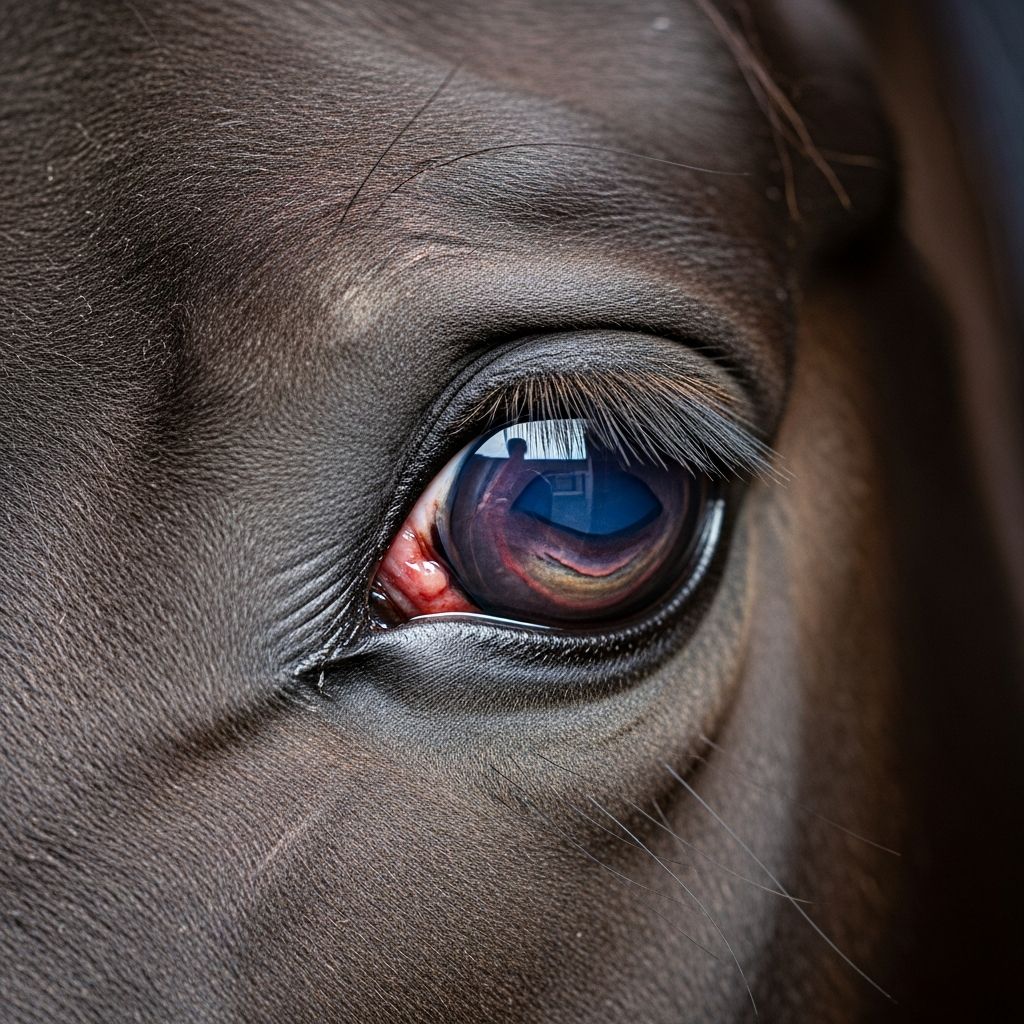
The anterior uvea, comprising the iris and ciliary body, is vital for equine eye function, regulating light entry and lens focus while producing nourishing fluids. Disorders here can severely impact vision, often linking to broader health issues. This article delves into equine eye anatomy, common pathologies, clinical signs, management approaches, and preventive measures, empowering owners to act swiftly.
Equine Eye Anatomy: Focus on the Uvea
Horses possess large, prominent eyes suited for wide-field vision, essential for survival in open terrains. The uvea forms the eye’s pigmented middle layer, with the
anterior uvea
including the iris—the colored structure encircling the pupil—and the ciliary body, which supports lens accommodation and secretes aqueous humor to maintain intraocular pressure (IOP) and nourish avascular tissues like the cornea and lens.The iris features a sphincter muscle for pupil constriction in bright light and a dilator for expansion in dim conditions. Its anterior surface often displays the corpora nigra, a protective projection reducing glare. The ciliary body, divided into pars plicata (folded, secretory) and pars plana (smooth), adjusts lens shape via zonular fibers and forms part of the blood-aqueous barrier, preventing inflammatory cells and proteins from clouding ocular media. Disruptions here lead to pain, vision loss, and secondary complications like glaucoma.
- Iris functions: Light modulation via pupillary control.
- Ciliary body roles: Aqueous production, lens focusing, barrier maintenance.
- Blood supply: Via long and short posterior ciliary arteries, ensuring nutrient delivery.
Primary Conditions Affecting the Anterior Uvea
Several disorders target the anterior uvea, with inflammation being predominant. These range from acute episodes to chronic, recurrent forms, often breed-predisposed.
Acute Anterior Uveitis (Iridocyclitis)
This inflammation arises from trauma, infections, or systemic diseases. Bacterial agents like Leptospira, viral pathogens (e.g., equine influenza), parasites (e.g., Onchocerca larvae), or abscesses trigger immune responses. Post-deworming flares occur if larvae migrate.
Clinical hallmarks include miosis (pupil constriction), aqueous flare (protein leakage indicating barrier breakdown), corneal edema, conjunctival hyperemia, episcleral injection, and photophobia causing blepharospasm. IOP may initially drop due to ciliary shutdown, risking hypotony.
Equine Recurrent Uveitis (ERU): The Leading Cause of Blindness
ERU, also termed moon blindness, manifests as repeated inflammatory bouts, affecting 10% of horses, highest in Appaloosas (up to 25%), warmbloods, and drafts—suggesting genetic factors like immunologic dysregulation. Episodes involve intraocular cells, fibrin, hyphema, and vitreous haze, progressing to synechiae (adhesions), cataracts, phthisis bulbi, and retinal degeneration.
Chronic changes feature iridal hyperpigmentation, corpora nigra atrophy, posterior synechiae, and perilimbal fibrosis. Bilateral yet asymmetric, it demands vigilant monitoring.
Congenital and Developmental Anomalies
Breeds like Rocky Mountain horses exhibit anterior segment dysgenesis, with heterozygous cases showing ciliary cysts and homozygous ones displaying iris hypoplasia, iridocorneal adhesions, megalocornea, and cataracts. These cysts, originating from peripheral retina or ciliary body, may prolapse or cause secondary uveitis.
Secondary Uveal Pathologies
Chronic uveitis fosters preiridal fibrovascular membranes, promoting neovascularization, ectropion uveae (pupil eversion), and trabecular obstruction leading to glaucoma. Tumors (e.g., melanomas) or intraocular parasites rarely cause unilateral uveitis.
Recognizing Symptoms: Early Detection Guide
Horse owners must spot subtle cues, as stoic animals mask pain. Key indicators:
| Symptom | Description | Implication |
|---|---|---|
| Epiphora & Blepharospasm | Excess tearing, frequent blinking/squinting | Pain, photophobia |
| Miosis | Constricted pupil unresponsive to light | Inflammatory spasm |
| Aqueous Flare/Hypopyon | Chamber haze, white pus settling | Protein/cells leakage |
| Corneal Opacity | Blue haze, edema, vascularization | Secondary keratitis |
| Iridal Swelling/Hyperemia | Thickened, reddened iris | Active inflammation |
Advanced signs: Lens opacities, retinal detachment, vision deficits like stumbling or wide turns. Routine ophthalmic exams, including fluorescein staining and tonometry, are crucial.
Diagnostic Approaches for Equine Uveitis
Veterinary assessment involves:
- Schirmer Tear Test: Quantifies tear production.
- Tonometry: Measures IOP (normal 15-30 mmHg); low in acute, high in chronic.
- Slit-Lamp Biomicroscopy: Reveals flare, cells, synechiae.
- Indirect Ophthalmoscopy: Assesses vitreous, retina.
- Serology/Culture: Identifies Leptospira, bacterials.
Ultrasonography aids obscured views, detecting retinal detachments or tumors.
Treatment Strategies: Medical and Surgical Interventions
Prompt therapy halts progression. Acute management:
- Topical Corticosteroids: E.g., prednisolone acetate q4-6h to quell inflammation.
- Mydriatics: Atropine 1% to break synechiae, relieve ciliary spasm (monitor IOP).
- Systemic NSAIDs: Flunixin meglumine for pain/IOP control.
- Antimicrobials: If infectious etiology suspected.
ERU requires lifelong control: Subpalpebral lavage for compliance, cyclosporine implants (e.g., Retisert) for sustained immunosuppression, core vitrectomy to remove vitreous opacities. Surgical options include cyclophotocoagulation for glaucoma or enucleation in blind, painful eyes.
Acute vs. Chronic Treatment Overview
| Phase | Medications | Frequency | Goals |
|---|---|---|---|
| Acute | Corticosteroids, Atropine, NSAIDs | Multiple daily | Reduce inflammation, pain relief |
| Chronic/Recurrent | Immunosuppressants, Implants | Long-term/sustained | Prevent flares, preserve vision |
Prevention and Long-Term Management
Minimize risks by:
- Deworming strategically, avoiding larval kill-back flares.
- UV-protective fly masks for Appaloosas.
- Quarterly ophthalmic screening.
- Leptospirosis vaccination where endemic.
- Stable hygiene to curb infections.
Breeding away from ERU-susceptible lines; genetic testing for dysgenesis breeds.
Frequently Asked Questions (FAQs)
What breeds are most prone to ERU?
Appaloosas, warmbloods, drafts show highest incidence due to genetic predisposition.
Can ERU be cured?
No, but managed effectively with vigilant therapy to extend vision.
Is uveitis contagious?
Not directly; systemic causes like Leptospira may spread environmentally.
How often should I check my horse’s eyes?
Annually routine, more for at-risk breeds or symptoms.
What if my horse squints suddenly?
Seek vet immediately—could indicate uveitis or trauma.
Maintaining anterior uveal health preserves equine welfare and performance. Collaborate with equine ophthalmologists for tailored care.
References
- Uvea — Veterian Key. Accessed 2026. https://veteriankey.com/uvea-2/
- Disorders of the Anterior Uvea in Horses — Merck Veterinary Manual. Accessed 2026. https://www.merckvetmanual.com/horse-owners/eye-disorders-of-horses/disorders-of-the-anterior-uvea-in-horses
- The Anterior Uvea in Animals — MSD Veterinary Manual. Accessed 2026. https://www.msdvetmanual.com/eye-diseases-and-disorders/ophthalmology/the-anterior-uvea-in-animals
- Uvea — PMC/NIH (Miller PE, 2009). 2009-01-01. https://pmc.ncbi.nlm.nih.gov/articles/PMC7149650/
- Diseases of the Uvea, Uveitis, and Recurrent Uveitis — Wiley Online Library (Gilger BC, 2022). 2022. https://onlinelibrary.wiley.com/doi/abs/10.1002/9781119782285.ch6
Similar Articles








Read full bio of Sneha Tete


