

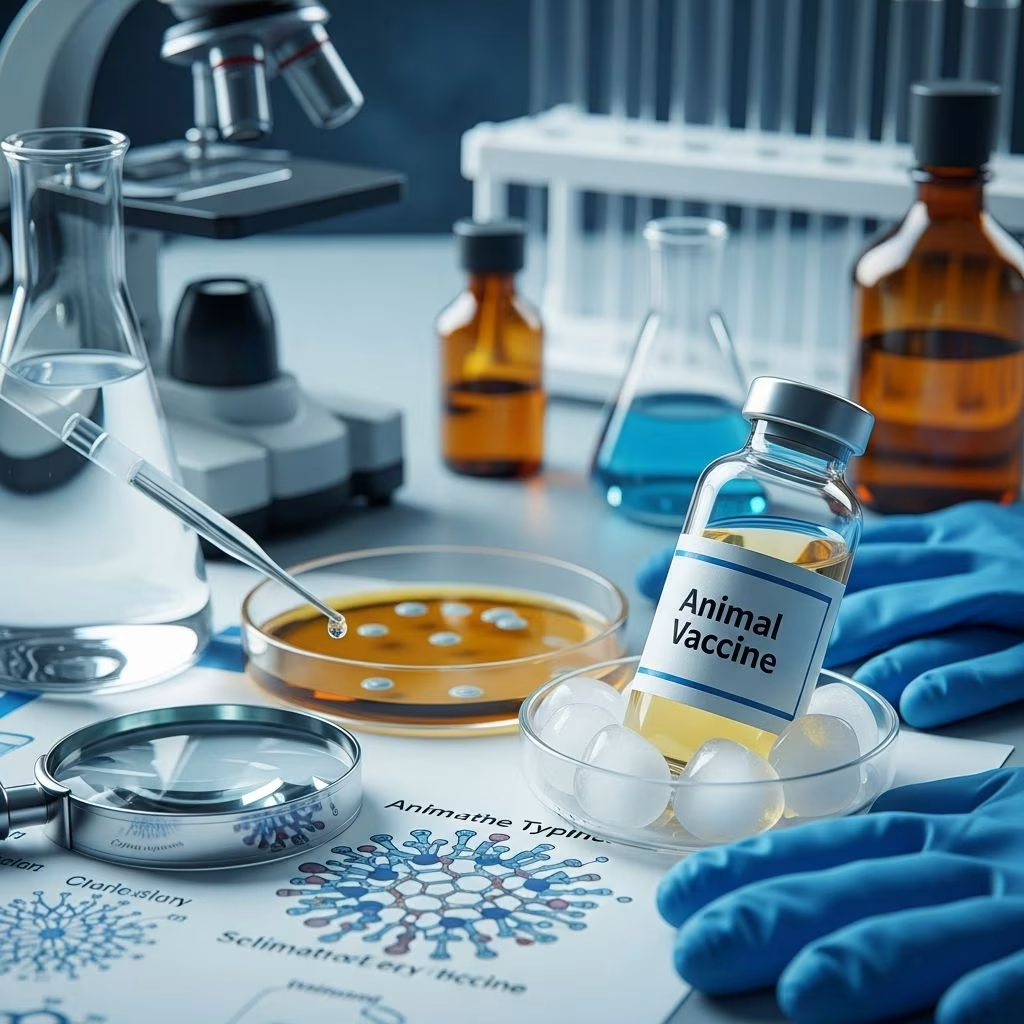
Animal vaccines play a crucial role in safeguarding pets, livestock, and wildlife against a wide array of infectious diseases. By stimulating the immune system to recognize and combat pathogens, these biologics prevent outbreaks, reduce mortality rates, and support overall animal health. This guide examines the primary categories of vaccines used in veterinary practice, highlighting their development processes, immune response mechanisms, advantages, limitations, and practical applications across species.
Core Principles of Vaccine Design in Animals
Vaccines mimic natural infections to train the animal’s immune system without causing disease. They target specific pathogens like viruses, bacteria, and toxins, categorized as core (essential for all animals, such as rabies in dogs) or non-core (lifestyle-dependent, like Lyme disease vaccines).
Key factors influencing vaccine choice include the animal’s age, health status, maternal antibody levels, and environmental risks. Core vaccines protect against ubiquitous threats, while non-core ones address regional or situational hazards.
Live Attenuated Vaccines: Mimicking Natural Infection
Live attenuated vaccines contain weakened forms of the pathogen that replicate mildly in the host, closely replicating natural infection dynamics. This elicits a robust, long-lasting immunity involving both humoral (antibody) and cellular responses.
Production involves passaging pathogens through cell cultures or hosts to reduce virulence while preserving immunogenicity. Examples include canine distemper, parvovirus, and adenovirus vaccines for dogs, as well as feline panleukopenia for cats.
- Advantages: Single-dose efficacy, broad protection, no adjuvants often needed.
- Disadvantages: Risk of reversion to virulence, contraindicated in immunocompromised animals or pregnant livestock.
- Applications: Poultry (Newcastle disease), equine (tetanus), and companion animals.
These vaccines excel in inducing mucosal immunity, vital for respiratory and enteric pathogens.
Inactivated Vaccines: Safety Through Neutralization
Inactivated vaccines use killed pathogens or components treated with chemicals like formalin or heat, ensuring no replication occurs. They provoke primarily antibody-based responses, often requiring boosters and adjuvants for potency.
Common in multivalent formulations for cattle (e.g., against foot-and-mouth disease) and swine (leptospirosis). They are stable and safe for all animals, including those with maternal antibodies.
| Vaccine Type | Examples | Booster Needs | Safety Profile |
|---|---|---|---|
| Inactivated | Rabies (cats/dogs), Clostridium (sheep) | Annual or biennial | High; no live pathogen |
| Live Attenuated | Distemper (dogs), Feline herpesvirus | Every 3 years | Moderate; shedding possible |
Adjuvants like aluminum hydroxide enhance responses but may cause local reactions.
Subunit and Purified Antigen Vaccines: Precision Targeting
Subunit vaccines isolate specific pathogen proteins or polysaccharides, excluding extraneous material to minimize side effects. They target critical antigens like surface proteins or pili that block pathogen adhesion.
Examples include tetanus toxoid (inactivated toxin) and OspA for Lyme disease in dogs. Production uses purification or recombinant tech for scalability.
- Benefits: Reduced reactogenicity, suitable for sensitive species.
- Challenges: Weaker initial response, adjuvant dependency.
Polysaccharide vaccines conjugate bacterial carbs to proteins for better efficacy in foals and calves.
Toxoid Vaccines: Neutralizing Pathogen Toxins
Toxoids detoxify bacterial exotoxins via formalin, retaining immunogenicity. Essential for clostridial diseases in ruminants and tetanus in horses.
They prevent toxin-mediated damage rather than infection itself, often combined in multivalent shots for sheep and cattle against blackleg or enterotoxemia.
Recombinant Vaccines: Genetic Engineering Innovations
Recombinant vaccines insert pathogen genes into harmless hosts like yeast or bacteria, producing pure antigens. Virus-like particles (VLPs) self-assemble into non-infectious mimics, potent without genetic material.
Examples: West Nile virus plasmid DNA for horses, rabies glycoprotein in vaccinia vectors for wildlife.
DNA plasmids enter cells to express antigens natively, bypassing maternal antibody interference. Effective against hard-to-culture agents like Borrelia.
RNA Vaccines: Rapid-Response Technology
RNA vaccines deliver messenger RNA in lipid nanoparticles, instructing cells to produce antigens transiently. Simpler than DNA vaccines, they act in cytoplasm without nuclear entry.
Emerging in veterinary use post-human COVID success, promising for avian influenza or porcine epidemics. Advantages include quick production and adaptability to variants.
Virus-Vectored Vaccines: Dual Protection Strategy
Virus-vectored vaccines use safe viruses (e.g., fowlpox, adenovirus) as carriers for pathogen genes. The vector infects cells, expressing foreign antigens for strong immunity.
Widely used in poultry (fowlpox-Newcastle combo), horses (West Nile-influenza), and rabies baits for wildlife. They differentiate infected from vaccinated animals (DIVA).
- Vectors: Poxviruses (large genome capacity), herpesviruses.
- Edge: Mucosal immunity, adjuvant-free, maternal antibody tolerance.
Adjuvants and Vaccine Enhancers
Adjuvants amplify responses in non-live vaccines via inflammation (e.g., mineral oils, cytokines). Newer options like CpG oligonucleotides target innate immunity.
Selection balances efficacy against injection-site sarcomas in cats or granulomas in horses.
Vaccination Strategies by Animal Group
Companion Animals
Dogs: Core (distemper, parvovirus, rabies); non-core (Bordetella, Leptospira).
Livestock
Cattle: Brucellosis (inactivated), bovine viral diarrhea (attenuated).
Poultry and Equine
Chickens: In ovo vectored vaccines; horses: Potomac fever subunit.
Challenges and Future Directions
Issues include cold-chain dependence, regulatory approval, and emerging resistance. Advances like plant-expressed antigens (tobacco for Newcastle) and nanotech delivery promise thermostability and oral dosing.
Personalized vaccines via genomics will tailor protection to herds or breeds.
Frequently Asked Questions (FAQs)
What is the difference between core and non-core vaccines?
Core vaccines protect against widespread, severe diseases; non-core target specific risks.
Are live vaccines safe for pregnant animals?
Generally no, due to reversion risks; use inactivated alternatives.
How do DNA vaccines work?
Plasmids express antigens intracellularly, mimicking live infection.
Can vaccines cause disease?
Rarely with attenuated types; inactivated are safer.
What are virus-like particles?
Empty viral shells inducing strong responses without replication.
References
- Types of Vaccines for Animals — Merck Veterinary Manual. 2023. https://www.merckvetmanual.com/pharmacology/vaccines-and-immunotherapy/types-of-vaccines-for-animals
- Vaccinology 101: Understanding the Reasoning Behind Your Veterinarian’s — Small Animal Clinic. 2022. https://www.smallanimalclinic.com/services/dogs/blog/vaccinology-101-understanding-reasoning-behind-your-veterinarians
- Animal Vaccines – Principles, Types, and Important Points to Know — University of Florida IFAS Extension. 2022-06-17. https://nwdistrict.ifas.ufl.edu/phag/2022/06/17/animal-vaccines-principles-types-and-important-points-to-know/
- Vaccine Overview and Types — American Animal Hospital Association (AAHA). 2022. https://www.aaha.org/resources/2022-aaha-canine-vaccination-guidelines/vaccine-overview-and-types/
- Vaccination for Animal Health: An Overview — National Office of Animal Health (NOAH). 2022. https://www.noah.co.uk/wp-content/uploads/2022/06/NOAH-BD-Vaccination-for-Animal-Health-Overview-26-01-1.pdf
- Guidelines for the Vaccination of Dogs and Cats — World Small Animal Veterinary Association (WSAVA). 2015 (updated relevance for core principles). https://wsava.org/wp-content/uploads/2020/01/WSAVA-Vaccination-Guidelines-2015.pdf
- Animal Vaccine FAQs: Protecting Pets, Livestock and Wildlife — American Society for Microbiology. 2025. https://asm.org/magazine/2025/fall/animal-vaccine-faqs-protecting-pets,-livestock-and



