

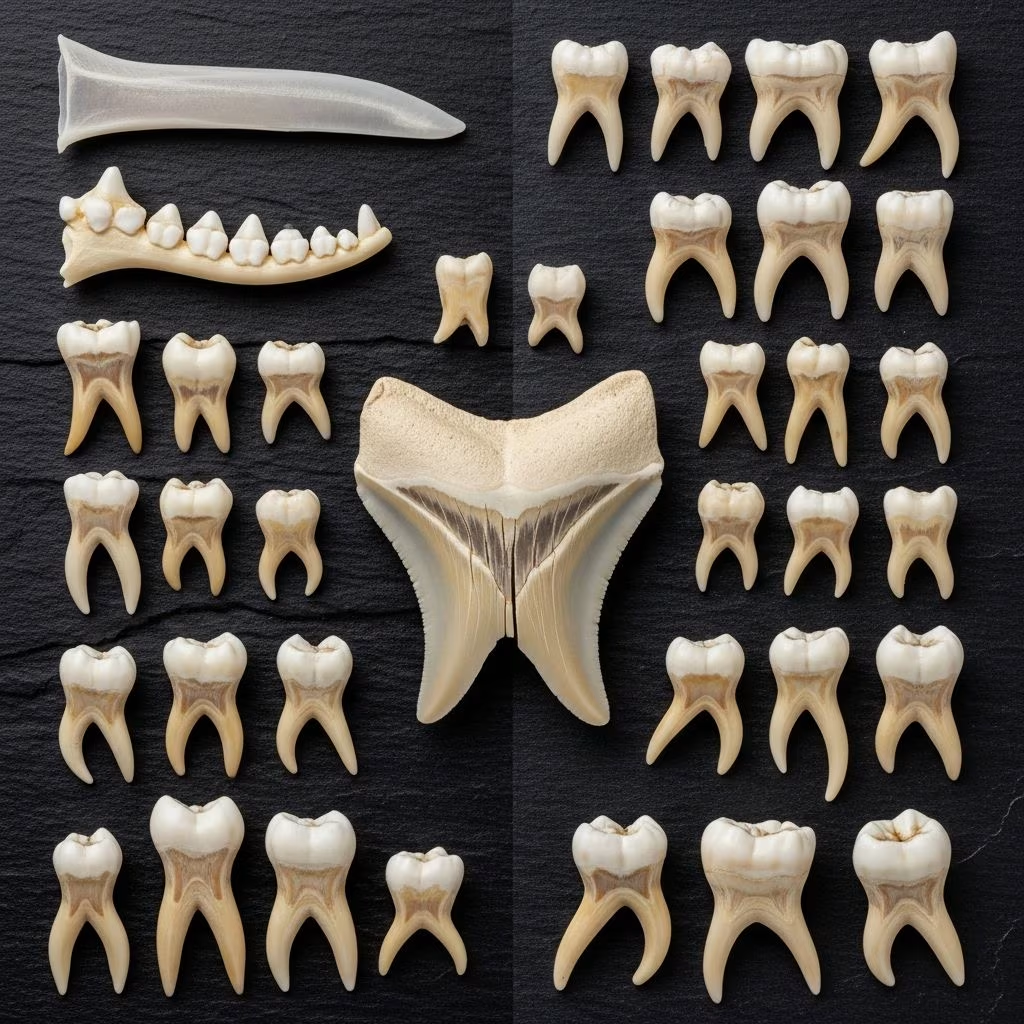
Understanding the structure, development, and identification of teeth in animals is fundamental for veterinary professionals. Different species exhibit unique dental arrangements adapted to their diets and lifestyles, ranging from slicing carnassials in predators to grinding molars in herbivores. This article examines tooth morphology, eruption patterns, dental formulas, and standardized naming conventions to aid in clinical practice.
Evolution of Dental Structures in Animals
Teeth in mammals evolve to fulfill specific roles: grasping, tearing, shearing, or pulverizing food. Incisors at the front chisel or nibble, canines puncture and hold prey, premolars crush or slice, and molars grind. Carnivores prioritize sharp, blade-like teeth for meat processing, while herbivores favor broad, ridged surfaces for vegetation breakdown.
Developmental patterns vary: some animals replace teeth multiple times (polyphyodonty, like sharks or reptiles, though less common in mammals), others once (diphyodonty in dogs and cats), or never (monophyodonty in certain species). In diphyodont mammals, deciduous teeth precede permanent ones, erupting early to support initial nutrition before shedding.
Core Tooth Categories Across Species
- Incisors: Frontmost teeth for cutting or nibbling. Numbered from the midline as first, second, or third in each quadrant. Single-rooted in most domestic animals.
- Canines: Pointed for gripping. Prominent in carnivores; reduced in herbivores.
- Premolars: Transitional teeth for shearing or crushing. In cats, the maxillary premolar distal to the canine is labeled the second premolar.
- Molars: Rear teeth specialized for grinding, absent in deciduous dentition.
Carnassial pairs—the upper fourth premolar and lower first molar in carnivores—form scissor-like mechanisms for slicing tough tissues. Hypsodont teeth (e.g., horses) grow continuously, while brachyodont (e.g., dogs) have fixed lengths.
Dental Formulas: Quantifying Tooth Counts
Dental formulas summarize tooth numbers per quadrant, doubling for bilateral symmetry. The primitive placental mammal formula is \(2(3/3, 1/1, 4/4, 3/3) = 44\) teeth, denoting incisors (I), canines (C), premolars (P), molars (M) above/below the line.
Dogs have \(2(3/3, 1/1, 4/4, 2/3) = 42\); cats \(2(3/3, 1/1, 3/2, 1/1) = 30\); horses \(2(3/3, 0/0, 3-4/3, 3/3) = 40-42\), with variable premolars. Deciduous formulas use lowercase or ‘d’ prefix, e.g., dog deciduous: \(2(3/3, 1/1, 3/3) = 28.
| Species | Permanent Formula | Total Teeth | Deciduous Formula | Total Deciduous |
|---|---|---|---|---|
| Dog | 2(3/3 C1/1 P4/4 M2/3) | 42 | 2(3/3 c1/1 p3/3) | 28 |
| Cat | 2(3/3 C1/1 P3/2 M1/1) | 30 | 2(3/3 c1/1 p2/2) | 26 |
| Horse | 2(3/3 C0-1/0-1 P3-4/3 M3/3) | 40-42 | 2(3/3 c0/0 p3/3) | 24 |
Standardized Tooth Identification Methods
Precise tooth labeling prevents errors in records and treatments. Common systems include:
- Anatomical Notation: Uses I, C, P, M with quadrant (U/L for upper/lower, R/L for right/left). Deciduous lowercase. Readable and descriptive. Example: Left maxillary third incisor = L3I.
- Modified Triadan System: Preferred in veterinary dentistry. Three digits: first for quadrant (1: UR permanent, 2: UL, 3: LR, 4: LL; 5-8 deciduous), last two sequential. Gaps for absent teeth, e.g., cat left maxillary first premolar is 206.
- Zsigmondy/Angle: Two-digit per quadrant, e.g., 04 for right maxillary fourth premolar.
- International Federation: Similar to Triadan but with comma, e.g., 3,04.
Triadan ensures universality across species, crucial for software and international collaboration.
Tooth Development and Tissue Layers
Teeth form from enamel (hard outer), dentin (bulk), pulp (vascular core), cementum (root cover), and periodontium. Dentin types: primary (pre-occlusion), secondary (post-root formation), tertiary (insult response: reactionary or reparative).
Eruption timing varies: dog permanent incisors at 3-5 months, carnassials 5-7 months; cats similar but faster. Hypsodont teeth (rabbits, horses) reserve crowns below gums for lifelong wear.
Species-Specific Dental Adaptations
Carnivores: Dogs and Cats
Dogs: 42 permanent teeth, carnassials (108/409) shear efficiently. Cats: 30 teeth, smaller molars, three-rooted upper carnassial.
Herbivores: Horses and Rabbits
Horses: Hypsodont, cheek teeth angle rostrally for grinding. Males have canines; deciduous shed by 5 years. Rabbits: Aradicular hypsodont, elodont (continuous growth), open-rooted.
Other Mammals
Pigs: Polyphyodont tendencies early, brachydont. Ruminants: No upper incisors, dental pad opposes lowers.
Fracture Classifications in Veterinary Dentistry
Tooth fractures graded by extent: complicated (pulp exposure: CCF, CRF) vs. uncomplicated (UCF, URF). Applicable to brachyodont/hypsodont teeth. Example: T/FX/CCF for crown with pulp exposure.
Clinical Relevance of Nomenclature
Standardized systems enhance charting, radiology, and surgery. Triadan gaps accommodate species variations, e.g., absent dog lower second molar (gap at 410). Accurate notation supports epidemiology and research.
Frequently Asked Questions (FAQs)
What is the Triadan system?
A three-digit code for tooth position, quadrant-specific, with gaps for missing teeth. Standard for vets.
How many teeth do dogs have?
42 permanent, 28 deciduous.
What are carnassial teeth?
Shearing pair: upper P4, lower M1 in carnivores.
Difference between premolars and molars?
Premolars shed with deciduous; molars permanent only.
Why use dental formulas?
Compact summary of dentition per species.
References
- Veterinary dentistry (9). Classification, nomenclature and … — PubMed/NCBI. 1995. https://pubmed.ncbi.nlm.nih.gov/7732510/
- AVDC Nomenclature — American Veterinary Dental College (AVDC). Accessed 2026. https://avdc.org/avdc-nomenclature/
- Teeth’s anatomy and dental nomenclatures of small animals — MedCrave Online. 2018. https://medcraveonline.com/MOJAP/teethrsquos-anatomy-and-dental-nomenclatures-of-small-animals.html
- Dental building blocks: Anatomy, charting and cleaning (Proceedings) — dvm360. Accessed 2026. https://www.dvm360.com/view/dental-building-blocks-anatomy-charting-and-cleaning-proceedings
- Dentition and Dental Nomenclature of Animals — Merck Veterinary Manual. Accessed 2026. https://www.merckvetmanual.com/digestive-system/dental-development-and-anatomy/dentition-and-dental-nomenclature-of-animals



