

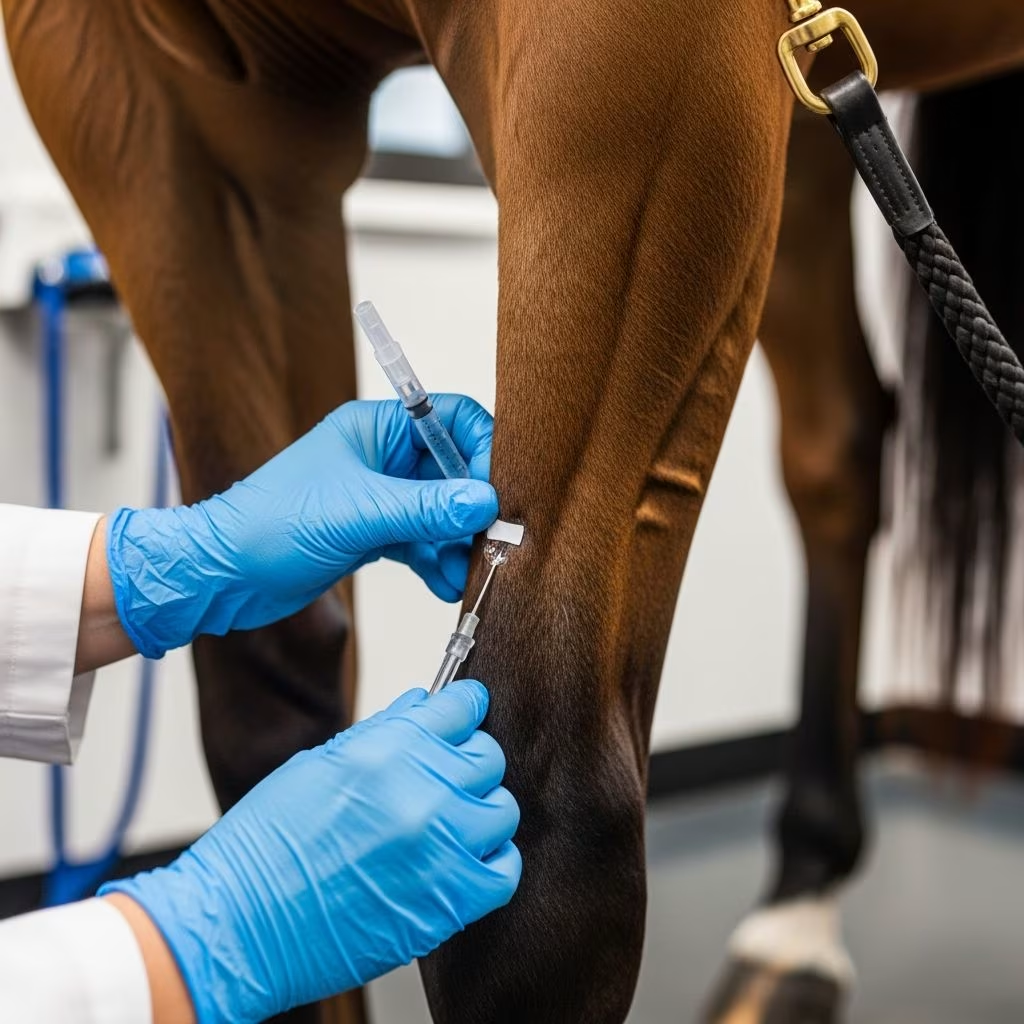
Lameness remains one of the most common challenges veterinarians face in equine practice, affecting performance, functionality, and overall quality of life in affected horses. While visual assessment and physical examination provide valuable initial information, definitively locating the source of pain often requires more sophisticated diagnostic approaches. Among the most valuable tools in a veterinarian’s diagnostic arsenal are anesthetic techniques designed to systematically eliminate regions of the body from suspicion, thereby narrowing the focus to the actual site of pathology. This article explores the principles, methods, and clinical applications of diagnostic anesthesia in equine lameness evaluation.
Understanding the Diagnostic Anesthesia Approach
Diagnostic anesthesia represents a logical and systematic methodology for pain localization in lame horses. The fundamental principle underlying this approach is straightforward: by temporarily blocking sensation to a specific anatomical region using local anesthetic agents, clinicians can observe whether a horse’s lameness improves, worsens, or remains unchanged. If lameness resolves or improves substantially following anesthetic application to a particular area, that region becomes the primary focus for further investigation and treatment planning.
The value of this technique extends beyond simple localization. Diagnostic anesthesia allows veterinarians to establish clinical significance for radiographic or ultrasound findings that might otherwise be ambiguous. A horse may display subtle radiographic changes that could be incidental rather than causative; anesthetic techniques help determine whether these findings correlate with the source of pain.
Foundational Assessment: Before Anesthesia Application
Proper execution of diagnostic anesthesia begins long before any needle is placed. Several critical preparatory steps ensure that subsequent anesthetic responses will be accurately interpreted and clinically meaningful.
Lameness Severity Consideration: The horse must demonstrate sufficient lameness that improvement following anesthesia can be reliably detected. Horses exhibiting only subtle lameness present interpretive challenges, as minor fluctuations in movement due to environmental factors, emotional state, or fatigue might be mistaken for responses to anesthesia. Conversely, some horses display lameness that improves spontaneously during exercise or warming up; premature anesthetic application in these cases could yield false-positive results suggesting pain localization when the lameness would have resolved naturally.
Objective Documentation Methods: Modern veterinary practice increasingly emphasizes objective assessment rather than relying solely on subjective clinical impression. Several techniques enhance diagnostic accuracy:
- Video recording of the horse’s gait before and after anesthetic application enables blinded, unbiased review
- Multiple experienced clinicians independently assessing movement patterns before and after blocks reduces individual observer bias
- Computerized gait analysis systems quantify asymmetry objectively, providing measurable data about movement changes
Exercise Protocols: The timing and intensity of exercise before anesthesia application significantly influences results. Lunging or controlled exercise may exacerbate subtle lameness, making it more apparent and easier to assess post-anesthesia. This foundational preparation ensures that the anesthetic response reflects true pain reduction rather than spontaneous improvement unrelated to the blocks.
Anatomical Basis for Anesthetic Techniques
Effective diagnostic anesthesia requires thorough understanding of equine neuroanatomy and the sensory innervation patterns of various structures throughout the limbs and trunk. Veterinarians must recognize that individual nerves supply overlapping territories, and anatomical variation between horses can influence block effectiveness.
The peripheral nerves of the equine limb follow predictable courses that veterinarians exploit when performing diagnostic blocks. Understanding which anatomical structures receive sensory innervation from specific nerves allows clinicians to design sequential blocks that progressively eliminate regions from consideration. Additionally, structures within synovial cavities—joints, bursae, and tendon sheaths—require intra-articular or intra-bursal anesthetic placement rather than perineural injection, as these sites have distinct sensory pathways.
Sequential Block Protocol: The Systematic Approach
The most widely recognized and reliable methodology for diagnostic anesthesia follows a sequential, progressive approach beginning distally and advancing proximally. This bottom-up strategy offers several advantages while presenting some practical challenges.
The Distal-to-Proximal Progression
Starting with anesthetic blocks at the lowest point of the affected limb—typically the foot region—and progressively advancing to higher anatomical levels creates a systematic elimination process. If lameness persists after distal blocks but resolves following a more proximal block, the clinician has successfully narrowed the pain source to the intervening anatomical region.
Each block application requires sufficient time for local anesthetic distribution and neural blockade to develop before gait reassessment. The horse is then jogged or lunged to evaluate whether lameness has changed. Documentation of the response—whether lameness improved, worsened, remained unchanged, or appeared to shift to a different limb—guides decisions about whether to apply the next block higher in the limb or to proceed with advanced imaging.
Challenges and Limitations of Sequential Blocks
While conceptually straightforward, sequential regional anesthesia presents several practical limitations:
- The process can be time-consuming, particularly when horses require evaluation of multiple limbs or when blocks must be performed at several levels
- Technical variability in block placement and anatomical variation between individual horses influence the specificity and consistency of neural blockade
- Repeated needle insertions may be poorly tolerated by some horses, leading to movement or anxiety that complicates assessment
- Some regional blocks desensitize broader anatomical territories than intended, making precise localization difficult
Despite these limitations, sequential regional anesthesia remains the gold standard for lameness localization in equine practice, valued for its cost-effectiveness and applicability in field settings.
Intra-Articular and Intra-Bursal Anesthetic Techniques
Structures enclosed within synovial cavities require distinct anesthetic approaches. Joints, bursae, and tendon sheaths possess specialized sensory innervation that differs from the perineural pathways used in regional blocks. Anesthetic must be deposited directly into these cavities to effectively block pain originating from their structures.
Joint Block Applications
Intra-articular anesthesia involves carefully injecting local anesthetic directly into the joint capsule. This technique effectively blocks pain from the articular surfaces, synovial membranes, and joint capsule itself. A positive response—improvement or resolution of lameness—strongly suggests pain originates within that specific joint.
Interestingly, research has revealed complex relationships between different joints and lameness presentation. For example, intra-articular anesthesia of the stifle joint has been demonstrated to reduce foot lameness in approximately one-third of horses, sometimes by up to 50 percent within thirty minutes. This counterintuitive finding illustrates how proximal joint dysfunction can manifest as distal lameness, highlighting the importance of complete diagnostic evaluation and the limitations of assuming pain location based solely on where lameness appears most pronounced.
Bursal and Tendon Sheath Blocks
Similar techniques are applied to other synovial structures. The navicular bursa, collateral sesamoidean ligament sheaths, and other specialized cavities can be anesthetized individually. These blocks require precise anatomical knowledge and careful technique to ensure anesthetic reaches the target structure without inadvertently anesthetizing adjacent neural pathways.
Interpretation Principles and Clinical Significance
Accurately interpreting responses to diagnostic anesthesia requires understanding several important principles and recognizing potential pitfalls in clinical reasoning.
Complete Versus Partial Response: Complete abolition of lameness following a block provides the most definitive evidence that pain originates within the desensitized region. However, partial improvement—a reduction in lameness severity without complete resolution—also carries clinical significance. Partial responses may indicate pain from multiple sources, with one originating in the blocked region and another located elsewhere.
Apparent Switching of Lameness: Occasionally, after a block is applied, lameness that appeared to originate in one limb now seems to manifest in a different limb. This phenomenon typically indicates that pain from the newly apparent lame limb was being masked or obscured by the more obvious lameness in the first limb. Recognition of this pattern guides further diagnostic pursuit toward the newly apparent pain source.
Failure to Improve: When lameness persists unchanged despite appropriate anesthetic blockade of an anatomical region, that area can be confidently excluded from the differential diagnosis. This negative information, while perhaps less dramatic than a positive response, proves equally valuable in narrowing diagnostic possibilities.
Reconciliation with Imaging Findings: Diagnostic anesthesia proves particularly valuable when radiographic or ultrasound findings appear inconsistent with clinical lameness severity or location. Anesthesia responses can establish that a suspicious radiographic lesion is indeed clinically significant, or conversely, reveal that radiographic abnormalities are incidental findings unrelated to the horse’s pain.
Distinction Between Diagnostic and Therapeutic Blocks
Although similar techniques are employed, diagnostic and therapeutic applications differ in important ways. Diagnostic blocks aim to desensitize the most specific anatomical region possible, providing precise localization through careful technique and attention to anatomical boundaries. In contrast, therapeutic blocks may intentionally desensitize broader regions to provide pain relief for extended periods, allowing performance of procedures or providing extended analgesia.
Clinicians must maintain clear awareness of which objective—diagnostic precision or therapeutic effect—guides their technique and interpretation. The standards for specificity and interpretation appropriately differ between these applications.
Advanced Imaging Integration with Diagnostic Anesthesia
Diagnostic anesthesia provides essential guidance for advanced imaging utilization. Once anesthesia has narrowed the pain source to a specific anatomical region, advanced imaging such as magnetic resonance imaging, computed tomography, or specialized ultrasound can be strategically focused on that area. This integration optimizes the diagnostic process by providing both functional information from anesthesia and detailed structural information from imaging.
Approximately 90 percent of lameness cases yield diagnostic answers through the combination of clinical examination, diagnostic anesthesia, and appropriate imaging modalities. This high success rate reflects the complementary value these techniques provide when applied systematically.
Special Considerations and Complications
Several practical and clinical considerations influence the application and interpretation of diagnostic anesthesia.
Individual Variation: Anatomical variation between horses, differences in nerve anatomy, and variation in local anesthetic sensitivity all influence block effectiveness. A technique that reliably produces expected results in most horses may occasionally produce unexpected outcomes in individuals with unusual anatomy.
Vascular Involvement: Proper technique avoids intravascular injection, which would prevent anesthetic from reaching neural tissue and potentially cause systemic toxicity. Aspiration before injection helps prevent this complication.
Time Allowance: Adequate time must be provided for anesthetic distribution and onset of action before gait reassessment. Premature evaluation before complete neural blockade develops may produce false-negative results.
Environmental Factors: Footing, surface camber, and environmental conditions influence how lameness is expressed. Consistent evaluation conditions between pre-anesthesia and post-anesthesia assessment ensure that observed changes reflect anesthetic effects rather than environmental variables.
Conclusion
Diagnostic anesthesia techniques represent essential clinical tools for equine veterinarians addressing lameness cases. Through systematic application of local anesthetic blocks, careful observation of gait changes, and integration with advanced imaging, veterinarians can definitively identify the anatomical source of pain in the vast majority of lame horses. This precise localization enables targeted treatment planning, appropriate prognostication, and optimization of therapeutic outcomes. The combination of clinical skill, anatomical knowledge, and objective assessment methods continues to make diagnostic anesthesia an indispensable component of comprehensive equine lameness evaluation.
References
- Step-by-Step Guide to Equine Lameness Diagnosis — Hallmarq Veterinary Imaging. 2025. https://hallmarq.net/us/2025/11/06/from-block-to-image-to-treatment-a-step-by-step-guide-to-equine-lameness-diagnosis/
- Intra-articular anaesthesia of the equine stifle improves foot lameness — PubMed Central/National Center for Biotechnology Information. PMC6851447. https://pmc.ncbi.nlm.nih.gov/articles/PMC6851447/
- Equine Local Anesthetic and Analgesic Techniques — VeterianKey. https://veteriankey.com/equine-local-anesthetic-and-analgesic-techniques/
- Diagnostic analgesia of the equine digit (Proceedings) — DVM360. https://www.dvm360.com/view/diagnostic-analgesia-equine-digit-proceedings
- Lameness Evaluation — University of California Davis School of Veterinary Medicine, Equine Surgery and Lameness Service. https://www.vetmed.ucdavis.edu/hospital/large-animal/equine-surgery-lameness



