

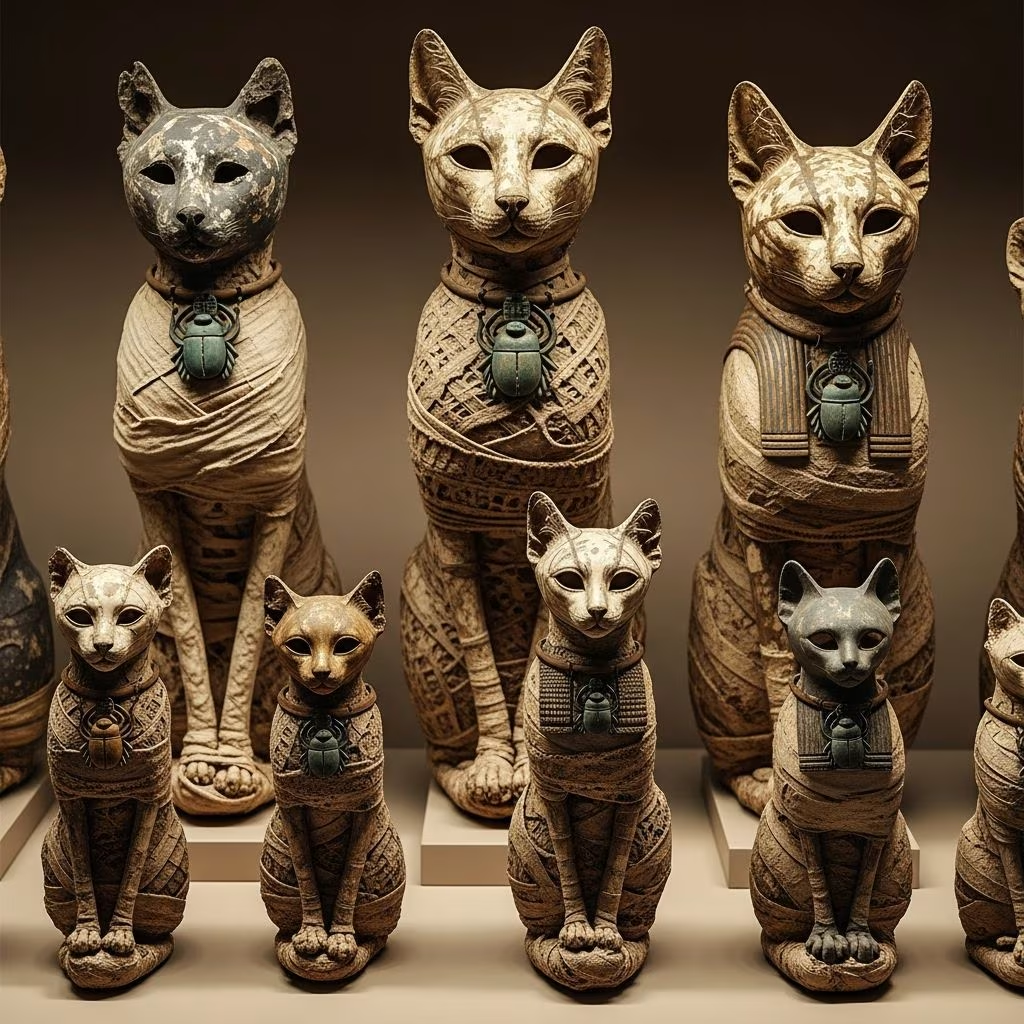
Cat mummies represent one of the most intriguing aspects of ancient Egyptian culture, blending religion, animal reverence, and early domestication practices. These preserved felines, often found in vast catacombs, served as votive offerings to the goddess Bastet and provide modern scientists with clues about the origins of domestic cats.
The Divine Connection: Cats and Goddess Bastet
In ancient Egypt, cats held a exalted status linked directly to Bastet, the goddess embodying protection, fertility, and joy. Temples dedicated to her, particularly at Bubastis, became centers for cat worship where pilgrims purchased mummified cats as offerings to seek divine favor. These acts were believed to strengthen the goddess’s presence on earth, with cats seen as her living embodiments.
Bastet’s cult peaked during the Late Period (664–332 BC) and extended into Ptolemaic and Roman times, leading to the mass production of cat mummies. Historical accounts from Greek writers like Herodotus describe massive festivals at Bubastis, where wine flowed freely and cat offerings were central to the rituals. Cats were not merely animals but conduits for spiritual communication, their mummification ensuring eternal service to the deity.
Historical Timeline of Cat Veneration
The reverence for cats evolved over millennia. Early evidence appears in Predynastic remains around 4000 BC at sites like Mostagedda and Abydos, where cat bones suggest initial human-feline interactions. By the Old Kingdom (c. 2663–2195 BC), textual references indicate growing familiarity, though full domestication signs emerge later.
- Predynastic/Early Dynastic (c. 4000–3000 BC): Skeletal remains hint at proximity to humans.
- Middle Kingdom (c. 2000 BC): Tomb art depicts cats, marking cultural integration.
- New Kingdom (c. 1500 BC): Increased representations in paintings and reliefs.
- Late Period/Ptolemaic (664 BC–30 BC): Boom in mummification for votive purposes.
- Roman Period (30 BC–AD 395): Continued production in catacombs.
This progression underscores how cats transitioned from wild predators to sacred companions.
Mummification Techniques and Processes
Ancient Egyptians applied sophisticated preservation methods to cats, similar to human mummification but adapted for animals. Votive cats underwent desiccation in natron salt, evisceration, and anointing with resins, then wrapped in linen bandages often adorned with woven patterns. Some were encased in wooden coffins depicting seated felines with paws together.
Not all mummies contained complete skeletons; radiographic studies reveal kittens or partial remains, indicating mass production to meet pilgrim demand. Breeding programs at temples supplied cats, some deliberately killed post-ritual to fulfill offerings. Challenges like tomb flooding and alkaline conditions preserved many, though DNA extraction proved difficult until recent advances.
Major Discovery Sites and Archaeological Finds
Catacombs at Saqqara, Bubastis, Thebes (Dra Abu el-Naga), Abydos, Dendera, and the Dakhla Oasis yielded thousands of mummies. Saqqara’s complex alone holds vast caches from the Late Period. In 1888, a farmer near Istabl Antar unearthed a mass feline grave, highlighting the scale of these burials.
| Site | Period | Key Finds |
|---|---|---|
| Saqqara | Late/Ptolemaic | Thousands of cat mummies, catacombs |
| Bubastis | Late Period | Temple offerings to Bastet |
| Thebes | New Kingdom onward | Pet and votive mummies |
| Abydos | Early/Late | Smaller cemeteries |
These sites reveal organized industries around cat mummification, supporting temple economies.
Genetic Insights: Proving Domestication
Modern science confirms ancient Egyptian mummies as domestic cats (*Felis silvestris catus*). A study analyzing mitochondrial DNA from three mummies dated to 664–332 BC found mitotypes matching modern domestic cats, with divergence estimates of 2,000–7,500 years prior—aligning with Near Eastern domestication during Predynastic Egypt. This provides the first genetic evidence of domesticated cats in votive mummies, suggesting Egyptians bred them extensively.
Skull analyses from Gizeh mummies (600–200 BC) further support this, linking them to ancestors of today’s felines. These findings refute wildcat theories, positioning Egypt as a hub for selective breeding.
Types of Cat Mummies and Their Purposes
Egyptian cat mummies fell into categories:
- Votive Offerings: Mass-produced for pilgrims, buried in catacombs to honor Bastet.
- Pet Mummies: Beloved companions interred with owners for afterlife reunion, as in Prince Thutmose’s sarcophagus (c. 1350 BC).
- Divine Manifestations: Ritually prepared cats housing Bastet’s spirit.
- Utility Symbols: Representing cats’ roles in pest control and snake warding.
Bronze figurines and amulets complemented mummies, amplifying magical properties.
Cultural and Practical Roles of Cats
Beyond religion, cats protected granaries from rodents and aided hunters in Nile marshes, as shown in Nebamun’s tomb painting. Diodorus noted their snake-confronting prowess. Temples allocated lands for sacred cats’ upkeep, fostering self-sustaining populations. Herodotus’s accounts of Bubastis festivals emphasize their societal integration.
Modern Study Challenges and Advances
Preservation issues like heat, humidity, and combustion hindered DNA recovery until 2012 breakthroughs. Ongoing radiography and genetic work continue to illuminate feline history, tracing modern cats to pharaonic lineages.
FAQs
Why did ancient Egyptians mummify cats?
Cats were mummified as votive offerings to Bastet, pets for the afterlife, and symbols of divine protection.
When did cat mummification peak?
It peaked in the Late Period (664–332 BC) through Ptolemaic and Roman eras.
Were mummified cats domesticated?
Genetic evidence confirms they were *Felis silvestris catus*, domesticated millennia earlier.
Where were most cat mummies found?
Major sites include Saqqara, Bubastis, and Thebes catacombs.
Did Egyptians breed cats for mummies?
Yes, temples bred and sometimes killed cats to meet pilgrimage demands.
Preserving the Legacy
Cat mummies offer a window into ancient beliefs, economy, and biology. Museums worldwide display these artifacts, reminding us of humanity’s enduring feline bond. Future research may uncover more about their global spread via trade.
References
- Genetic Comparison of Egyptian Cat Mummies to their Feline Contemporaries — Draemer et al., PMC/NIH. 2012-07-18. https://pmc.ncbi.nlm.nih.gov/articles/PMC3426309/
- Cat Mummies — McClung Museum of Natural History & Culture. 2001-05-01. https://mcclungmuseum.utk.edu/2001/05/01/cat-mummies/
- Why Were Cats Mummified in Ancient Egypt? — Carnegie Museum of Natural History. N/A. https://carnegiemnh.org/why-were-cats-mummified-in-ancient-egypt/
- Animal Mummy — Wikipedia (informational, primary sources referenced). N/A. https://en.wikipedia.org/wiki/Animal_mummy
- The Mummified Cats of Ancient Egypt — Morrison-Scott, Zoological Society of London. 1952. https://zslpublications.onlinelibrary.wiley.com/doi/abs/10.1111/j.1096-3642.1952.tb00788.x



