

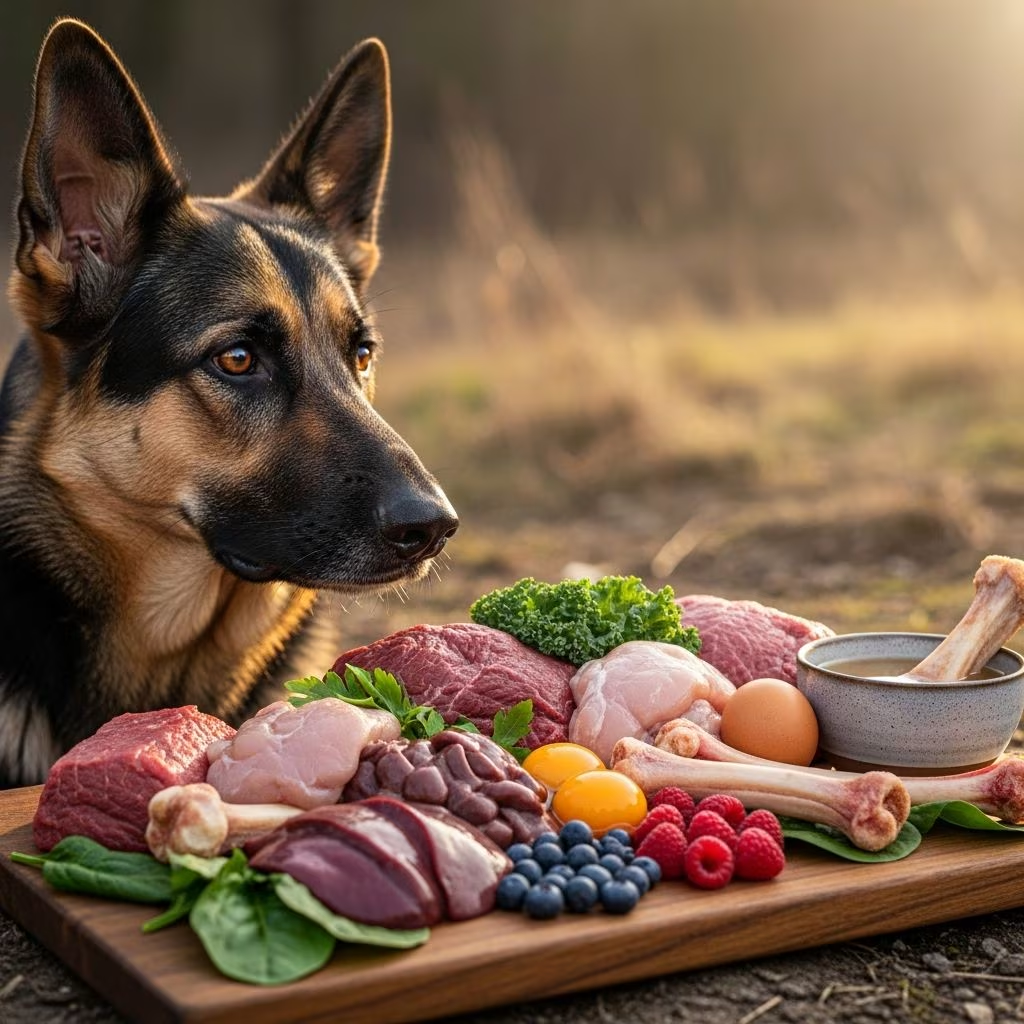
For thousands of years, dogs consumed what nature intended—raw meat, bones, and organs foraged or hunted alongside their human companions. Yet within a single century, this natural feeding pattern nearly disappeared, replaced by processed kibble and convenience-based nutrition. Today, a growing body of scientific evidence and veterinary practitioners are challenging this industrial shift, reigniting interest in species-appropriate feeding practices. Understanding this transformation requires examining not just what happened, but why—and how a single veterinarian in Australia helped reverse decades of nutritional misconception.
The Pre-Commercial Era: Dogs and Natural Nutrition
Before the mid-1800s, dogs occupied a fundamentally different role in human society than they do today. These animals were primarily working companions—herding livestock, hunting game, guarding property—rather than household pets. Their diets reflected this utilitarian relationship. Dogs survived primarily on kitchen scraps, bones from butchering, and whatever they could scavenge from their immediate surroundings. This wasn’t considered a formal feeding system; it was simply how coexistence functioned.
During this period, the canine digestive system had already undergone significant evolutionary changes from their wolf ancestors. Scientific research has demonstrated that dogs developed genetic adaptations specifically for processing starches and carbohydrates, allowing them to digest grains and agricultural byproducts more efficiently than their wild relatives. This adaptation occurred not through intentional breeding but through thousands of years of consuming human food scraps as humans transitioned from hunter-gatherer societies to agricultural civilizations.
Despite this metabolic flexibility, dogs remained fundamentally carnivorous animals. Their teeth structure, digestive enzyme profiles, and nutritional requirements still reflected their origins as meat-eating predators. The difference was one of degree, not kind—dogs could tolerate plant-based ingredients, but their optimal nutrition came from animal proteins and fats.
The Birth of Commercial Pet Food: Innovation Meets Marketing
The transformation began unexpectedly. In the 1860s, an American businessman named James Spratt witnessed sailors at English docks discarding hardtack—a dense biscuit made from flour, water, and salt—to stray dogs. This observation sparked an idea. If dogs would consume hardtack, might they consume a purpose-built biscuit? Spratt developed the first commercial dog food: a mixture of grains, vegetables, beetroot, and dried beef parts formed into cakes.
What made Spratt’s innovation revolutionary wasn’t the product itself but the marketing strategy surrounding it. He aggressively promoted his dog cakes through testimonials from show dog owners and strategic advertising campaigns. He also pioneered the concept of specialized nutrition, creating different formulas for puppies (enriched with cod liver oil for development) and different-sized dogs (grade-specific biscuits). By the early 1900s, commercial dog food had transitioned from novelty to norm among middle and upper-class dog owners.
The next major innovation arrived after World War I. Horse meat, surplus from trench warfare in Europe, became an abundant and inexpensive ingredient. In 1922, brothers Philip, Earl, and Ernst Chappel created Ken-L-Ration, a paste of grains and horse meat that could be canned and preserved. The product was so successful that by the 1930s, the company was breeding horses specifically for dog food production. Though the marketing carefully obscured the horse meat ingredient, the product dominated the market, at one point capturing 90% of the commercial dog food industry.
Kibble and the Post-War Shift
World War II created an unexpected pivot point in pet food history. With metal rationed for military use and canned goods restricted, dog food manufacturers faced a crisis. The solution emerged from an unexpected source: the cereal industry. Ralston Purina Company adapted extrusion technology—the same high-pressure, high-temperature process used to manufacture Chex cereal—to pet food production. The result was Purina Dog Chow, the first commercial dry kibble.
Kibble offered unprecedented advantages: it was shelf-stable, economical to produce, easy to store, and simple to feed. Marketing campaigns emphasized convenience and scientific advancement, positioning kibble as a superior nutritional choice developed through modern research. Within decades, the vast majority of pet owners in Western countries had abandoned raw feeding entirely, viewing it as primitive or risky compared to laboratory-formulated kibble.
What wasn’t discussed openly was that kibble’s manufacturing process—high heat, high pressure, and extended shelf storage—fundamentally altered the nutritional profile of ingredients. Nutrients were destroyed, enzymes were deactivated, and the biological availability of nutrients decreased. Manufacturers attempted to compensate by adding synthetic vitamins, but these laboratory-created supplements were crude approximations of whole-food nutrition.
Geographic Divergence: Australia’s Alternative Path
While American and European dog owners enthusiastically adopted commercial pet food in the 1950s and 1960s, Australia followed a different trajectory. The commercial pet food industry arrived in Australia several decades later than in North America. Consequently, during the 1960s, many Australian dog owners still maintained traditional feeding practices, providing their dogs with raw bones and household scraps. This geographic and temporal accident would prove historically significant.
Into this environment was born Ian Billinghurst, a veterinarian who would later challenge the entire commercial pet food paradigm. Growing up in a society where raw feeding remained common, Billinghurst witnessed firsthand the apparent health and vitality of raw-fed dogs. When he entered veterinary graduate school in the early 1970s, however, he encountered the conventional wisdom of modern veterinary medicine: that commercial pet food represented nutritional progress and that raw feeding was an outdated, potentially dangerous practice.
A Veterinarian’s Counterintuitive Observation
What made Billinghurst’s position unique was his dual perspective. He possessed both traditional knowledge of raw feeding from his childhood and contemporary veterinary training. Over several years, he began privately experimenting with his own dogs, returning them to the diet he remembered from his youth: raw meaty bones and household scraps.
The results were striking. Dogs fed this way displayed remarkable improvements in multiple health markers. Skin conditions resolved. Dental disease decreased significantly. Vision clarity improved. Growth patterns normalized. Reproductive issues diminished. These observations flew directly in the face of conventional veterinary teaching, which held that such problems were either genetic, environmental, or required pharmaceutical intervention—not dietary modification.
Billinghurst didn’t rely on anecdotal observation alone. He studied nutrition science, reviewed veterinary literature, consulted colleagues, and compiled case studies documenting health transformations in raw-fed dogs. This rigorous approach lent credibility to his observations and positioned him as a serious scientific voice rather than merely a contrarian.
Publishing the Challenge: “Give Your Dog a Bone”
In 1993, Billinghurst published his groundbreaking work, Give Your Dog a Bone, which systematically argued for a return to raw, uncooked, bone-inclusive diets. The title itself was provocative—directly contradicting decades of veterinary warnings about the dangers of bone feeding. Yet Billinghurst’s evidence suggested that whole, raw bones presented minimal risk when handled appropriately, and that the nutritional and health benefits substantially outweighed theoretical dangers.
Two core principles anchored his dietary philosophy. First, dogs thrived on diets containing raw meaty bones, which provided not only complete nutrition but also mechanical cleaning of teeth and appropriate digestive stimulation. Second, and equally important, dog food should never be cooked. Cooking destroyed heat-sensitive nutrients, reduced enzyme activity, altered protein structures in ways that made them less bioavailable, and fundamentally changed the nutritional profile of ingredients. A raw potato and a cooked potato, for example, present entirely different nutritional profiles—not just in degree but in kind.
The Scientific Foundation: Genetic Evidence
Billinghurst’s advocacy gained additional scientific support from emerging genetic research. A landmark 2013 study published in Nature demonstrated that dogs had evolved multiple genes specifically for starch digestion, giving them metabolic flexibility that wolves lacked. This research proved that dogs were genuinely omnivorous, not obligate carnivores like their ancestors. However, this genetic adaptation didn’t negate canine carnivory—it simply expanded their capacity to tolerate plant-based ingredients.
The critical distinction is between “can digest” and “should eat.” Dogs can process starches, but optimal canine nutrition remains centered on animal proteins and fats, supplemented with whole foods. The ability to digest something is not synonymous with deriving optimal nutrition from it.
Core Principles of Ancestral Canine Feeding
Raw feeding advocates and supporting veterinarians established several foundational principles:
- Biological Appropriateness: Dogs thrive on diets that mirror what their wild relatives consume—primarily fresh meat, organs, and bones—supplemented with small amounts of plant matter
- Enzyme Preservation: Raw food contains living enzymes that support digestive function and nutrient absorption; cooking destroys these enzymes permanently
- Nutrient Density: Whole raw foods contain bioavailable nutrients that synthetic supplements cannot replicate, even when formulated to match nutritional profiles
- Oral Health: Raw meaty bones provide natural dental cleaning through mechanical action and enzyme-rich saliva stimulation
- Digestive Optimization: Dogs possess the stomach acid production and digestive enzymes specifically evolved to process raw meat safely
Addressing Safety and Practical Concerns
Critics of raw feeding raised legitimate concerns about bacterial contamination, nutritional imbalance, and health risks. Raw feeding advocates addressed these methodically. Regarding bacteria: dogs possess dramatically more powerful stomach acid than humans (pH 1-2 versus human pH 3-4), enabling them to neutralize pathogens that would sicken people. Additionally, their shorter digestive tract means food passes through quickly, reducing pathogen proliferation time.
Regarding nutritional balance: proponents argued that the commercial pet food industry created the impression that complex nutritional calculations were necessary, when in reality whole foods naturally provided balanced nutrition across varied ingredients and sources. A dog fed a rotating variety of muscle meats, organs, and bones from different animal sources would receive complete nutrition without laboratory formulation.
Regarding health risks: decades of anecdotal evidence and increasing case studies documented dramatic health improvements in dogs transitioning to raw diets—improvements that contradicted predictions of harm from veterinary establishment institutions.
The Modern Raw Feeding Movement
What began as one veterinarian’s counter-cultural observation in 1990s Australia has evolved into a significant movement. Pet owners worldwide now examine the history of their dogs’ nutrition, recognizing that the commercial pet food industry had systematized feeding practices primarily for corporate profit and convenience rather than canine health. The movement includes veterinary professionals, nutritionists, breeders, and health-conscious pet owners who view raw feeding not as fad but as return to biological fundamentals.
Contemporary raw feeding encompasses multiple approaches: whole prey feeding (consuming entire small animals), muscle meat and organ combinations, bone broths, and supplemented raw diets designed for specific health conditions. The diversity reflects recognition that dogs, like people, may thrive on varied dietary approaches.
Frequently Asked Questions
- Is raw feeding safe for all dogs?
- Raw feeding is generally considered safe for healthy adult dogs; however, puppies, immunocompromised dogs, and those with specific health conditions should be approached cautiously and ideally under veterinary guidance.
- Does raw food cost more than kibble?
- Initial costs may seem comparable to premium kibbles, but raw feeding often reduces veterinary expenses through improved health, potentially offsetting food costs.
- Can I mix raw and cooked foods?
- Most raw feeding advocates recommend against mixing raw and cooked foods in single meals, as they digest at different rates and may create digestive stress.
- What about nutritional balance in raw diets?
- Proper raw diets include muscle meat, organ meats, and bone in appropriate ratios—typically 70% muscle, 10% organ, 10% bone, with seasonal adjustments and variety across protein sources.
Conclusion: History Informing Future Choices
The evolution from ancestral raw feeding to industrial kibble to contemporary raw food revival traces a complete circle—but with crucial differences. Modern raw feeding advocates combine traditional wisdom with scientific understanding, approaching canine nutrition as biology rather than mere convenience. As the commercial pet food industry matured and veterinary research deepened, inconsistencies between marketed scientific advancement and actual canine health outcomes became impossible to ignore.
Billinghurst’s legacy extends beyond raw feeding methodology. He demonstrated that challenging established industry practices through careful observation, rigorous documentation, and scientific integrity could influence a profession and reshape how millions of pet owners viewed their animals’ nutrition. Whether pet owners ultimately choose raw feeding or not, the movement prompted reconsideration of how we nourish our companions—moving beyond accepting convenient defaults toward actively questioning whether industrial solutions truly serve the beings we love.
References
- The history of dog food and nutrition, from hunting to the raw food movement — Ollie. 2026. https://www.ollie.com/history-of-dog-food-and-nutrition-from-hunting-to-the-raw-food-movement/
- The history of pet food and the rise of raw diets — ManyPets. 2026. https://manypets.com/uk/articles/history-pet-food-rise-raw-food-diets-dogs/
- From Scraps to Science: The Human-Driven Evolution of Dog Nutrition — Feed Petaluma. 2026. https://www.feedpetaluma.com/blogs/blog/from-scraps-to-science-the-human-driven-evolution-of-dog-nutrition
- The Evolution of the Raw Dog Food Diet — Whole Dog Journal. 2026. https://www.whole-dog-journal.com/food/the-evolution-of-the-raw-dog-food-diet/
- The Evolution from Raw Dog Food and Back! — Canino. 2026. https://canino.ca/blogs/the-raw-dog-food-blog/the-evolution-of-dog-food
- Raw diets for dogs and cats: a review, with particular reference to zoonotic aspects — PMC/NIH National Center for Biotechnology Information. 2019. https://pmc.ncbi.nlm.nih.gov/articles/PMC6849757/



