Amphibians: Biology And Diversity, 3 Major Orders Explained
Discover the fascinating world of amphibians, from their unique biology to veterinary care essentials for these vital ecosystem players.
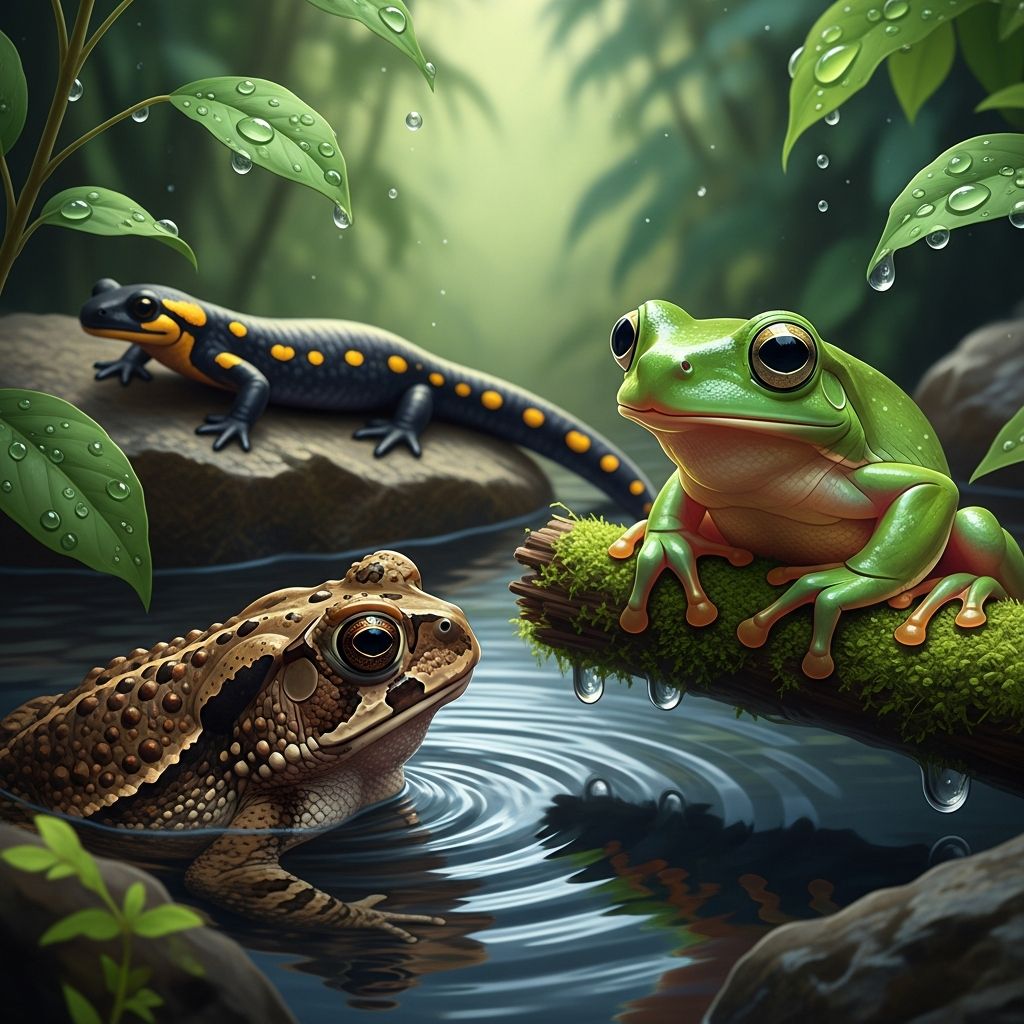
Amphibians represent a diverse class of vertebrates known for their dual life in aquatic and terrestrial environments, featuring over 6,000 species worldwide. These ectothermic animals, belonging to the class Amphibia, exhibit unique adaptations that bridge fish-like aquatic larvae and land-dwelling adults.
Evolutionary Origins and Key Traits
Amphibians evolved as the first vertebrates to colonize land, transitioning from water-bound ancestors during the late Devonian period. They are characterized by smooth, moist, glandular skin without scales, which facilitates cutaneous respiration and water absorption. Unlike reptiles, birds, and mammals—classified as amniotes—amphibians are anamniotes, laying eggs without protective amniotic membranes, necessitating moist environments for reproduction.
Their three-chambered hearts, permeable skin, and cold-blooded nature define their physiology, allowing them to regulate body temperature via external sources. Most undergo metamorphosis, dramatically changing form from gilled larvae to lung-breathing adults.
Major Groups of Living Amphibians
Modern amphibians fall under the subclass Lissamphibia, comprising three primary orders: Anura (frogs and toads), Caudata (salamanders and newts), and Gymnophiona (caecilians). Each order displays distinct morphological and ecological specializations.
Anura: Frogs and Toads
Anura, with approximately 7,360 species across 53 families, dominate amphibian diversity. These jumpers feature elongated hind limbs for leaping, short forelimbs, and no tails in adulthood. Suborders include Archaeobatrachia (primitive forms like Leiopelmatidae) and Mesobatrachia (fossorial and aquatic groups like Pipidae), with Neobatrachia encompassing most advanced species.
- Adaptations: Powerful hind legs for propulsion, vocal sacs for mating calls, and sticky toe pads in arboreal species.
- Habitats: Freshwater wetlands, forests, and deserts; some are fully aquatic or fossorial.
Caudata: Salamanders and Newts
The Caudata order includes 764 species in 9 families, retaining larval traits like tails into adulthood. They possess four equal limbs, moist skin, and often exhibit paedomorphosis, where adults remain aquatic with external gills.
- Locomotion: Walking or swimming via lateral undulation.
- Defense: Skin toxins and autotomy (tail shedding).
Gymnophiona: Caecilians
Caecilians, with 215 species in 10 families, are limbless, burrowing worm-like amphibians primarily in tropical regions. Known as Apoda, they feature annular grooves, sensory tentacles, and bone-covered eyes.
- Unique Features: Venom glands, mucus secretion for hydration, and chemosensory tentacles for prey detection.
- Distribution: Africa, Asia, South America; fossorial or aquatic lifestyles.
Habitats and Global Distribution
Amphibians thrive in freshwater ecosystems, wetlands, riparian zones, and terrestrial habitats like forests and soil. Their distribution spans every continent except Antarctica, with highest diversity in tropical rainforests. Fossorial caecilians burrow in soil, arboreal frogs climb trees, and semiaquatic salamanders occupy streams.
Climate sensitivity ties their survival to moisture levels; permeable skin demands humid microhabitats to prevent desiccation.
Reproductive Strategies
Amphibian reproduction hinges on external fertilization in water for most species, producing gelatinous eggs. Parental care varies: some frogs guard eggs, salamanders provide skin nourishment, and caecilians exhibit live birth with fetal tooth-feeding.
| Order | Fertilization Type | Egg Type | Larval Stage |
|---|---|---|---|
| Anura | External | Gelatinous clusters | Tadpoles with gills |
| Caudata | External/Internal | Individual or clusters | Gilled larvae |
| Gymnophiona | Internal | Viviparous/oviparous | Direct development |
Physiological Adaptations
Skin serves multiple roles: respiration (up to 50% oxygen uptake), osmoregulation, and defense via mucus and toxins. Lungs are simple sacs in adults, supplemented by buccal pumping. Their diet includes insects, worms, and small vertebrates, captured via sticky tongues (Anura) or direct lunges.
Veterinary Considerations for Amphibians
In exotic and laboratory settings, amphibians require precise husbandry: temperatures 20-28°C, high humidity (70-100%), and UVB lighting. Common issues include chytridiomycosis, ranavirus, and metabolic bone disease from poor calcium.
- Housing: bioactive enclosures mimicking natural substrates.
- Nutrition: Gut-loaded insects dusted with supplements.
- Health Monitoring: Regular skin checks for parasites, weight assessments.
Conservation Challenges
Habitat loss, pollution, and disease threaten 40% of species, with many listed as endangered. Climate change exacerbates dehydration risks, underscoring amphibians’ role as biodiversity indicators.
Amphibians in Research and Education
Laboratory amphibians like Xenopus aid developmental biology studies due to external fertilization and rapid metamorphosis. Their use demands ethical protocols, including anesthesia and humane endpoints.
Frequently Asked Questions (FAQs)
What defines an amphibian?
Amphibians are ectothermic vertebrates with moist skin, undergoing metamorphosis, and belonging to orders Anura, Caudata, or Gymnophiona.
How many amphibian species exist?
Approximately 6,200-8,000 species, with Anura being the most speciose.
Do all amphibians need water?
Most require moist environments for skin and reproduction, though some tolerate drier conditions.
What are caecilians?
Limbless, burrowing amphibians with sensory adaptations for underground life.
Why are amphibians declining globally?
Factors include habitat destruction, chytrid fungus, and climate shifts.
References
- Characteristics of Class Amphibia — BYJU’S. 2023. https://byjus.com/biology/amphibia/
- Amphibian — Wikipedia. 2026-02-20. https://en.wikipedia.org/wiki/Amphibian
- 12.14: Amphibian Classification — Biology LibreTexts. 2024. https://bio.libretexts.org/Bookshelves/Introductory_and_General_Biology/Introductory_Biology_(CK-12)/12:_Vertebrates/12.14:_Amphibian_Classification
- Amphibians | Overview, Types & Traits — Study.com. 2025. https://study.com/academy/lesson/amphibians-traits-types-roles.html
- Classification and Description of Amphibians Commonly Used for… — NCBI Bookshelf. 2023. https://www.ncbi.nlm.nih.gov/books/NBK217595/
- Amphibians — University of Hawaii Manoa. 2024. http://manoa.hawaii.edu/exploringourfluidearth/biological/amphibians-reptiles-and-birds/amphibians
Similar Articles








Read full bio of Sneha Tete