Amphibian Anatomy: 3 Key Orders And Respiratory Adaptations
Discover the unique physical traits and biological adaptations that define amphibians, from skin and limbs to life cycles.
Amphibians represent a captivating class of vertebrates renowned for their dual lifestyles spanning aquatic and terrestrial realms. Belonging to the class Amphibia, these creatures exhibit remarkable adaptations that allow them to thrive in diverse environments. Their physical characteristics, from permeable skin to complex life cycles, underscore their evolutionary significance as transitional species between fish and fully terrestrial vertebrates.
The Dual Nature of Amphibian Habitats
Amphibians are defined by their ability to inhabit both water and land, a trait reflected in their name derived from Greek roots meaning “double life.” Most species begin life fully aquatic as larvae, relying on gills for respiration, before undergoing metamorphosis to become air-breathing adults capable of venturing onto land. This biphasic existence demands specialized physiological features, including moist skin that facilitates gas exchange and prevents desiccation.
While adults may roam terrestrial landscapes, they invariably return to water for reproduction, highlighting their perpetual tie to moist environments. This dependency makes them sensitive indicators of ecosystem health, as pollution or habitat degradation can disrupt their life cycles.
Thermoregulation: Ectothermic Lifestyles
As ectotherms, or cold-blooded animals, amphibians cannot internally regulate body temperature and instead absorb heat from their surroundings. This poikilothermic nature allows them to inhabit warm climates efficiently, conserving energy that would otherwise be expended on maintaining constant internal heat.
Their metabolic rates fluctuate with environmental temperatures, slowing in cooler conditions to enter states of torpor or hibernation. This adaptation enables high energy efficiency, with some species converting over half of ingested energy into body mass, far surpassing endothermic vertebrates like birds and mammals.
Skin: A Multifunctional Barrier
The skin of amphibians is a hallmark feature: smooth, scaleless, and perpetually moist due to abundant mucous glands. This permeability to water, ions, and gases serves multiple roles, including cutaneous respiration where oxygen diffuses directly through the epidermis.
Mucus production not only keeps the skin hydrated but also provides protection against pathogens and desiccation. Many species possess poison glands that secrete irritants or toxins, deterring predators. The skin sheds periodically in a single piece, a process regulated by hormones from the pituitary and thyroid glands.
- Moist texture: Prevents dehydration and aids in gas exchange.
- Glandular secretions: Mucus for lubrication; toxins for defense.
- Permeability: Allows cutaneous breathing, crucial for small, lungless species.
Respiratory Adaptations Across Life Stages
Amphibian respiration evolves dramatically during development. Larvae, such as tadpoles, utilize external gills for aquatic oxygen uptake, akin to fish. During metamorphosis, gills regress, and functional lungs develop alongside enhanced skin respiration.
Adults employ a trio of methods: buccal pumping into lungs, buccopharyngeal respiration via mouth lining, and cutaneous exchange through skin. Some terrestrial salamanders forgo lungs entirely, relying solely on skin for all gas needs. This versatility supports their semiaquatic lifestyles, allowing submersion without surfacing frequently.
| Life Stage | Primary Respiration | Secondary Methods |
|---|---|---|
| Larval (e.g., Tadpole) | Gills | Skin |
| Adult (Aquatic) | Lungs + Skin | Buccopharyngeal |
| Adult (Terrestrial) | Skin + Lungs | None |
Skeletal Framework and Locomotion
Amphibian skeletons are lightweight and hollow, homologous to other tetrapods yet adapted for flexibility. Most possess four limbs, though caecilians are limbless, resembling worms. Hind limbs typically dominate, powering jumps in anurans (frogs and toads) or undulating swims in salamanders.
The vertebral column features interlocking processes for stability, while the pectoral and pelvic girdles anchor musculature. The ilium orients forward, keeping the body low to the ground for efficient movement. These structures support diverse gaits: hopping, walking, swimming, or burrowing.
Diversity Among Amphibian Orders
Anura: Frogs and Toads
Anurans boast robust hind legs for leaping, elongated tibiotarsus bones, and webbed feet for propulsion in water. Their compact bodies lack tails, with fused vertebrae forming a urostyle for leap support. Tympanic membranes enable acute hearing.
Urodela: Salamanders and Newts
Salamanders retain larval traits into adulthood, featuring long tails for swimming and equal-sized limbs for crawling. Some species exhibit neoteny, remaining fully aquatic with gills. Their moist skin demands high humidity.
Gymnophiona: Caecilians
These burrowing specialists lack limbs, sporting annulated, scale-embedded skin and sensory tentacles. Powerful skulls aid in subterranean navigation, with internal fertilization via a protrusible phallus.
Metamorphosis: A Profound Transformation
Indirect development defines most amphibians, progressing from egg to larva to adult via metamorphosis. Eggs, laid in gelatinous clusters, hatch into gilled aquatic juveniles. Thyroxine triggers changes: gill resorption, lung development, limb growth, and tail reduction in anurans.
This process, counterbalanced by prolactin, adapts organisms to new niches. Environmental cues like temperature and food availability influence timing, with some species direct-developing without free larvae.
Frequently Asked Questions
What makes amphibian skin unique?
Amphibian skin is scaleless, glandular, and permeable, enabling respiration, hydration, and defense through mucus and toxins.
How do amphibians breathe?
They use gills as larvae, lungs and skin as adults, with some relying entirely on cutaneous respiration.
Why are amphibians ectotherms?
As poikilotherms, they rely on external heat sources, optimizing energy for growth and reproduction.
What are the three main orders of amphibians?
Anura (frogs/toads), Urodela (salamanders), and Gymnophiona (caecilians).
Can amphibians live without water?
No, their permeable skin requires moisture, and reproduction demands aquatic environments.
Internal Organs and Physiology
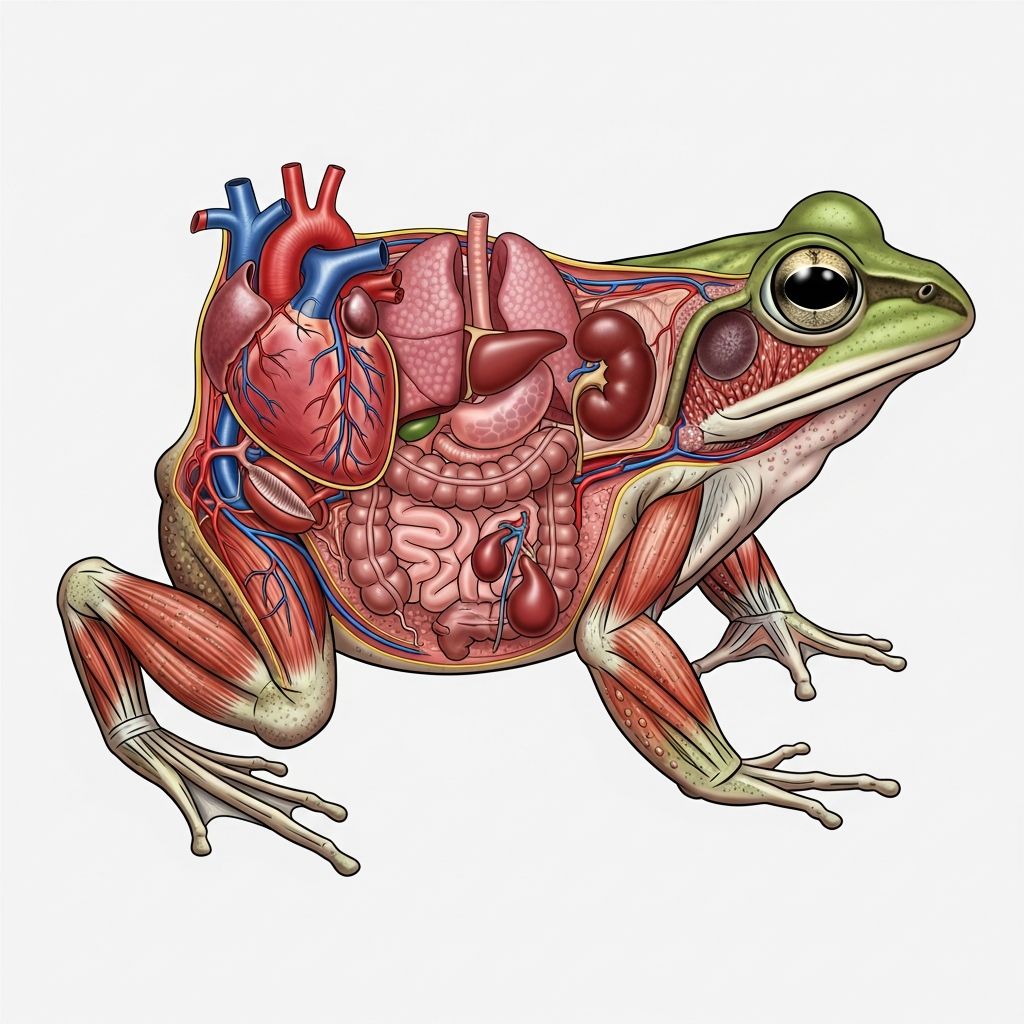
Amphibian hearts are three-chambered, mixing oxygenated and deoxygenated blood efficiently for their low-pressure systems. Kidneys produce ammonia or urea, with urinary bladders aiding water balance in semi-aquatics.
Large livers store glycogen and fats seasonally, complemented by abdominal fat bodies. A pancreas regulates digestion, while cranial nerves (ten pairs) support keen senses: lateral lines in larvae detect vibrations, eyes focus on movement, and olfactory organs discern chemicals.
Sexes are separate, with external fertilization dominant except in salamanders and caecilians. Breeding synchronizes with seasonal rains, ensuring larval survival in temporary pools.
Ecological Roles and Vulnerabilities
Amphibians control insect populations, serving as prey for larger animals. Their thin skin absorbs environmental toxins, making them bioindicators. Global declines stem from habitat loss, climate change, and chytrid fungus, underscoring conservation urgency.
In veterinary contexts, understanding these traits informs captive care: humid enclosures, UVB lighting, and varied diets mimic natural conditions, preventing metabolic bone disease or respiratory issues.
References
- Amphibians Characteristics, Life Cycle & Examples – Lesson — study.com. Accessed 2026. https://study.com/academy/lesson/amphibian-life-cycle.html
- Characteristics of Class Amphibia — BYJU’S. Accessed 2026. https://byjus.com/biology/amphibia/
- Amphibian — Wikipedia (informed by primary sources). Accessed 2026. https://en.wikipedia.org/wiki/Amphibian
- Amphibian Biology and Husbandry — ILAR Journal, Oxford Academic. 2007-09-01. https://academic.oup.com/ilarjournal/article/48/3/203/663160
- All About Amphibians — Burke Museum. Accessed 2026. https://www.burkemuseum.org/collections-and-research/biology/herpetology/all-about-amphibians/all-about-amphibians
- Amphibian Structure and Function — Biology LibreTexts. Accessed 2026. https://bio.libretexts.org/Bookshelves/Introductory_and_General_Biology/Introductory_Biology_(CK-12)/12:_Vertebrates/12.12:_Amphibian_Structure_and_Function
Similar Articles








Read full bio of Sneha Tete