

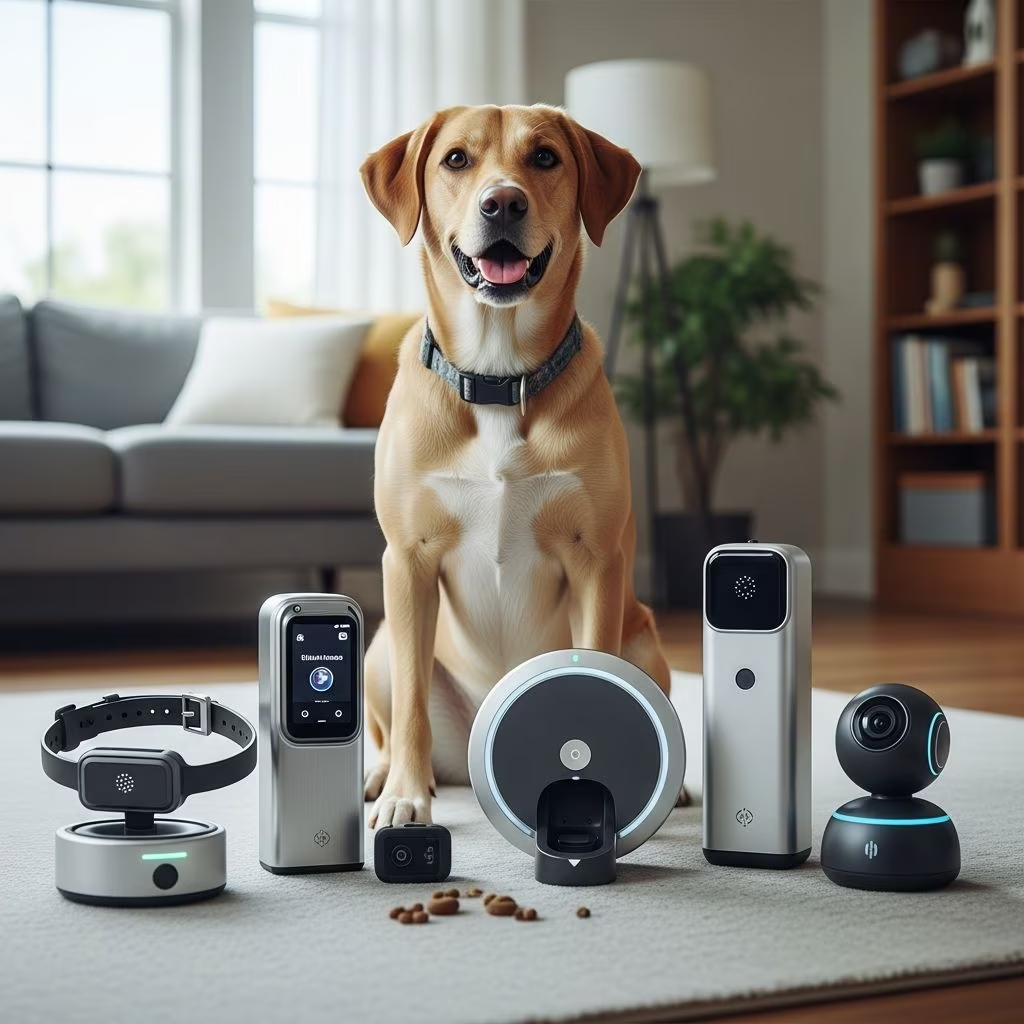
Would You Let A Robot Train Your Dog?
The landscape of pet care is rapidly evolving, and one of the most innovative developments in recent years is the emergence of AI-powered dog training devices. Companion, a leading pet technology company, has developed a revolutionary device that might fundamentally change how we train our pets, whether we’re home or not. According to Companion’s founder and CEO John Honchariw, the mission is straightforward yet ambitious: “We basically want to give you superpowers with all of the behaviors that make living with your loved one as safe, convenient, and fun as possible.”
Understanding the Companion AI Training Device
At its core, the Companion device is an intelligent training system that automatically engages with your dog in real-time, analyzing behavior and adapting to each animal’s specific needs. This technology represents a significant departure from traditional training methods, as it operates continuously, even when pet owners are away from home. The device uses advanced computer vision and behavioral analysis to understand your dog’s responses and adjust training protocols accordingly.
The company emphasizes that their approach to training differs from conventional methodologies. As Honchariw explains, “We call it training, but what we’re really focused on is improving the consistency and responsiveness of all of the commands and communications that make up what people generally refer to as the human-animal bond, or at least a subset of it.” This nuanced perspective highlights that the technology isn’t just about obedience—it’s about strengthening the relationship between dogs and their owners.
The Power of Consistency and Patience
One of the most compelling advantages of AI-powered training devices is their ability to provide perfect consistency and infinite patience—qualities that are challenging for human trainers to maintain. Honchariw notes: “The unfair advantage that devices generally have is that they are perfectly consistent and they’re infinitely patient. So they think nothing of helping you with 10,000 practices of ‘sit’ over the first six to nine months to really get that behavior going.”
This consistency is crucial for effective dog training. Dogs learn through repetition and predictability, and a device that never gets tired, frustrated, or impatient can provide an optimal learning environment. However, the device doesn’t replace human interaction entirely. Instead, Companion includes professional coaching to help transfer learned behaviors from the machine to the owner. As the CEO explains, “The coach is really there to help you generalize that behavior, to help transfer the behavior from the machine to you and give you fun exercises to really build up that muscle.”
Professional Guidance and Expert Advisory
Recognizing that technology alone cannot address all training challenges, Companion has assembled a roster of professional trainers and behavioral experts available through its accompanying app. The company’s advisory team includes prestigious figures in the field:
- Dr. Marty Becker, DVM, Founder of Fear Free
- Erica Feuerbacher, Assistant Professor of Companion Animal Behavior and Welfare at Virginia Tech
- Ken Ramirez, Executive Vice President and Chief Training Officer of Karen Pryor Clicker Training
These experts ensure that the technology incorporates the most up-to-date and innovative research in animal behavior and training methodologies. Beginning with a personalized guided onboarding, your assigned coach remains available throughout your dog’s training journey. The accompanying app tracks your dog’s development, allowing you to monitor progress in real-time and understand which training approaches are most effective for your specific animal.
Positive Reinforcement: The Foundation of Training
A critical aspect of Companion’s approach is its unwavering commitment to positive reinforcement only. The device provides treats when your dog executes a desired action and withholds them while they learn, creating an environment where dogs are motivated to repeat successful behaviors. Honchariw emphasizes the philosophy behind this choice: “We are squarely in the camp of positive reinforcement only because we do think consistency is kindness.”
This approach aligns with modern understanding of animal psychology and welfare. Positive reinforcement-based training has been scientifically demonstrated to be more effective than punishment-based methods, while also promoting better mental health and stronger human-animal bonds. By consistently rewarding desired behaviors without resorting to aversive techniques, the device creates a safe and encouraging learning environment.
How AI Enhances Dog Training Capabilities
Recent research has demonstrated the remarkable potential of artificial intelligence in understanding and improving dog training. A study led by Prof. Anna Zamansky from the University of Haifa’s Information Systems Department revealed that “an AI-based model can significantly enhance trainers’ ability to interpret a dog’s behavior” by detecting subtle movement patterns invisible to the human eye.
The research utilized advanced computer vision technology to analyze dogs’ tail movements, tracking angle, speed, and patterns to predict scent detection success. The AI model’s predictions were compared to assessments by 190 experienced trainers, and remarkably, the AI significantly outperformed human trainers, especially as scent concentration decreased. This breakthrough suggests that AI can identify behavioral cues that precede obvious signals, potentially helping trainers understand what subtle signs indicate successful learning or readiness for the next training stage.
Real-Time Behavior Analysis and Adaptation
The technology underlying AI training devices represents a significant advancement in understanding canine behavior. Through computer vision and behavioral analysis algorithms, these systems can:
- Monitor physical movements and body language in real-time
- Identify patterns that correlate with successful behavior execution
- Detect emotional states through subtle physiological signals
- Adapt training intensity and methods based on individual learning curves
- Provide immediate feedback and rewards with precision timing
This level of analysis goes beyond what even experienced trainers can observe, enabling more effective and personalized training protocols.
Integration with Professional Coaching
While the AI device handles the technical aspects of training, the human coach provides the essential element of personalized guidance. The coaching component includes:
- Initial assessment of your dog’s personality and learning style
- Customized training plans tailored to your specific goals
- Real-time progress tracking through the companion app
- Behavioral guidance for transferring learned skills to real-world situations
- Support for addressing specific behavioral challenges
- Ongoing adjustments based on your dog’s development
This hybrid approach—combining AI automation with human expertise—addresses the limitations of both fully automated systems and traditional one-on-one training.
The Science Behind AI-Powered Training
The effectiveness of AI training devices is grounded in behavioral science principles. Dogs learn through association, repetition, and reward timing. AI systems excel at these elements because they can:
- Deliver rewards with millisecond precision, crucial for associative learning
- Maintain perfect consistency across thousands of training repetitions
- Never experience fatigue or frustration that might affect training quality
- Continuously monitor and analyze behavioral responses
- Adjust difficulty and pacing based on individual learning speed
These capabilities address fundamental challenges in traditional dog training, where human inconsistency and limitations can slow learning progress.
Addressing Common Concerns About AI Training
For those concerned about the role of technology in pet care, Companion’s approach offers reassurance. The device is not intended to replace human interaction but rather to enhance it. The technology handles repetitive training tasks that benefit from perfect consistency, while professional coaches provide the nuanced guidance that only humans can offer. This balanced approach respects both the science of dog training and the importance of the human-animal bond.
Furthermore, the device’s commitment to positive reinforcement ensures that training is humane and aligned with modern animal welfare standards. Dogs trained with positive reinforcement methods show lower stress levels, better retention of learned behaviors, and stronger attachments to their owners compared to those trained with aversive methods.
The Future of Dog Training Technology
As AI continues to advance, the potential applications in dog training will likely expand. Future developments may include even more sophisticated behavioral analysis, integration with health monitoring systems, and personalized training protocols based on breed-specific genetics and individual personality traits. However, experts in the field emphasize that the future of dog training will balance technological innovation with the irreplaceable value of human connection and understanding.
Choosing the Right Training Approach for Your Dog
While AI-powered training devices offer significant advantages, the best training approach depends on your dog’s specific needs, personality, and your personal preferences as an owner. Consider the following factors when deciding whether an AI training device might be right for you:
- Your dog’s personality and learning style: Some dogs respond exceptionally well to automated, consistent training, while others may benefit from more varied human interaction
- Your lifestyle and availability: If you have limited time for training, an AI device can provide valuable automation
- Specific behavioral challenges: Complex behavioral issues may require specialized professional assessment alongside AI training
- Your comfort level with technology: You should feel confident using and understanding the device
- Your training goals: Whether you’re addressing specific behavioral issues or building foundational obedience affects the most suitable approach
Frequently Asked Questions
Q: Can AI devices completely replace professional dog trainers?
A: No, AI training devices are designed to work alongside professional coaching, not replace it. The device handles consistent, repetitive training while professional coaches provide personalized guidance, behavioral assessment, and help transfer learned behaviors to real-world situations. This hybrid approach leverages the strengths of both technology and human expertise.
Q: Is training with AI devices as effective as traditional training?
A: Research suggests AI systems can match or exceed human trainer effectiveness in certain aspects, particularly with consistency and detecting subtle behavioral cues. However, effectiveness depends on using proven positive reinforcement methods and having professional guidance to help generalize learned behaviors.
Q: Will my dog bond with a machine instead of me?
A: No, AI training devices are specifically designed to strengthen the human-animal bond, not replace it. The device handles training tasks while coaches help you transfer learned behaviors to yourself, ensuring you remain the primary focus of your dog’s training and attention.
Q: Can AI training devices handle dogs with anxiety or fear issues?
A: AI devices using positive reinforcement methods can help with anxiety-related behaviors by building confidence through successful experiences. However, severe behavioral issues may require comprehensive assessment from a professional animal behaviorist alongside technology-assisted training.
Q: How long does it take to see results with AI training?
A: Results vary by dog and training goals. Some behaviors can show improvement within weeks, while foundational obedience typically requires six to nine months of consistent practice. The AI device can provide thousands of training repetitions during this period, accelerating learning compared to traditional methods.
Q: Is positive reinforcement-based training suitable for all dogs?
A: Yes, positive reinforcement works for all dogs regardless of breed, age, or personality type. This method has strong scientific support and promotes better welfare, lower stress, and stronger human-animal bonds across all populations.
References
- AI Discovers 5 Different Dog Personalities—Which One is Your Pup? — Kinship. 2024. https://www.kinship.com/dog-behavior/ai-discovers-dog-personalities-news
- AI can predict sniffer dog success better than trainers, study finds — YNet News. 2024. https://www.ynetnews.com/health_science/article/byx0i8jyel
- Would You Let A Robot Train Your Dog? — Kinship. 2024. https://www.kinship.com/dog-behavior/companion-ai-trainer
- 5 Ways AI Could Change the Relationship With Your Pet in 2026 — Kinship. 2025. https://www.kinship.com/uk/pet-lifestyle/ai-artificial-intelligence-relationship-pet-tech



