

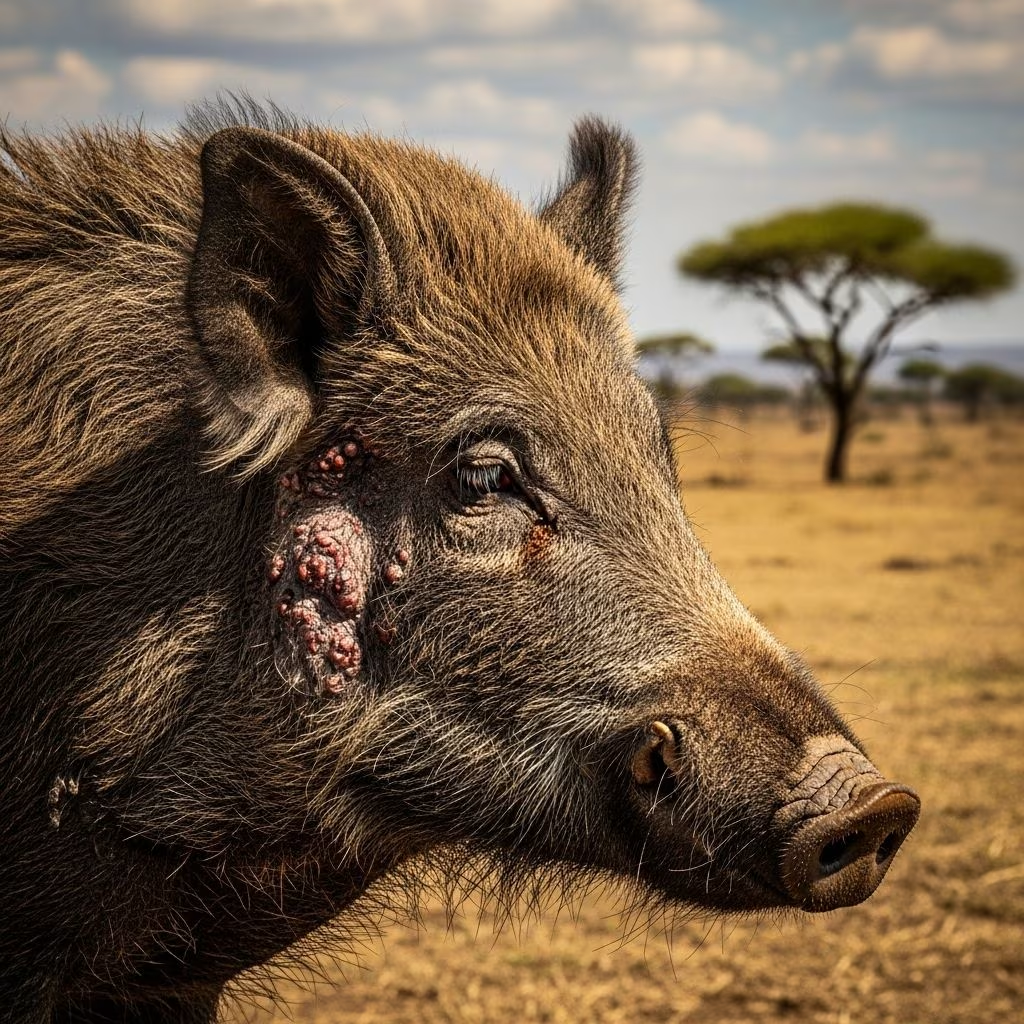
African Swine Fever (ASF) represents one of the most severe viral diseases impacting domestic pigs and wild boar populations across the globe. Caused by the African Swine Fever Virus (ASFV), this highly contagious pathogen leads to high mortality rates, often approaching 100% in acute cases, posing significant economic challenges to the swine industry.
The Nature of the ASF Virus
ASFV belongs to the Asfarviridae family and is unique among DNA viruses for its large, enveloped structure. This stability allows it to persist in various environments, including blood, tissues, and processed pork products, facilitating widespread dissemination. The virus targets the mononuclear phagocytic system, particularly in the tonsils and lymph nodes of the upper respiratory tract, before disseminating systemically via the bloodstream.
Key characteristics include its resistance to extreme pH, temperature fluctuations, and common disinfectants, enabling survival for months in chilled meat or even longer in frozen conditions. This resilience underscores the importance of stringent biosecurity in affected regions.
Epidemiological Cycles and Transmission Pathways
ASFV maintains distinct transmission cycles that vary by geography. In sub-Saharan Africa, a sylvatic cycle persists between warthogs, bushpigs, and soft ticks of the Ornithodoros moubata complex. These ticks serve as biological vectors, transmitting the virus transstadially (across life stages), transovarially (to eggs), and sexually, with infectivity lasting up to eight years in some cases.
Upon spillover to domestic pigs, the virus establishes epidemic and endemic cycles. Primary infection occurs via the oronasal route through direct contact with infected animals, ingestion of contaminated feed like swill containing unprocessed pork, or tick bites. In Europe and Asia, wild boar populations act as reservoirs, sustaining outbreaks independently through contact with live animals, carcasses, or environmental contamination.
- Direct transmission: Nose-to-nose contact or bodily fluids from infected pigs.
- Indirect transmission: Contaminated fomites (vehicles, clothing, equipment), feed, or semen.
- Vector-mediated: Soft ticks in endemic areas; mechanical spread by insects under investigation.
- Human-mediated: Long-distance jumps via movement of infected meat products.
Studies indicate wild boar spread at 10-12 km per year without human intervention, but human activities accelerate dissemination over hundreds of kilometers.
Clinical Manifestations and Disease Forms
Following an incubation period of 3-15 days (typically 3-7), pigs exhibit acute signs including high fever exceeding 42°C, loss of appetite, weakness, and recumbency. Hemorrhagic manifestations rapidly follow, with reddening or cyanosis of extremities, generalized skin erythema, epistaxis, and rectal bleeding. Respiratory distress, vomiting, diarrhea, and abortion in gestating sows are common.
ASF presents in four forms:
| Form | Mortality Rate | Key Features |
|---|---|---|
| Peracute | Nearly 100% | Sudden death without prior signs. |
| Acute | 90-100% | Fever, hemorrhages, rapid progression. |
| Subacute | 30-70% | Milder signs, respiratory involvement, joint lesions. |
| Chronic | Variable | Intermittent fever, emaciation, skin ulcers; survivors may shed virus. |
Pathologically, ASF is characterized by splenomegaly, hemorrhagic lymph nodes, and disseminated intravascular coagulation disrupting hemostasis. Gross lesions include petechiae in multiple organs and fluid-filled lungs.
Global Spread and Historical Context
Endemic in Africa since its identification in the 1920s, ASF emerged internationally in 1957 (Portugal), 1960 (Brazil), and 1978 (Caribbean via Hispaniola). The 2007 Georgia outbreak (genotype II) ignited the current pandemic, spreading to Europe, Asia, and the Caribbean by 2023, affecting over 20 countries. Factors include intensified pork trade, wild boar ecology, and inadequate swill feeding regulations.
In Europe, wild boar density drives persistence, with carcass-mediated transmission amplifying outbreaks. Asia reports massive losses, with billions in economic damage from culls and trade bans.
Diagnosis and Differential Considerations
Diagnosis combines clinical suspicion, epidemiology, and lab confirmation. Serological tests (ELISA) detect antibodies, while molecular assays (real-time PCR) identify viral DNA in blood, tissues, or swabs. Virus isolation in porcine macrophages confirms viability.
Differentials include classical swine fever, porcine reproductive and respiratory syndrome, and septicemias like salmonellosis. Necropsy findings—massive spleen, blood-swollen nodes—aid distinction.
Prevention and Control Strategies
No licensed vaccines existed until recent advancements, but control relies on biosecurity, surveillance, and stamping-out policies.
- Strict biosecurity: Quarantine new introductions, disinfect premises, control feed sources.
- Swill feeding ban: Prohibit uncooked waste; heat-treat if necessary.
- Wildlife management: Fencing, hunting to reduce boar density, carcass removal.
- Movement controls: Traceability, regionalization for trade.
- Surveillance: Passive reporting, active testing in high-risk areas.
Human factors are critical: vehicle decontamination prevents iatrogenic spread. In the U.S., FDA and USDA emphasize garbage feeding prohibitions.
Advances in Vaccination and Future Prospects
Promising vaccines, including live-attenuated strains like ASFV-G-∆I177L, undergo field trials. Licensed options emerge in Vietnam and China, showing efficacy against virulent strains. Challenges persist in marker vaccine development for differentiation of infected from vaccinated animals (DIVA).
Research at institutes like Pirbright focuses on genomic attenuation and subunit platforms to enable global deployment.
Economic and Zoonotic Implications
ASF devastates livelihoods, with annual losses exceeding $10 billion globally. Trade restrictions amplify impacts. Importantly, ASFV poses no zoonotic risk to humans, though secondary bacterial infections occur in pigs.
Frequently Asked Questions (FAQs)
Is African Swine Fever transmissible to humans?
No, ASFV does not infect humans or other species beyond suids.
How long does ASFV survive outside the host?
Up to 6 months in blood at room temperature, years in frozen meat, and indefinitely in ticks.
Can processed pork products spread ASF?
Yes, even cured hams retain viability; cooking to 71°C inactivates it.
What is the role of wild boars in ASF spread?
They serve as reservoirs, transmitting via contact and carcasses.
Are there treatments for infected pigs?
No specific antivirals; supportive care is ineffective in acute cases.
References
- African Swine Fever – Generalized Conditions — Merck Veterinary Manual. 2023. https://www.merckvetmanual.com/generalized-conditions/african-swine-fever/african-swine-fever
- African Swine Fever: Transmission, Spread, and Control — PMC/NCBI. 2023-11-01. https://pmc.ncbi.nlm.nih.gov/articles/PMC10674562/
- African Swine Fever Factsheet — Center for Food Security and Public Health, Iowa State University. 2022. https://www.cfsph.iastate.edu/Factsheets/pdfs/african_swine_fever.pdf
- African Swine Fever Virus — The Pirbright Institute. 2024. https://www.pirbright.ac.uk/our-science/viruses/african-swine-fever-virus
- Disease Alert: African Swine Fever — USDA APHIS. 2025. https://www.aphis.usda.gov/livestock-poultry-disease/swine/african-swine-fever
- African Swine Fever — U.S. Food and Drug Administration. 2024. https://www.fda.gov/animal-veterinary/safety-health/african-swine-fever



