

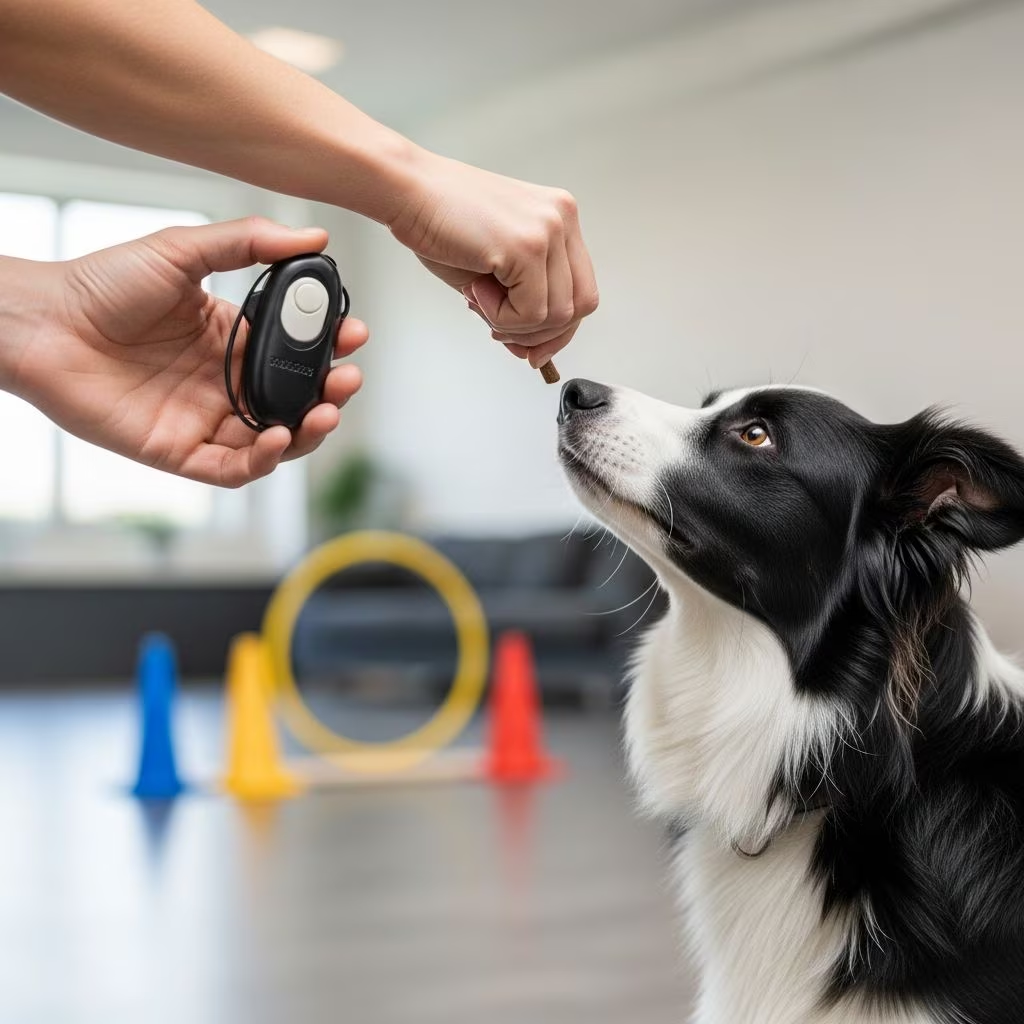
Advanced Clicker Training: Teaching Your Dog Behavior Chains
Clicker training has revolutionized modern dog training by providing a precise, science-based method for marking desired behaviors. While basic clicker training focuses on teaching individual commands, advanced clicker training takes your dog’s capabilities to the next level by teaching behavior chains—sequences of multiple actions performed in succession. Whether you’re training for competitive dog sports, complex household routines, or simply want to challenge your dog mentally, understanding how to build behavior chains with clicker training is an invaluable skill.
Behavior chains represent a significant step forward in dog training sophistication. Rather than rewarding isolated actions, you’re teaching your dog to string together multiple behaviors in a specific sequence, with each action transitioning smoothly into the next. This advanced technique opens doors to impressive performances and builds a deeper level of communication between you and your canine companion.
Understanding Behavior Chains and Their Benefits
A behavior chain is a sequence of distinct behaviors linked together where the completion of one behavior signals the beginning of the next. For example, a behavior chain might include: sit, down, stay in place, then come to you on command. Each element must be completed before the next one begins, and the entire sequence flows as one cohesive action.
The benefits of teaching behavior chains extend far beyond entertainment value. These chains develop impulse control, enhance focus, strengthen your bond with your dog, and provide excellent mental stimulation. Dogs that learn behavior chains often demonstrate improved obedience overall because they’re learning to think several steps ahead and maintain concentration throughout a sequence.
Foundational Skills Before Starting Behavior Chains
Before attempting to teach complex behavior chains, your dog must have a solid foundation in clicker training basics. This includes:
Charging the Clicker: Your dog must firmly associate the click sound with an incoming reward. This means practicing the charge repeatedly until your dog’s eyes light up at the sound of the clicker. If your dog isn’t food-motivated, consider using alternative rewards like toys or praise to build value into the click.
Understanding Single Behaviors: Each behavior in your chain must be well-established before being incorporated into a sequence. Your dog should perform each action reliably in response to a verbal cue or hand signal, with minimal distractions.
Consistency and Timing: Precise timing is critical for successful clicker training. The click must occur exactly when your dog performs the desired action, not before or after. This precision allows your dog to make clear connections between actions and rewards.
Back-Chaining: Building Chains from the End
Back-chaining is one of the most effective techniques for building reliable behavior chains. Rather than teaching behaviors in the order you want them performed, back-chaining starts with the final behavior and works backward, adding each preceding behavior one at a time.
Why Back-Chaining Works: This method is particularly effective because your dog consistently practices the end behavior most frequently, which receives the primary reward. The final behavior becomes extremely reliable, and each preceding behavior gains strength through repetition and association with the behavior that follows it.
Example: Teaching a Three-Behavior Chain
Let’s say you want to teach your dog to sit, then down, then stay. Using back-chaining:
Step 1: Teach and heavily reinforce the “stay” behavior in isolation until it’s rock solid.
Step 2: Once “stay” is reliable, add the “down” behavior before it. Practice: down → stay. Click and reward only when both are completed in sequence.
Step 3: Finally, add the “sit” behavior at the beginning. Practice: sit → down → stay. Now all three behaviors form a complete chain, with the entire sequence earning the reward.
By building backward, each new behavior links to an already-established behavior, creating strong associations throughout the chain.
Forward-Chaining: Building Chains from the Beginning
While back-chaining is often more effective, forward-chaining builds sequences from the first behavior onward. This method involves teaching behaviors in the order they’ll be performed.
When to Use Forward-Chaining: This approach works well for shorter chains or when the final behavior is complex. It also mimics how dogs naturally think about sequences—completing one action before moving to the next.
Implementation Tips: Start with just the first two behaviors in your chain. Once these flow smoothly together, add the third behavior, then the fourth. Move slowly through this process, ensuring each behavior is performed correctly before adding complexity. Keep training sessions short (5-10 minutes) to maintain your dog’s focus and enthusiasm.
Enhancing Cue Discrimination in Chains
As your dog progresses with behavior chains, they need to learn to distinguish between different cue types and know exactly which behavior comes next. Advanced trainers use multiple cue forms to increase precision:
Verbal Cues: Words or phrases that trigger specific behaviors within the chain.
Visual Cues: Hand signals or body position that communicate what behavior is expected.
Environmental Cues: Location or context that signals when a chain should begin or which behavior should be performed.
By combining these cue types, you create redundancy in communication. Your dog learns that different signals might precede the same behavior, making responses more flexible and reliable. In competitive settings like rally obedience, where handlers use both verbal commands and hand signals in rapid succession, this discrimination training proves invaluable.
Shaping and Capturing Within Behavior Chains
Shaping involves reinforcing small steps toward the final desired behavior, while capturing means clicking and rewarding behaviors your dog offers naturally. Both techniques are powerful tools for building behavior chains.
Shaping Complex Obstacles: In agility training, shaping helps teach complex behaviors like scaling an A-frame or navigating a teeter-totter. Break the obstacle into smaller components and gradually guide your dog toward mastering the full task through successive approximations.
Capturing Natural Behaviors: If your dog naturally offers a behavior that fits into your desired chain, capture it with a click and reward. This accelerates learning and teaches your dog that offering behaviors voluntarily can earn rewards.
Using Targeting for Precision Within Chains
Targeting—teaching your dog to touch a specific object or location with their nose or paw—provides precise positional control within behavior chains. A target stick or marker helps ensure accurate behavior execution, particularly important in competitive contexts where precision matters.
Practical Applications: In agility competitions, targeting can help your dog place their paws precisely on contact zones. In obedience, it ensures proper heel position during heelwork sequences. Teaching your dog solid targeting skills early makes incorporating positional behaviors into chains much easier.
Building Speed and Responsiveness
In competitive scenarios, speed matters. Advanced clicker training incorporates rapid-fire reinforcement techniques where dogs are rewarded for increasingly faster responses. However, speed must never come at the expense of accuracy.
Progressive Speed Training: Start with normal-paced chains, ensuring flawless execution. Gradually increase the speed by clicking and rewarding faster completions. Only proceed when the chain remains accurate at the faster pace. This approach builds reliable speed without sacrificing precision.
Variable Reinforcement Schedules: Once chains are solid, you can use intermittent reinforcement—rewarding only some correct performances rather than every single one. This builds even stronger, more persistent behavior chains.
Managing Mistakes and Troubleshooting
When training behavior chains, mistakes will happen. Your response to errors determines how quickly your dog learns.
The No-Reward Marker: Some trainers use a verbal marker like “oops” or “try again” to indicate that a behavior didn’t earn a reward. This clearly communicates that something was incorrect, though it’s important to immediately show your dog what you wanted so they can try again.
Backtracking: If your dog struggles with a particular chain, temporarily go back to practicing the individual behaviors that comprise it. Build confidence in isolated behaviors before linking them together again.
Preventing Rehearsal of Errors: Practice in controlled environments early on. As your dog becomes reliable, gradually practice in more distracting locations. This prevents your dog from rehearsing errors before the chain becomes strong enough to handle distractions.
Application Examples: Competitive Contexts
Agility Competition Chains: Agility courses require dogs to navigate multiple obstacles in sequence. Using shaping for complex obstacles and targeting for accuracy, trainers can teach dogs to perform high-speed weaves through poles, followed by precise stops at contact zones. The behavior chain combines speed with accuracy—both essential for competitive success.
Obedience Chains: In competitive obedience, particularly at advanced levels, utility obedience requires behavior chains including scent discrimination, precise heel work, and directed retrieves. Clicker training allows for precise marking of correct scent selections and subtle position corrections during heelwork, building the exact behaviors competition judges require.
Canine Freestyle and Dressage: In disciplines emphasizing choreography, advanced clicker training methods are invaluable for teaching complex behaviors that sequence into dynamic routines. Using chaining techniques, trainers build flowing routines where each behavior transitions smoothly into the next, incorporating unique movements like spins, bows, or paw waves. The resulting performances combine technical skill with artistic expression.
Fine-Tuning Timing and Precision
In competitive settings, the timing of cues significantly impacts performance. Advanced trainers use several strategies to refine timing:
Video Analysis: Record training sessions to evaluate your timing and refine your techniques. Video reveals subtle timing issues that might be causing chain breakdowns.
Practicing Micro-Behaviors: Break behaviors into smaller components and perfect each one before combining them. This methodical approach ensures that each chain element is executed with speed and accuracy.
Consistency in Cue Delivery: Deliver verbal cues at the exact same tempo and volume consistently. Deliver hand signals with identical body position each time. This consistency helps your dog reliably anticipate transitions within chains.
Using Single vs. Double Clicks for Chain Communication
Advanced trainers often use different click patterns to add nuance to training. While this technique is more subtle than traditional single-click training, it can enhance communication within behavior chains:
Single Click: Marks “good, keep going”—useful for duration behaviors or intermediate steps within a chain where your dog should continue to the next behavior.
Double Click: Marks “yes, come get paid”—indicates task completion and signals that reward delivery is coming.
By strategically using double clicks only at chain completion, you create clearer communication about when your dog should continue versus when the chain ends and reward arrives.
Progressive Difficulty: Expanding Your Dog’s Repertoire
Start with 2-3 behavior chains before attempting longer sequences. Once your dog is performing three behaviors reliably together, you can expand to four or five-behavior chains. However, each addition should be carefully planned and methodically trained using back-chaining techniques.
As chains become more complex, practice maintaining them during different environmental conditions—different rooms, outdoor settings, with distractions present. This generalization step ensures your dog performs chains reliably regardless of context.
The Role of Reward Timing in Behavior Chains
Where you deliver the reward within a chain significantly impacts learning. While the entire chain earns the reward, you can vary reward location to emphasize specific behaviors. Delivering rewards at the chain’s conclusion is standard, but occasionally clicking and rewarding intermediate behaviors can strengthen those transitions.
Be mindful not to interrupt the chain flow with rewards that disrupt timing. Some advanced trainers use partial rewards (smaller treats) during intermediate behaviors and save large rewards for chain completion.
Frequently Asked Questions
Q: How long does it typically take to teach a behavior chain?
A: Timeline varies based on individual dog, chain complexity, and training frequency. Simple two-behavior chains might take 1-2 weeks of daily practice. Complex five-behavior chains may require several months of consistent training. Quality matters more than speed—rushing results in unreliable chains.
Q: Can older dogs learn behavior chains?
A: Absolutely. Clicker training and behavior chains can be taught to dogs of any age. Senior dogs often excel at these training games because they focus on mental engagement rather than physical demands.
Q: What if my dog breaks the chain midway?
A: This indicates insufficient practice on that particular behavior or transition. Temporarily separate the chain back into individual behaviors and strengthen the weak link. Practice that behavior extensively before re-linking it with others.
Q: Should I always use treats as rewards?
A: No. While food works well for many dogs, toys, play, or enthusiastic praise can be equally rewarding. The best reward is whatever your individual dog finds most motivating.
Q: Can behavior chains be used for correcting problem behaviors?
A: Yes. Behavior chains can redirect problem behaviors by redirecting your dog into specific sequences. For example, if your dog jumps on guests, teach a chain of sit → down → stay, which becomes an incompatible alternative to jumping.
References
- Advanced Clicker Training Techniques for Competitive Animal Training — Acme Whistles. https://www.acmewhistles.co.uk/stories/advanced-clicker-training-competitive-animal-training
- Mastering Precision: Clicker Training Your Dog — Haven Dog Training. https://havendogtraining.com/blog/clicker-training-your-dog
- Clicker Training and Marker-Based Systems: Effective Dog Training — Proven Dog Training. https://www.provendogtraining.com/clicker-training-and-marker-based-systems/
- Dog Clicker Training: The Complete Guide — NJ Dog Training. https://njdog.com/dog-clicker-training/
- Fifteen Tips for Getting Started with the Clicker — Clicker Training. https://clickertraining.com/15tips/



