

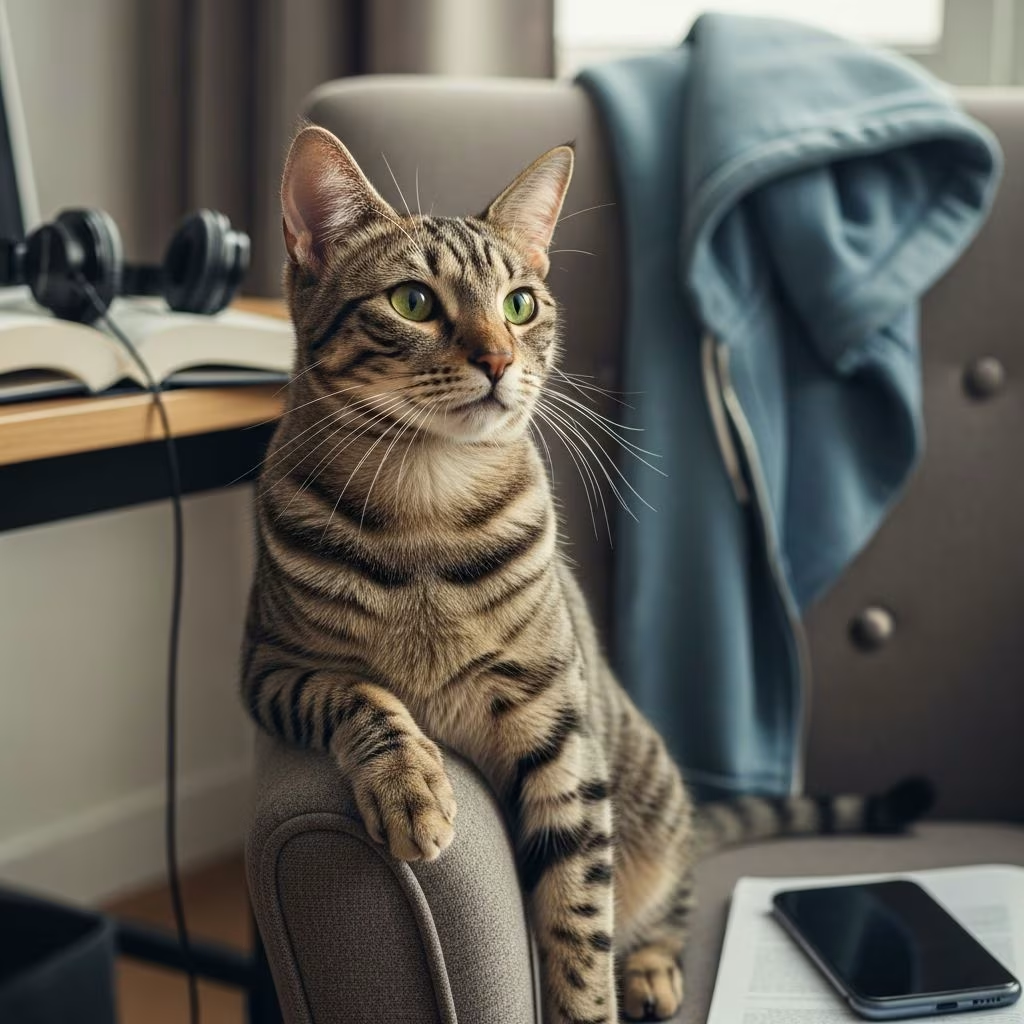
The teenage years represent one of the most challenging periods for both parents and the adolescents themselves. During this transformative stage, young people begin to establish their independence, navigate complex emotional landscapes, and redefine their relationships with authority figures. Interestingly, many of these behavioral patterns mirror those observed in domestic cats. Both teenagers and cats share certain developmental and psychological characteristics that, when understood through this lens, can provide valuable insights into managing these unpredictable and often frustrating phases of life.
The Quest for Autonomy and Territorial Control
One of the most striking parallels between teenagers and cats lies in their need for autonomy and control over their personal space. Just as cats are inherently territorial animals that require their own domain within a home, teenagers begin establishing independence by claiming personal spaces—their bedrooms, hangout spots with friends, or digital spaces online. This territorial behavior is not merely about physical space but represents a deeper psychological need to assert control over their lives.
Cats demonstrate their territorial ownership through various behaviors, including rubbing their heads on furniture to leave scent markers and maintaining certain areas as their exclusive domain. Similarly, teenagers establish their territories through decorating their rooms, controlling access to personal items, and creating exclusive social circles. Both cats and teenagers become reactive when they perceive threats to their established territories, whether that threat is a parent entering a room without permission or a friend trying to influence their choices.
The need for territorial control in both species reflects a fundamental developmental process. For teenagers, this behavior indicates healthy growth toward independence. Understanding this parallel helps parents recognize that a teenager’s insistence on privacy or personal space is not necessarily defiance but rather a normal developmental milestone, much like a cat’s need to establish its territory.
Communication Styles: Subtle and Misunderstood
Both teenagers and cats employ complex communication methods that can be easily misinterpreted by those unfamiliar with their behavioral patterns. Cats communicate through a combination of vocalizations, body language, and subtle behavioral cues. A cat’s slow blink, for instance, indicates affection and trust, yet many people misinterpret feline behavior as indifference or hostility. Similarly, teenagers communicate through words, tone, body language, and behavioral signals that parents and adults often struggle to decode correctly.
Consider the teenage eye-roll or the dismissive grunt—these are the adolescent equivalents of a cat’s tail flick or ear position change. Both forms of communication convey emotional states and intentions, but without proper understanding, they create conflict. A cat that holds its tail high and approaches with confidence is demonstrating friendliness and contentment, much like a teenager who engages in conversation and maintains eye contact is indicating openness and comfort. Conversely, withdrawn behavior in both species suggests fear, anxiety, or discomfort with the current situation.
The vocalizations of both teenagers and cats can also be misunderstood. A cat’s meow serves various purposes—greeting, request, protest, or attention-seeking—depending on context and tone. Teenagers employ similar vocal variation, using the same words with different intonations to convey entirely different meanings. “I’m fine” can mean genuine contentment or suppressed frustration, depending on the delivery. Understanding that communication in both species requires attention to context and subtle cues can prevent unnecessary conflict and misinterpretation.
Behavioral Shifts Based on Comfort and Confidence
Research on feline behavior reveals that cats display distinctly different behaviors depending on their confidence levels and sense of security. A confident cat moves through its environment with an upright posture, tail held high, and demonstrates proactive engagement with its surroundings. An anxious or fearful cat, by contrast, becomes more reactive, crouching low, pulling whiskers close to the face, and making itself appear smaller to avoid threats.
Teenagers exhibit remarkably similar patterns. Adolescents who feel secure in their relationships and confident in their abilities display proactive behaviors—they initiate conversations, pursue goals, and engage meaningfully with their environment. Those experiencing anxiety, stress, or lack of confidence become reactive, withdrawing socially, avoiding new situations, and protecting themselves emotionally by becoming more defensive or dismissive.
This parallel has significant implications for understanding teenage behavior. When a teenager suddenly becomes withdrawn or defensive, it may indicate a shift in their confidence or security level, much like a cat’s postural changes indicate emotional states. A parent or educator who recognizes these shifts can respond with increased support and reassurance rather than punishment or escalation.
The Independence-Affection Balance
Cats are known for their contradictory nature regarding human interaction. They demand independence and reject unwanted attention, yet they also seek affection and companionship on their own terms. A cat might spend the morning aloof and disinterested, then demand attention and physical closeness in the evening. This unpredictability frustrates many cat owners, who struggle to understand the seemingly arbitrary nature of feline affection.
Teenagers display this same balance, often in a more exaggerated form. An adolescent might reject a parent’s offer for quality time, insisting they want to be left alone, only to seek emotional support or comfort hours later during a moment of vulnerability. They might dismiss family gatherings as boring while simultaneously feeling hurt if not included in family activities. They crave independence while still needing the security of parental support and guidance.
Understanding this parallel helps parents and caregivers recognize that the teenager’s push for independence does not eliminate their need for connection. Just as cats require both autonomy and affection, teenagers need freedom and boundaries, independence and guidance. The key is reading the signals and providing support when it is wanted while respecting the need for space when it is requested.
Responses to Stress and Environmental Changes
Both cats and teenagers respond to stress and environmental changes with behavioral shifts that can seem disproportionate to the trigger. Cats may become more aggressive, withdrawn, or display inappropriate elimination habits when stressed or when their environment changes significantly. A new family member, a move to a new home, or even a change in household routines can trigger noticeable behavioral changes in felines.
Teenagers similarly react strongly to environmental stressors—academic pressure, social dynamics, family changes, or transitions in their physical environment. Both species handle uncertainty poorly and may respond with behaviors that seem excessive or inappropriate to adults. A teenager’s emotional outburst over a seemingly minor issue might stem from accumulated stress, just as a cat’s litter box avoidance might indicate stress despite appearing to be a behavioral problem.
The similarity in stress responses highlights the importance of environmental stability for both teenagers and cats. Creating predictable routines, maintaining consistent expectations, and providing advance notice of changes helps both species adjust more successfully. Additionally, recognizing that behavioral changes often signal underlying stress rather than defiance or misbehavior enables more compassionate and effective responses.
Curiosity and the Drive to Explore
Kittens and young cats are famously curious, constantly exploring their environment, testing boundaries, and investigating anything novel. This curiosity is essential to their development as hunters and independent animals. However, this same curiosity often leads to mischief and requires parental guidance to channel appropriately.
Teenagers exhibit comparable curiosity and exploration drives, though they manifest differently. The teenage years are characterized by heightened interest in new experiences, ideas, relationships, and social groups. This exploratory behavior is developmentally normal and necessary for identity formation and independence. Like young cats, teenagers may pursue risky or inappropriate avenues for exploration if not guided toward healthier channels.
Parents and caregivers who understand this parallel can better facilitate healthy exploration while maintaining necessary safety boundaries. Rather than attempting to suppress the exploratory drive—which is both futile and harmful—effective approaches involve channeling curiosity toward constructive activities, education, and social engagement.
The Role of Play and Engagement
Play serves critical functions for both cats and teenagers. For cats, play develops hunting skills, provides physical exercise, and offers mental stimulation. Cats that lack adequate play opportunities may develop behavioral problems, obesity, or depression. The quality and type of play also matters—interactive play with humans strengthens bonds and provides richer engagement than solitary play.
Similarly, teenagers require adequate physical activity, mental stimulation, and engaging social interaction. Play and recreation are not frivolous indulgences but essential components of healthy development. Teenagers who lack opportunities for physical activity, hobbies, or positive social engagement often develop behavioral problems, mental health issues, or destructive coping mechanisms.
The parallel suggests that providing structured opportunities for engagement—sports, creative pursuits, social activities, and interactive family time—is not just beneficial but necessary for healthy adolescent development. Just as a cat owner must actively provide play opportunities and environmental enrichment, parents and educators must intentionally create engagement opportunities for teenagers rather than expecting them to self-motivate.
Personality Variation and Individual Differences
Not all cats behave identically, and not all teenagers follow the same developmental pathway. Feline personalities vary widely, with some cats being bold and social while others are shy and reserved. Research has identified distinct personality traits in cats, including variations in confidence, sociability, and reactivity levels. Some cats are naturally outgoing and engage readily with humans, while others are solitary by nature.
Teenagers similarly display wide personality variations. Some are naturally extroverted and thrive in social situations, while others are introverted and require more time alone. Some teenagers are early bloomers in terms of emotional maturity, while others lag significantly behind their peers. These individual differences are not deficiencies or problems but rather natural variations in personality and developmental timeline.
Recognizing and respecting these individual differences—in both cats and teenagers—leads to more effective management and support. A parenting or teaching approach that works perfectly for one teenager may be entirely ineffective or even counterproductive for another, just as different cats respond to different handling and environmental approaches.
FAQ Section
Why do teenagers act like they do not care what adults think?
Similar to cats establishing territorial independence, teenagers are developing their own identities separate from parental influence. This apparent indifference is actually a healthy developmental step toward autonomy, even though it can frustrate adults. Like cats that must establish their own territories, teenagers need to develop their own values and perspectives.
How should adults respond to teenage withdrawal?
When teenagers withdraw, much like cats that retreat to hiding spaces during stress, it often indicates discomfort or anxiety rather than willful defiance. The most effective response involves providing support without forcing engagement, respecting their need for space while maintaining availability for when they are ready to reconnect.
Are teenage behavioral changes always a cause for concern?
Not all behavioral shifts in teenagers indicate serious problems, just as not all changes in cat behavior are pathological. Many fluctuations reflect normal developmental processes, environmental stress, or personality expression. However, extreme or persistent changes in mood, behavior, or social engagement warrant attention and possibly professional support.
Can understanding animal behavior really help with teenagers?
Behavioral parallels between species can provide useful frameworks for understanding complex behaviors. While teenagers are more cognitively complex than cats, recognizing similar patterns in communication, territorial needs, independence seeking, and stress responses can help adults respond more empathetically and effectively.
References
- Cat behavior — Wikipedia. 2025. https://en.wikipedia.org/wiki/Cat_behavior
- 6 Common Cat Behaviors Explained — UC Davis Magazine. 2023. https://www.ucdavis.edu/magazine/6-common-cat-behaviors-explained
- Understanding Cat Behavior — PAWS Chicago. 2024. https://www.pawschicago.org/news-resources/all-about-cats/understanding-cat-behavior
- The Definitive Guide to Cat Behavior and Body Language — Tuft & Paw. 2024. https://www.tuftandpaw.com/blogs/cat-guides/the-definitive-guide-to-cat-behavior-and-body-language
- Welfare of cats: normal behaviour patterns — nidirect. 2024. https://www.nidirect.gov.uk/articles/welfare-cats-normal-behaviour-patterns
- A Cat’s Personality — FOUR PAWS in US. 2024. https://www.fourpawsusa.org/our-stories/publications-guides/a-cats-personality



